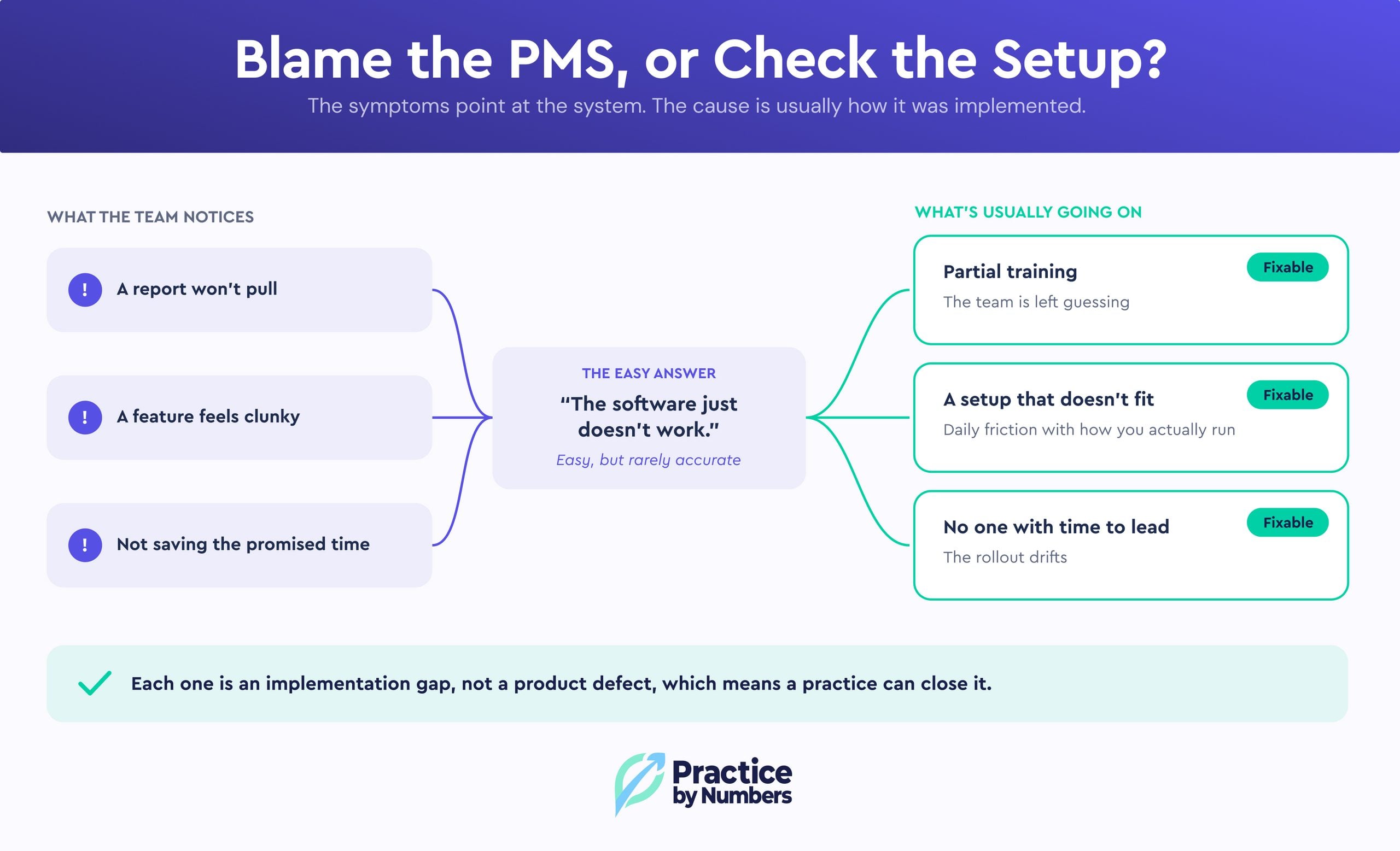
Every dental practice has heard it, and most have said it: “the software just doesn’t work.” A report won’t pull, a feature feels clunky, the system isn’t saving the time it promised, and the practice management software takes the blame. On the Special Edition of the Practice Pulse podcast, host and Practice by Numbers co-founder Dr. Aditi Agarwal sat down with Jill Nesbitt, founder of Optimize Dental, whose entire business is implementing and optimizing technology for dental group practices. Her message was direct: most of the time, the software is not the real problem.
This article unpacks why a practice management system so often underdelivers, what the real causes usually are, and what actually turns software into results.
- Blaming the software is the easy answer, but it’s rarely the accurate one.
- The common real causes are incomplete training, a setup that doesn’t fit the practice, and no one with time to lead the rollout.
- A great system still underdelivers if it isn’t implemented well.
- Most practices buy software with the right intentions, then run out of time to make it work.
- The fix is to treat implementation as real work: define success from the practice’s point of view, then set up, document, and train against it.
- Practice by Numbers connects to your PMS and turns well-used data into clear results you can see.
The Easy Answer Is Almost Always the Software
When technology disappoints, there’s a natural place to point. Jill sees it constantly in her work with group practices.
“It is awfully easy to blame the software. Oh, it’s the software that doesn’t work. It’s the feature that’s broken.”
– Jill Nesbitt
It’s an understandable reflex. The software is the newest thing in the room, and it’s easier to fault a tool than a process. But Jill’s experience points somewhere less convenient and more useful.
“What I find more often than not is that unfortunately it’s not the software and we can’t just point the finger at someone else.”
– Jill Nesbitt
What’s Usually Going On Instead
If the platform isn’t the problem, what is? Jill lays out the causes she sees again and again, and none of them are about a broken product.
“The problem is, we didn’t really understand how it worked. We maybe didn’t attend the whole training. Maybe we didn’t set it up right because it didn’t make sense the way our practice runs and the way the software works.”
– Jill Nesbitt
Read that list again, because each item is fixable. Partial training leaves the team guessing. A setup that doesn’t match how the practice actually runs creates friction every day. And very often there simply wasn’t anyone with the time to lead the project, so it drifted. These are implementation gaps, not product defects, which is good news: a practice can close them.
The Point That Reframes Everything
Jill Nesbitt spent years inside practices and software companies before founding Optimize Dental, and one lesson sits underneath all of her work.
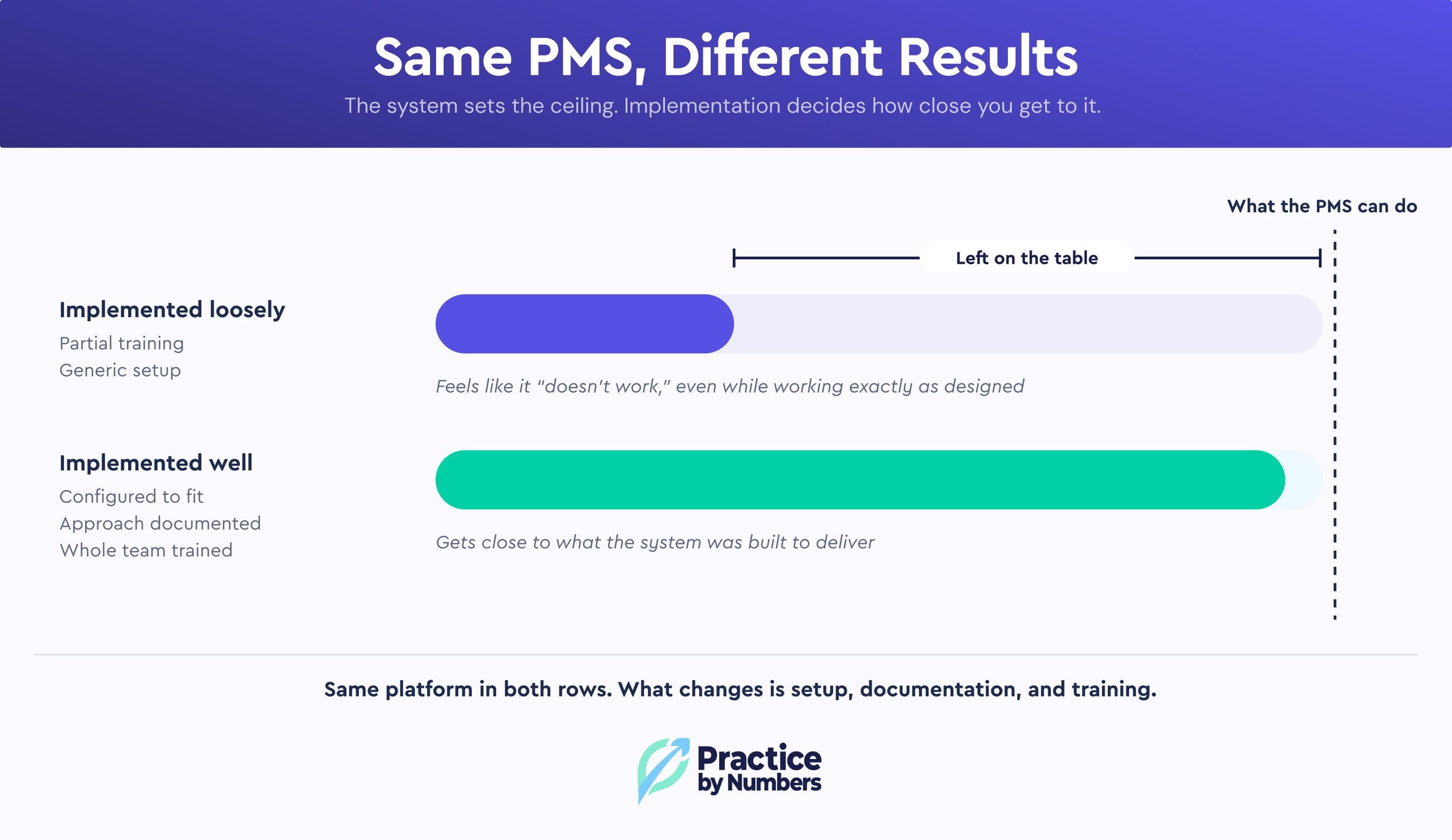
“It doesn’t matter how great your software is if we don’t implement it well.”
– Jill Nesbitt
That single idea reframes the whole conversation. The quality of the platform sets a ceiling, but implementation decides how close you get to it. A capable PMS that nobody was fully trained on, or that was left configured for a generic practice instead of yours, will always feel like it “doesn’t work,” even when it’s working exactly as designed.
👉 See What Might Be Quietly Draining Your Dental Practice Accounts
Good Intentions, No Time
None of this happens because practices are careless. They buy technology for all the right reasons: to save time, to collect more reliably, to run a better practice. The gap opens after the purchase.
“We buy the technology, but we don’t get the results.” Jill Nesbitt
The reason is almost always capacity. As Jill put it, nobody has time to figure it out and sort through it, and doing it properly is more work than people expect. The office manager already has a full plate, so the deep setup and training that would unlock the tool keeps getting pushed to “later.” The software isn’t failing. It’s waiting.
👉 Cloud-Based vs On-Premise Dental Software: Which One Wins?
What Actually Turns Software Into Results
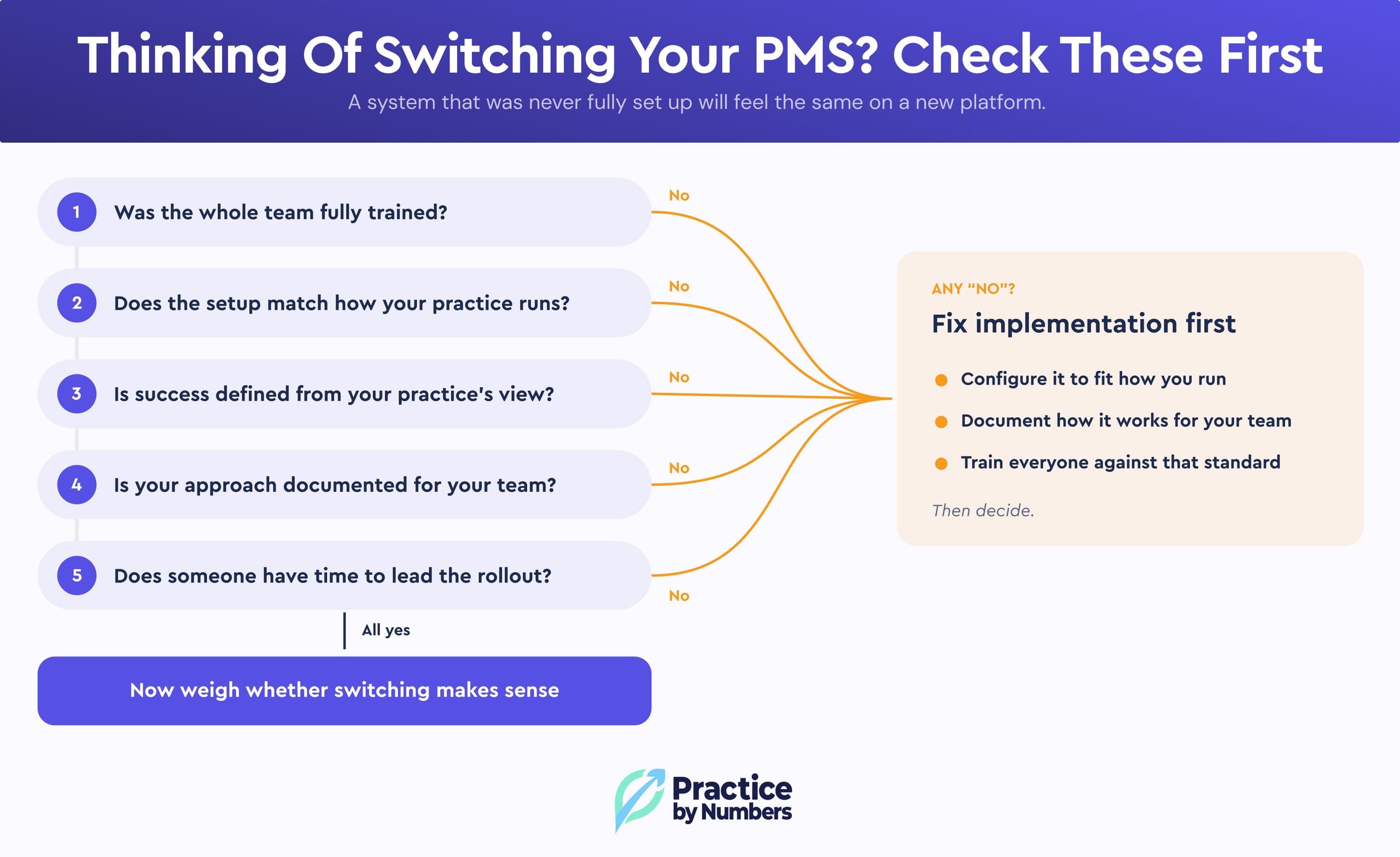
The fix is to treat implementation as real, planned work rather than a switch you flip. Jill’s approach is a useful model for any practice, whether you bring in help or do it yourself.
It starts with defining what success even means, and defining it from the right point of view.
“We actually document at the outset – what would success look like? And we define that not necessarily from the vendor perspective, from the practice perspective.”
– Jill Nesbitt
From there, the work is concrete: set the system up to match how your practice runs, then write down how it will work for your team specifically, not just how the software works in general.
“Not just how does the software work, because hopefully the software vendor has some great content for that, but how will it work for us? What is our approach?”
– Jill Nesbitt
Those practice-specific standard operating procedures, paired with proper training, are what close the gap between a tool you pay for and results you can feel. The order matters: decide what success looks like, configure to fit, document your way of working, then train the whole team against it.
👉 See 7 Reasons Why PbN Is a Strong Integration Choice for Curve Dental
Turn Your PMS Data Into Measurable Practice Growth With Practice by Numbers
A well-configured PMS helps your practice run smoothly. Practice by Numbers takes it a step further by helping you understand what’s working, where opportunities are being missed, and what your team can do to improve results.
By connecting with your existing PMS, PbN helps your practice:
- Gain clearer visibility: Understand production, collections, scheduling, and overall practice performance without piecing together multiple reports.
- Identify growth opportunities: Spot gaps in your schedule, overdue patient visits, and unscheduled treatment that might otherwise go unnoticed.
- Make better daily decisions: Give your team a shared understanding of priorities so everyone knows where to focus their efforts.
- Improve team accountability: Turn insights into clear follow-up actions and keep important opportunities from falling through the cracks.
- Track meaningful progress: See how operational improvements translate into better efficiency, stronger patient engagement, and practice growth.
Your PMS manages the day-to-day operations. Practice by Numbers helps your team make more informed decisions, act on opportunities, and get more value from the system you already use.