The question is popping up more often: Should we automate that? Should AI handle intake forms, call summaries, and follow-ups?
Most practices frame it as a binary. Automate everything or keep doing it manually. But that’s the wrong question. The real one is: Which parts should AI handle so your team can focus on the parts that actually need human judgment?
Done right, automation doesn’t replace your team. It amplifies them. Here’s how to think about it.
TL;DR
Automate repetitive work. Keep human judgment, human.
Best tasks for AI:
- Patient intake forms
- Data entry
- Form summaries
- Call note summaries
- Appointment reminders
- Pattern detection and alerts
Keep human-led:
- Treatment planning
- Clinical decisions
- Financial discussions
- Patient concerns and complaints
- Complex problem-solving
Most effective approach:
AI handles the first draft. Humans review, personalize, and decide.
The biggest benefit isn’t saving time, it’s using that time to improve patient experience and grow the practice.
Why Administrative Work Is Slowing Practices Down
Most dental teams aren’t overwhelmed because they’re doing difficult work. They’re overwhelmed because they’re doing repetitive work.
The same information gets entered multiple times. Forms need to be reviewed. Notes need to be documented. Calls need to be summarized. Follow-ups need to be tracked.
None of these tasks directly improves patient outcomes, yet they consume hours every week. As practices grow, that administrative burden grows too. Hiring additional staff can help, but it doesn’t solve the underlying problem, which is that too much time is being spent moving information instead of acting on it.
That’s where AI can have the biggest impact. Not by replacing expertise, but by reducing the manual work surrounding it.
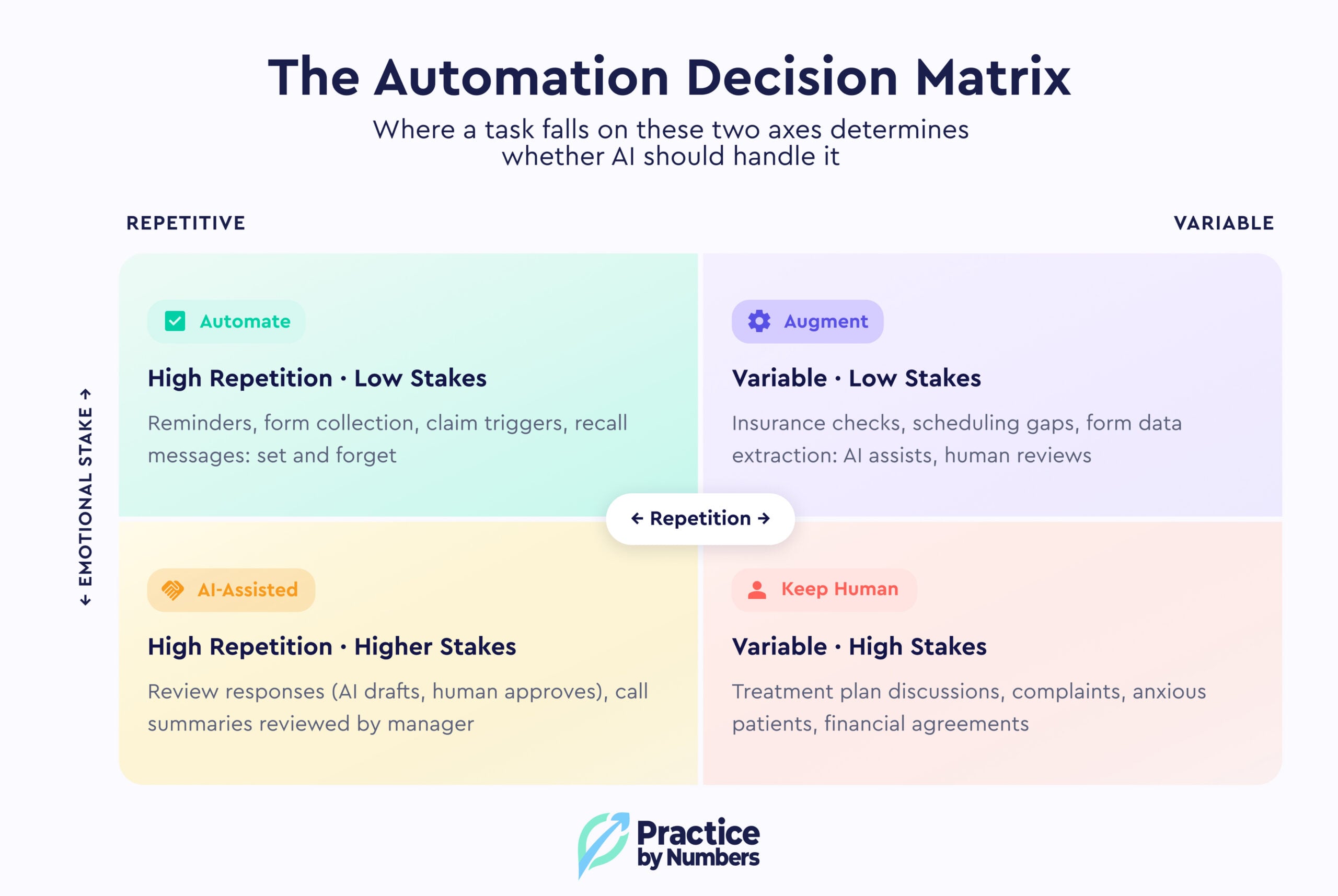
What Makes a Task Ideal for AI?
A simple rule:
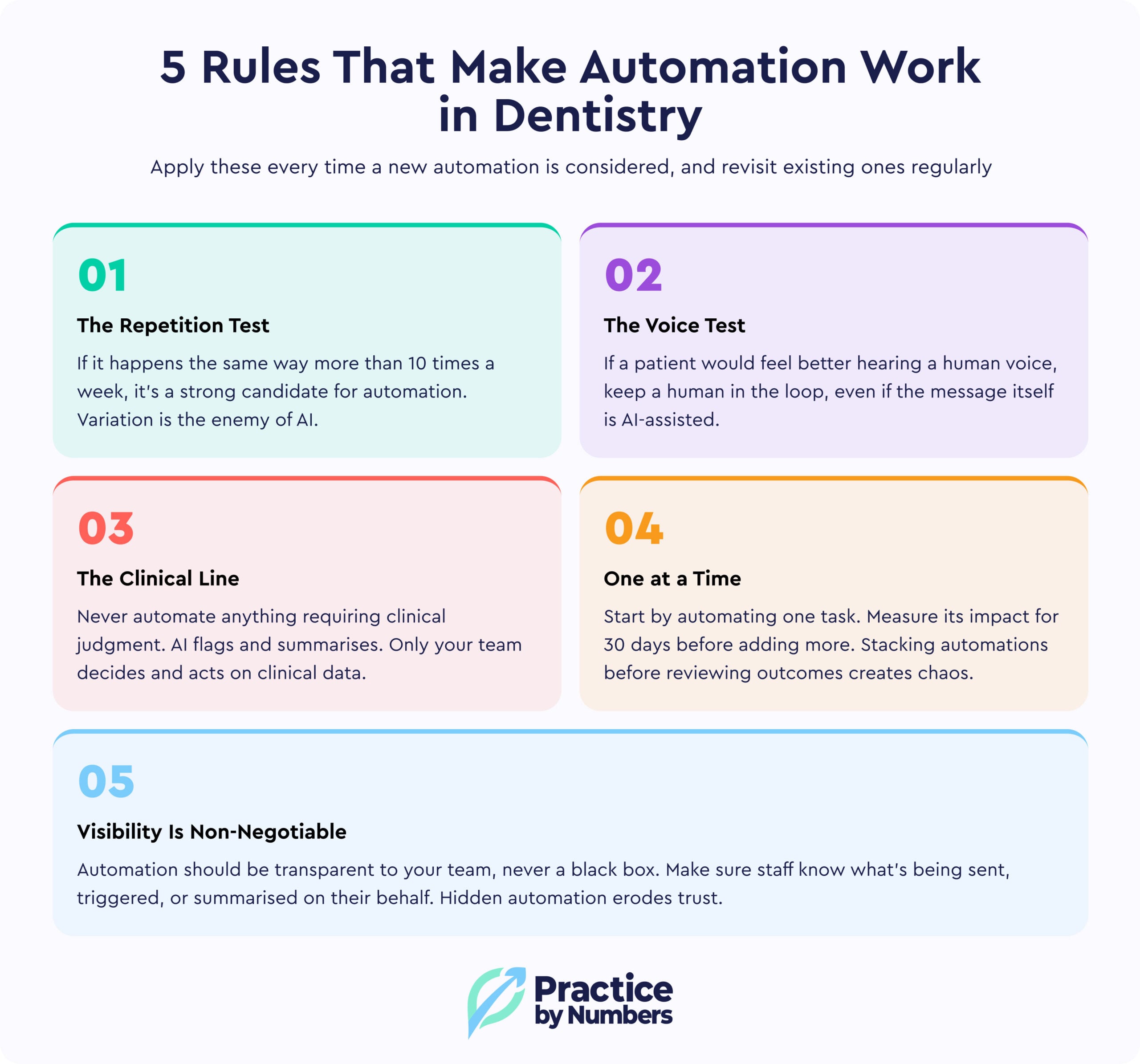
The more repetitive and predictable a task is, the better candidate it is for automation.
If a task follows the same process every time, requires little interpretation, and involves moving or summarizing information, AI can often do it faster.
Examples include:
- Reading patient intake forms
- Extracting information from documents
- Summarizing conversations
- Sending appointment reminders
- Identifying patterns in patient activity
These are important tasks, but they don’t require clinical expertise or relationship management. They require time. And that’s exactly what AI can help give back.
👉 See How Virtual Receptionists Improve Call Coverage in Dental Practices
What Actually Makes Sense to Automate in a Dental Practice?
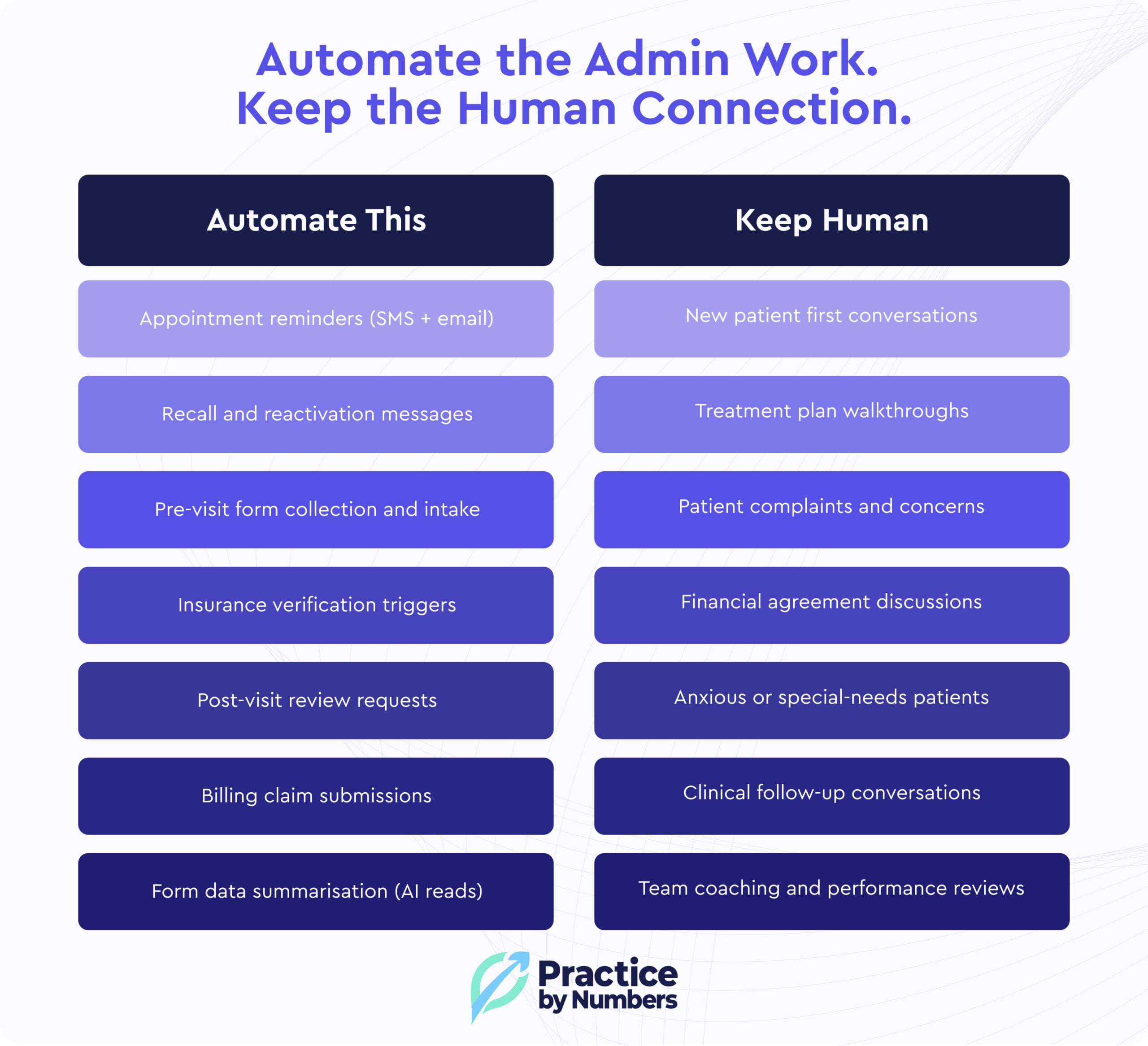
Not every task belongs on the same side of the automation debate. Some responsibilities are repetitive, predictable, and ideal for AI. Others require judgment, empathy, and decision-making that technology simply can’t replicate. The key is knowing the difference. Here’s a practical framework for deciding what to automate, what to keep human-led, and where a combination of both works best.
What Dental Practices Should Automate First
Some of the biggest time drains in a dental practice come from routine administrative work. These tasks are important, but because they follow a predictable process, they’re often the safest and most effective places to introduce automation.
Patient Intake Forms and Data Entry
Patient forms are one of the most time-consuming administrative tasks in a dental office.
Information must be reviewed, interpreted, and entered into patient records. Handwriting can be difficult to read. Details can be missed.
AI can extract information from both handwritten and digital forms and organize it for review, dramatically reducing manual entry while improving consistency.
Instead of spending several minutes processing every form, teams can focus on verifying information and helping patients.
Call Note Summaries
Every patient call generates information that should be documented.
The challenge is that documenting calls often takes almost as long as the conversation itself.
AI-generated summaries allow teams to review key discussion points quickly instead of manually creating detailed notes from scratch.
The result is better documentation with less administrative effort.
Pattern Detection and Patient Alerts
Some of the most important patient signals are easy to miss.
- A patient who repeatedly cancels appointments.
- Someone who hasn’t scheduled overdue treatment.
- A patient whose intake form indicates elevated anxiety.
AI is particularly effective at identifying patterns across large amounts of information and surfacing them for staff attention.
Instead of replacing decision-making, it helps teams know where to focus it.
What Should Always Stay Human
Some responsibilities go beyond efficiency. They require empathy, context, critical thinking, and professional judgment. These are the moments where people, not technology, create the most value for patients and the practice.
Treatment Planning and Clinical Decisions
AI can organize information.
It cannot replace clinical expertise.
Diagnosis, treatment recommendations, and patient care decisions should always remain in the hands of qualified providers.
Sensitive Patient Conversations
Patients don’t want automated empathy.
Financial discussions, treatment concerns, complaints, and difficult conversations require trust, context, and human communication.
Technology can support these interactions, but it shouldn’t replace them.
Unusual Situations and Exceptions
Every practice encounters situations that don’t fit neatly into a workflow.
When patients have unique circumstances, complex questions, or unexpected issues, flexibility matters.
These are moments where human judgment becomes irreplaceable.
The Real Value of AI Isn’t Time Saved, It’s Time Reinvested
Most practices focus on the time saved with automation. The best practices focus on what happens next.
Imagine two practices that each save 30 minutes a day through automation.
Practice A automates patient form intake and saves 30 minutes per day. They use those 30 minutes to… keep the same schedule and feel less rushed.
Practice B automates patient form intake and saves 30 minutes per day. They use those 30 minutes to follow up with lapsed patients, reach out to people with overdue hygiene, or have better conversations during consultations.
Practice B grows. Practice A stays the same.
Automation creates capacity. Growth comes from how that capacity is used.
Automation only delivers value if the team redirects the saved time toward higher-value work. Otherwise, it’s just… fewer tasks to do.
👉 Discover Top AI Applications in Healthcare
How to Know If Your Dental Practice Is Ready for AI
Not every practice is ready to adopt AI tools effectively. You are ready if:
- Your team has defined workflows for routine tasks (so you know what to automate)
- You have clear decision criteria for when exceptions need human review
- You have a plan for how the team will use the time saved
- You’re willing to train staff on new tools and processes
- You have someone responsible for monitoring the output (automation isn’t perfect)
If most of your workflows are ad-hoc and everyone does things differently, automation will create more confusion, not less. Get your processes consistent first, then automate them.
How Practice by Numbers Makes AI Amplify Your Team
Ops AI by PbN helps dental teams eliminate repetitive administrative work by summarizing forms, extracting key information, and surfacing important patient details automatically. Instead of spending time digging through paperwork, your team gets the information they need upfront.
With Form Summary, your team can:
- Review medical history, medications, allergies, and past procedures in seconds
- Quickly understand key details from new patient intake forms
- Surface important consent form acknowledgments and patient requests
- Automatically flag critical information such as allergies and high-risk conditions
- Reduce chart review time and walk into appointments better prepared
Rather than reading pages of patient-submitted forms, your team gets a concise summary of what matters most, so they can spend less time reviewing paperwork and more time focusing on patient care.
👉 Here’s The Complete Guide to PbN AI
FAQs
Q. What dental tasks are safe for AI to automate?
Safe tasks are routine, repetitive, and don’t require clinical judgment: patient intake form processing, call note summarization, appointment reminders, patient data verification, pattern flagging (no-shows, missed recalls, high anxiety). Not safe: diagnosis, treatment planning, clinical decisions, sensitive patient communication, exceptions or complaints.
Q. What happens when AI gets something wrong?
That’s why the hybrid model works. AI does the heavy lifting but your team reviews the output before it matters. For form summaries, your team glances at what was extracted and fixes anything wrong before the patient record is finalized. For call notes, they read the summary and add context AI missed. AI isn’t perfect, but AI+human review is usually faster and better than all-human or all-AI.
Q. How long does it take to see ROI from practice automation?
Usually within 30-60 days. The time savings are immediate in fewer data entry hours, faster form processing. But the real ROI takes longer because it depends on what your team does with that time. If they immediately start higher-value activities (better hygiene tracking, patient outreach, case acceptance work), you’ll see production lift within 90 days. If they just get less busy, you’re missing the point.
Q. What’s the biggest mistake practices make when implementing automation?
Automating before they have consistent workflows. If your form process is different for every staff member, automating it creates chaos. Get your processes standardized and documented first. Then automate them. Also: not training the team on how to use automated systems effectively. Good tools with untrained teams underperform.
Q. Should a small practice automate, or is it only for bigger practices?
Small practices benefit more from automation than big ones, because time matters more when you’re understaffed. A 5-provider group might not notice 2 hours saved per week. A solo practice with one coordinator absolutely notices, that’s 10% of their workday. Start with high-impact, easy-to-automate tasks and expand from there.