A patient says “let me think about it” after you present a crown. Someone cancels their hygiene appointment. An insurance claim gets denied. A new patient calls and leaves a voicemail.
Each one of these moments needs a follow-up. And in most practices, at least a few of them, sometimes all of them, just don’t happen.
Not because your team doesn’t care. They care a lot. But when follow-ups live in someone’s head or on a sticky note, they disappear the moment the day gets busy. That’s the follow-up gap and it costs the average dental practice far more than most owners realize.
TL;DR
The follow-up gap is the space between something that needs to happen and someone actually doing it. It’s one of the most common and most expensive operational problems in dentistry.
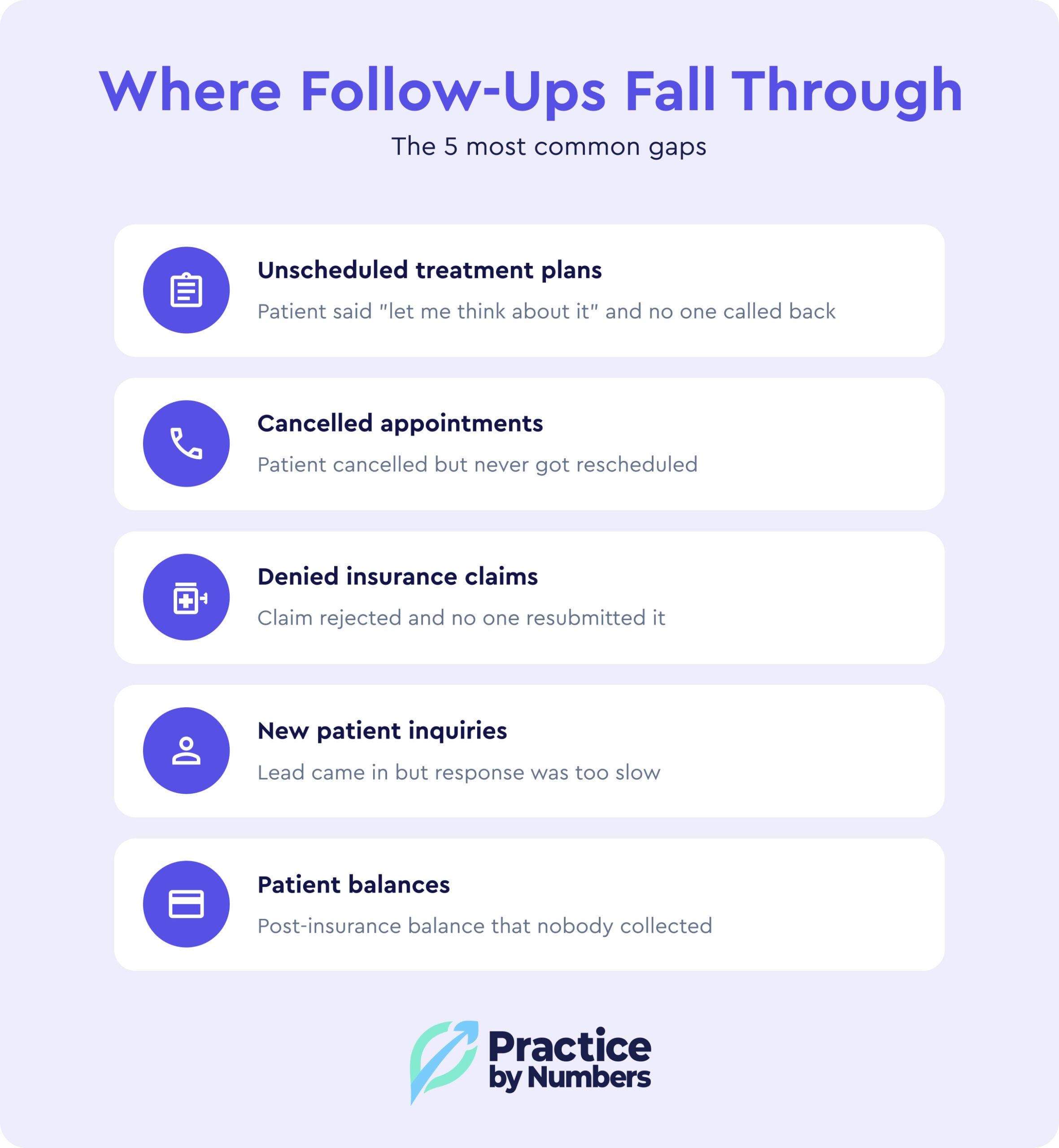
The highest-value follow-ups that practices consistently miss are:
- Unscheduled treatment plans: patients who said “maybe later”
- Cancelled appointments that never got rescheduled
- Denied insurance claims that no one resubmitted
- New patient inquiries that got a slow response
- Patient balances that no one collected
The issue isn’t people, it’s the absence of a system. When tasks are tracked, assigned, and visible to the whole team, follow-through goes up dramatically. The practices that close this gap consistently are the ones that grow fastest.
What Is the Follow-Up Gap in a Dental Practice?
Every day, your practice creates dozens of moments that require someone to do something next. A patient declines treatment, someone should follow up in a week. An appointment has been canceled, someone should call to reschedule. A claim gets denied, someone should resubmit it.
The follow-up gap is what happens when those “someone should do this” moments go unassigned. Nobody writes it down. Nobody owns it. Life moves on. And the revenue, the appointment, or the patient relationship quietly disappears.
Individually, each gap seems small. But across a full practice with 30, 40, 50 patients a day, those small gaps add up to a very large number.
Why Is the Follow-Up Gap So Expensive?
Lost follow-ups create more than scheduling problems. They create:
- Lost Production: Unscheduled treatment often becomes unscheduled forever.
- Lower Patient Retention: Slow communication damages patient experience.
- Increased Administrative Work: Teams spend time searching for information instead of acting.
- Reduced Operational Visibility: Practice owners often cannot see what is being missed.
Even recovering a small percentage of missed follow-ups can create substantial production gains.
👉 See Where Is the Hidden Revenue Every Dental Practice Has
Why Do Follow-Ups Get Dropped So Often?
The honest answer is that most practices weren’t built with a follow-up system in mind. They were built to deliver excellent clinical care, which they do. But the operational infrastructure around patient communication, task ownership, and accountability often gets pieced together informally over time.
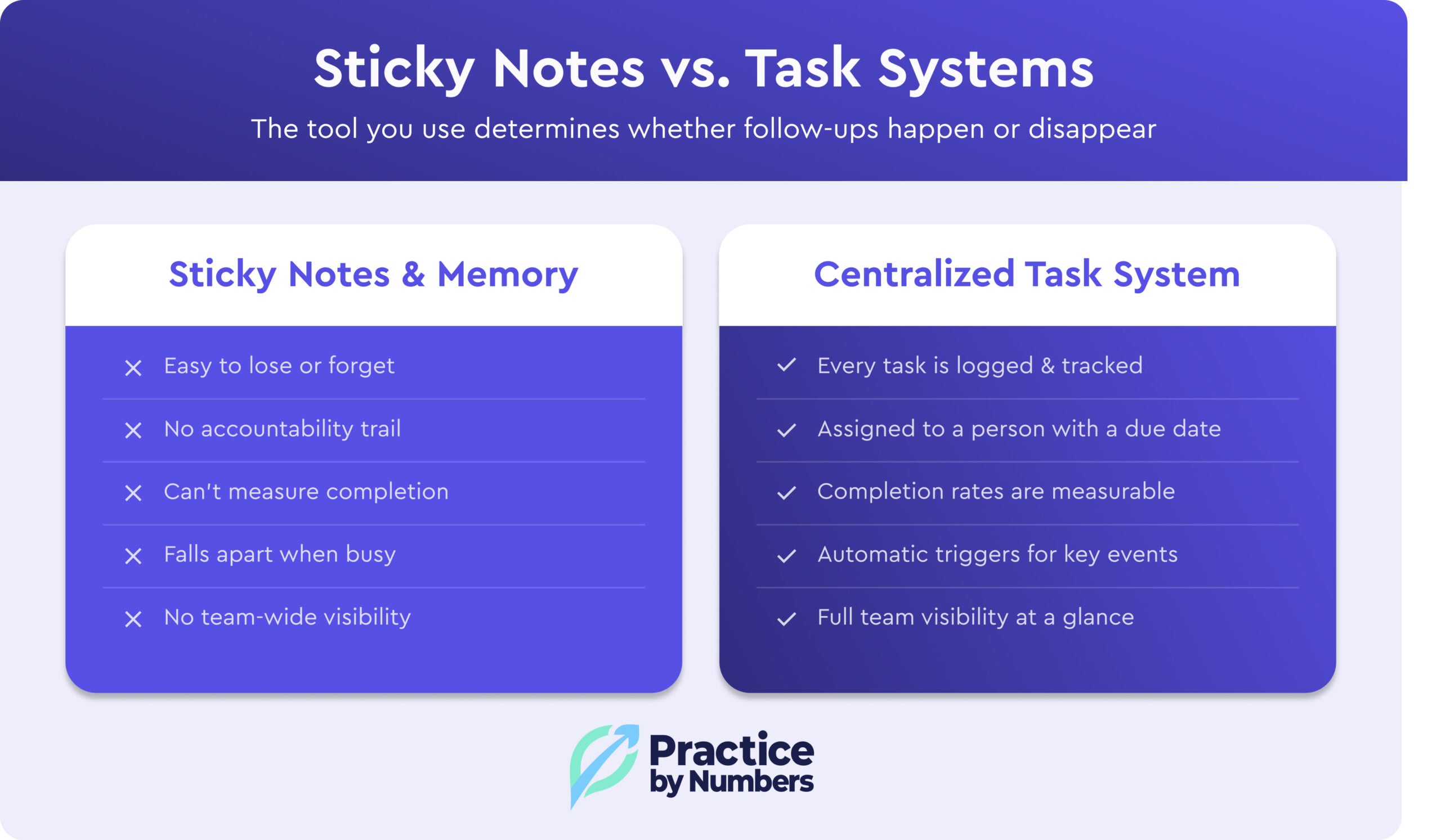
Sticky notes. Mental notes. “I’ll remember to call her tomorrow.” Whiteboard lists that get erased. These systems work when a practice is small and slow. They break down completely when you’re seeing 40 patients a day and three things go sideways before lunch.
The problem isn’t the people. It’s the process. Or more accurately, the lack of one.
How Do Top Practices Build a Follow-Up System That Works?
The practices that consistently close treatment, recover cancellations, and keep schedules full don’t necessarily have bigger teams. They usually have better systems. A strong dental practice follow-up system isn’t complicated. But it does require consistency across four areas.
1. Everything Gets Documented, Not Just Remembered
Top practices treat every required follow-up as a task, a specific thing that needs to be done, by a specific person, by a specific date. Not a mental note. Not a verbal handoff. A logged, visible task.
This sounds simple. But it’s the single biggest difference between practices where follow-through is consistent and practices where it isn’t.
2. Every Task Has an Owner
It’s not enough to log a task. Someone has to own it. “Someone should call Mrs. Johnson” is not a task. “Sarah will call Mrs. Johnson about her crown estimate by Thursday” is a task. The specificity creates accountability.
When nobody owns a task, the implicit assumption is that someone else is handling it. Often, nobody is.
3. Follow-Up Is Built Into the Workflow, Not Added On Top
The best systems don’t rely on someone remembering to create a task. They make task creation automatic. Patient declines treatment? A follow-up task is created. Appointment cancels without rescheduling? A callback task is assigned. Claim gets denied? A resubmission task appears.
When the workflow creates the task, follow-through stops depending on memory and starts depending on the system.
4. Completion Gets Measured, Not Just Assumed
Creating tasks isn’t enough if nobody’s checking whether they’re getting done. Top practices measure task completion rates the same way they measure production. What percentage of open tasks are being closed on time? How many are overdue right now? How quickly is the team responding after a trigger event?
That visibility changes behavior fast.
What’s the Real Cost of Not Following Up?
Let’s put a number on it. If 10 patients a week present with treatment and decline or defer and nobody follows up and the average treatment value is $800, that’s $8,000 a week in potential production that evaporates. Over a year, that’s more than $400,000.
Even if you could recover just 20% of those patients with a timely, personal follow-up, that’s over $80,000 back in annual production. From one type of follow-up alone.
Add in uncollected balances, unrescheduled cancellations, and stalled insurance claims and the total follow-up gap in a mid-size practice is often six figures.
👉 Learn How Smart Practices Keep More Revenue
Where Do You Start?
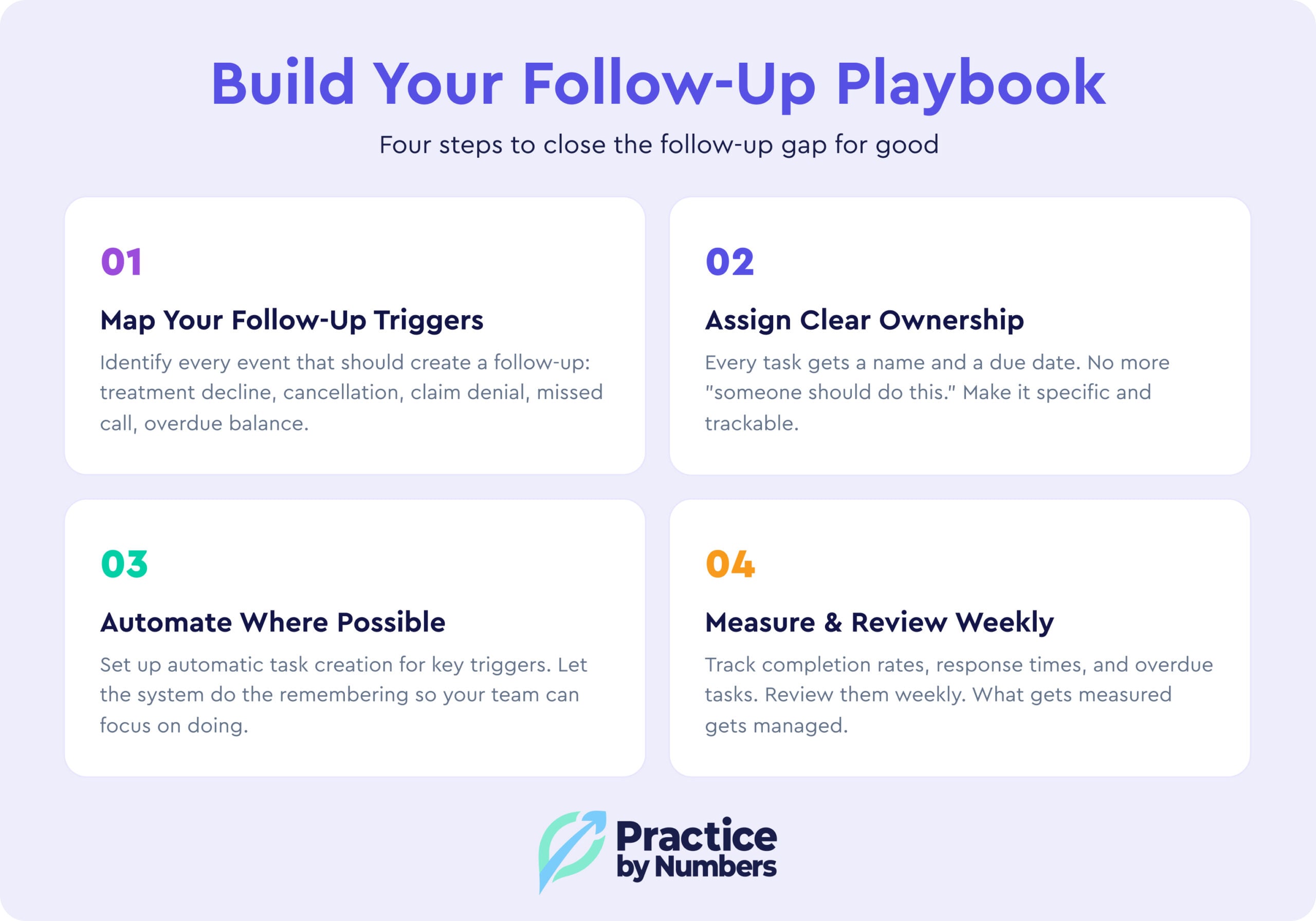
Start by mapping your follow-up triggers. What are the specific events in your practice that should automatically create a follow-up task? Most practices can identify at least 5–8 right away: treatment declined, appointment cancelled, claim denied, new patient inquiry received, balance unpaid after 30 days, hygiene overdue, lab case delayed.
Once you know your triggers, decide who owns each one. Not “the front desk” a specific person or role. Then decide how long they have to act on it.
Finally, make the tracking visible. Weekly team reviews of open and overdue tasks take 5 minutes and create enormous accountability. When the team can see what’s open and who owns it things get done.
How Advanced Task Management by PbN Closes the Gap
Advanced Task Management by Practice by Numbers gives your team a single place to create, assign, and track every follow-up across the practice.
With Advanced Task Management, your team can:
- Create tasks directly linked to specific patients and appointments
- Assign tasks to team members with clear due dates
- Trigger tasks automatically based on practice events
- Track completion rates and overdue items at a glance
- Review open follow-ups in the daily huddle without extra prep
When every follow-up has an owner and a deadline, and both are visible, things stop falling through the cracks.
FAQs
Q. What is a follow-up gap in a dental practice?
It’s the space between a moment that requires action, like a patient declining treatment or an appointment being cancelled, and someone actually taking that action. When those moments go untracked, the follow-up never happens, and revenue, appointments, and patient relationships quietly slip away.
Q. Why do dental practices miss so many follow-ups?
Mostly because follow-ups rely on memory instead of systems. When tasks live in someone’s head, on a sticky note, or in a verbal handoff, they disappear as soon as the day gets busy. It’s not a people problem, it’s a process problem. Practices with a structured task system close significantly more follow-ups than those without one.
Q. What are the most important follow-ups in a dental practice?
The highest-impact ones are: unscheduled treatment plans (patients who said maybe later), cancelled appointments that weren’t rescheduled, denied insurance claims, new patient inquiries, and unpaid patient balances. These five categories alone can represent hundreds of thousands of dollars in recoverable revenue each year.
Q. How quickly should dental practices follow up with patients?
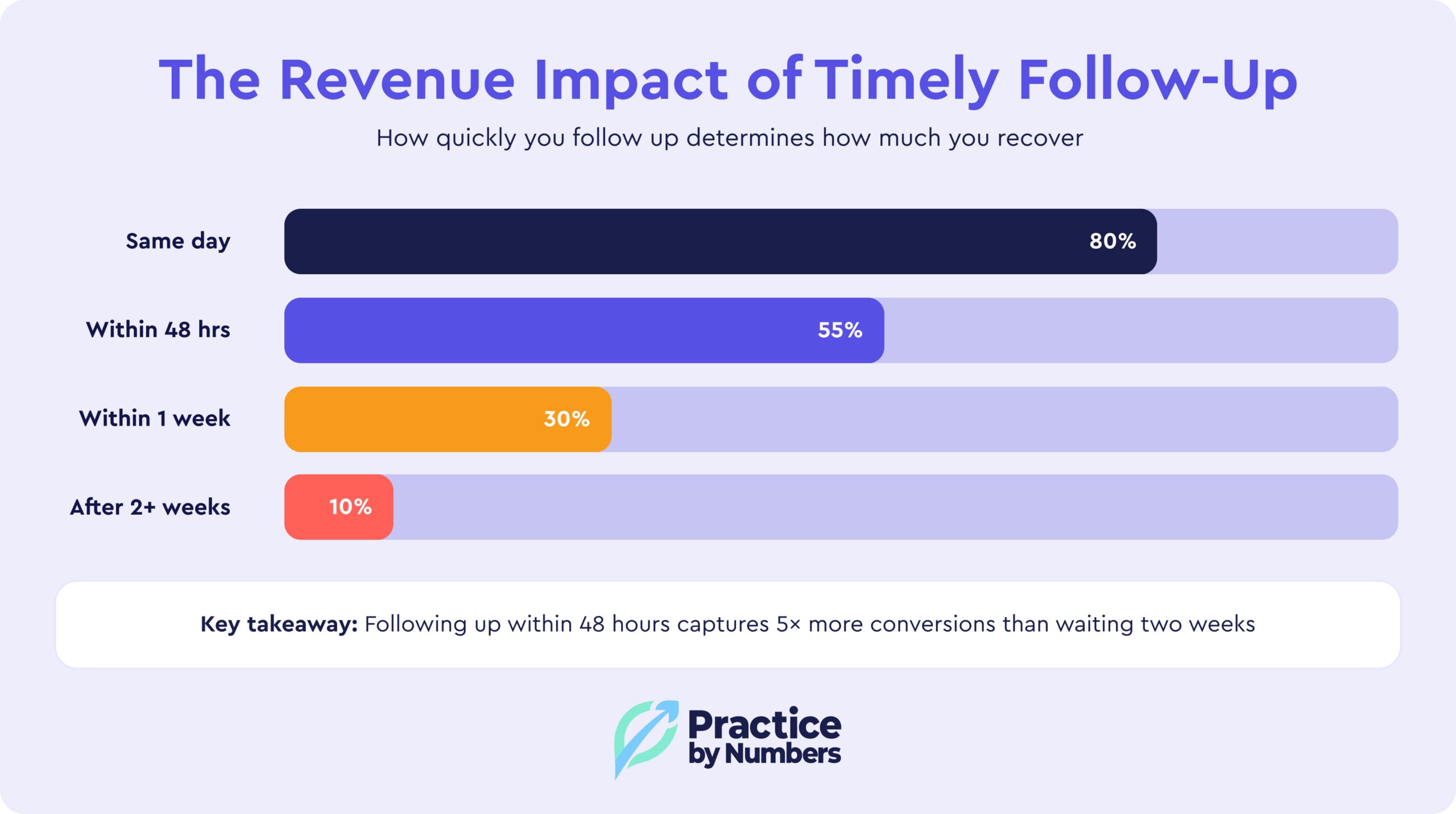
As quickly as possible. For new patient inquiries, same-day or within a few hours is the standard. For treatment follow-ups, within 48 hours is a strong benchmark. Research consistently shows that follow-up conversion rates drop sharply after the first week and dramatically after two weeks. Speed matters more than most practices realize.
Q. What’s the best way to track follow-ups in a dental office?
Move everything out of people’s heads and into a shared, visible system. Every follow-up should be a logged task with a specific owner and a due date. That system could be a shared spreadsheet, a whiteboard, or dedicated task management software — but it needs to be consistent, visible to the whole team, and reviewed regularly.
Q. How do I know if my practice’s follow-up system is working?
Track three numbers: task completion rate (what percentage of follow-up tasks are completed on time), average response time (how quickly does the team act after a trigger event), and follow-up conversion rate (of patients you follow up with, how many actually schedule or accept treatment). If any of those three are poor, you’ve found the problem.