Your next big revenue jump might not come from new patients. It might already be sitting inside your practice: unscheduled, unfollowed, and uncollected.
The average dental practice has thousands of dollars in diagnosed treatment and recurring care opportunities that never convert into actual production. Not because patients don’t need treatment, but because the practice never followed up consistently, never re-engaged the patient, or simply lost visibility inside the practice management system.
This is hidden revenue.
It’s not hypothetical revenue. It’s revenue already tied to real patients, diagnosed needs, incomplete treatment, overdue hygiene visits, and outstanding balances. In many cases, the practice already did the hard work of earning patient trust and diagnosing care. The opportunity was simply never activated.
The good news? Hidden revenue is recoverable when practices know where to look.
TL;DR
Most dental practices are already sitting on untapped revenue, they just can’t see it clearly.
The biggest growth opportunities are often hidden inside:
- Unscheduled treatment plans
- Overdue hygiene patients
- Inactive patient lists
- Uncollected balances
- Missed insurance follow-ups
The issue usually isn’t patient demand. It’s inconsistent visibility and follow-through.
Practices that systematically identify and act on these gaps can recover significant production without increasing marketing spend, adding providers, or extending hours. The key is turning patient data into actionable workflows instead of static reports.
What Is Hidden Revenue in a Dental Practice?
Hidden revenue is the gap between your practice’s production potential and the revenue you actually collect. This includes patients who need treatment, patients who are overdue for care, balances that haven’t been collected, but that never actually hit your bank account. It’s the gap between your practice’s potential and its reality.
Most practices instinctively focus on attracting new patients when growth slows. But growth does not always require more marketing or longer hours. Often, the fastest path to increased revenue is improving conversion and retention inside your existing patient base.
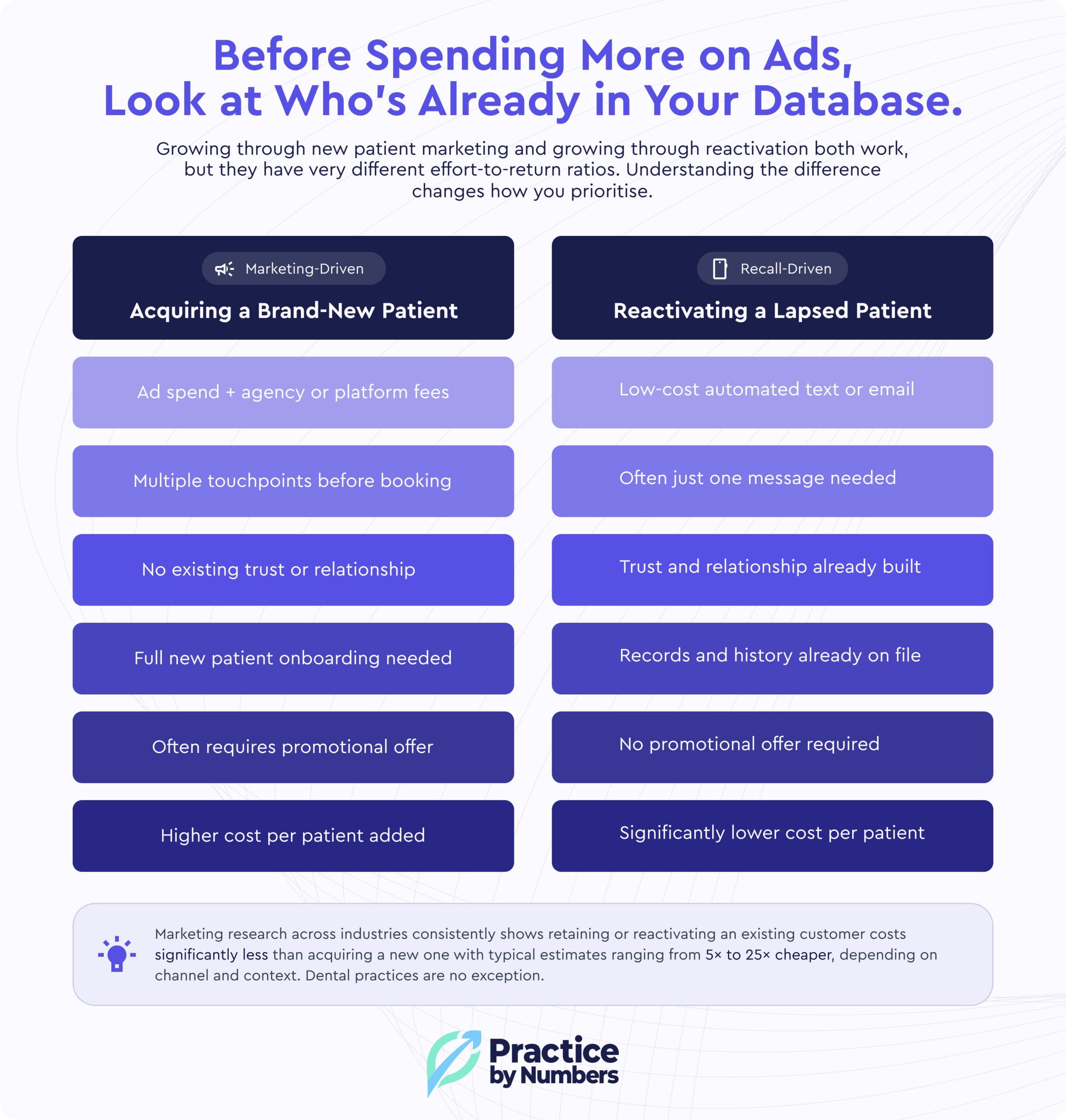
Acquiring a new patient is significantly more expensive than retaining and reactivating existing ones. Existing patients already know your team, trust your practice, and are far more likely to accept care when communication is timely and personalized.
That means your biggest revenue opportunity may already exist in your database.
Where Does Hidden Revenue Come From?
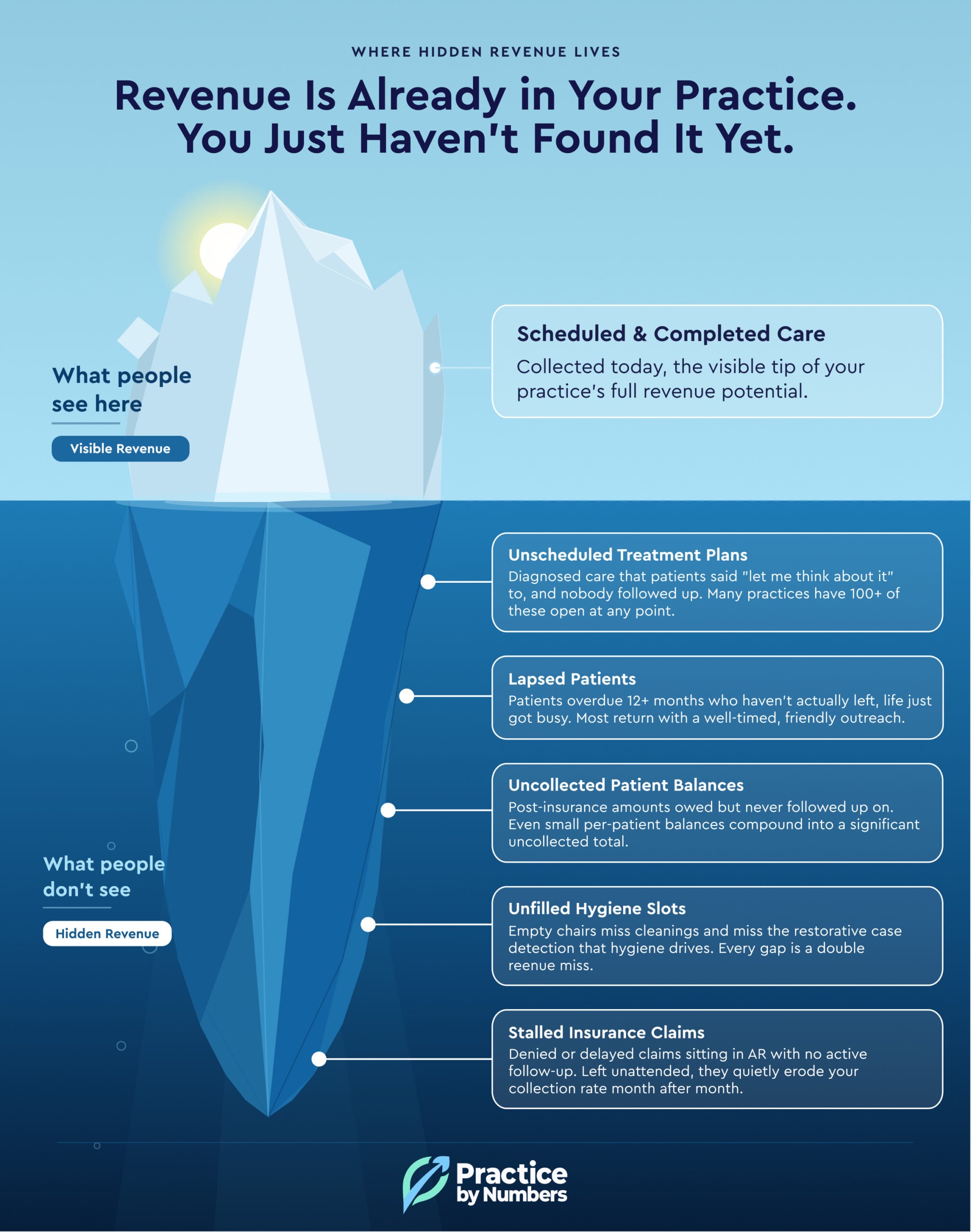
Hidden revenue rarely comes from one major issue. More often, it builds quietly through small operational gaps that compound over time, like missed follow-ups, overdue patients, incomplete scheduling, delayed collections, and disconnected workflows.
The challenge is that most of these opportunities already exist inside your practice management system, but without the right visibility and processes, they go unnoticed. Understanding where revenue leakage happens is the first step toward recovering production your practice has already earned.
1. Unscheduled Treatment Plans
A patient came in, you diagnosed a crown or a filling, they said, “Let me think about it,” and no one followed up.
Now multiply that by 20, 50, or 100 patients. Over time, practices accumulate hundreds of open treatment plans sitting untouched in the PMS. The issue usually isn’t treatment acceptance resistance. It’s inconsistent communication. Patients get busy, forget, or delay decisions when there is no structured follow-up process.
Practices that implement systematic treatment follow-up often see major improvements in case acceptance because the outreach feels supportive rather than sales-driven. Simple reminders, remaining insurance benefit notifications, financing options, or educational follow-ups can dramatically improve scheduling rates.
Even recovering a fraction of unscheduled treatment can translate into substantial monthly production gains.
2. Lapsed Patients
Inactive patients are another major hidden revenue source.
These are patients who haven’t been in for 12, 18, or even 24 months. They didn’t leave because they were unhappy. Life just got busy. But they’re still your patients, and most of them will come back if you ask them to.
The problem is that many practices stop communicating after a patient misses recall cycles. Reactivation campaigns consistently outperform cold marketing because these patients already have a relationship with your office. A thoughtful text, email, or phone call reminding them they’re overdue for care often brings them back faster and at a far lower cost than acquiring new patients through ads.
More importantly, reactivated patients frequently require restorative treatment after delayed hygiene and preventive care, increasing both patient health outcomes and practice production.
Practices that actively monitor inactive patient segments create a predictable source of recurring revenue without increasing marketing budgets.
3. Undercollected Patient Balances
Small balances become large financial leaks when collection processes are inconsistent. A practice with 1,000 active patients who each owe an average of $75? That’s $75,000 in uncollected revenue.
Many practices delay patient collections because financial conversations feel uncomfortable or because front desk teams are overwhelmed with competing priorities. But even modest balances spread across hundreds of patients can create significant accounts receivable problems.
Modern patients expect convenience. Practices that simplify payment experiences through automated reminders, online payment links, financing options, and transparent treatment estimates typically see stronger collection rates and fewer aging balances.
Automated payment reminders, easy online payment options, and clear financial policies at the time of treatment can dramatically improve your patient collections.
👉 Learn How to Streamline Collections and Cash Flow
4. Hygiene Recare That’s Falling Through the Cracks
Hygiene is often the engine that drives long-term production.
When hygiene schedules develop gaps, practices don’t just lose recare revenue. They lose restorative diagnosis opportunities, patient engagement touchpoints, and future treatment acceptance.
Many practices rely on basic reminder systems that patients increasingly ignore. Generic notifications without personalization or follow-up rarely create urgency.
A stronger hygiene recovery strategy includes:
- Identifying overdue patients early
- Segmenting based on recare history
- Personalizing communication timing
- Following up across multiple channels
- Assigning accountability internally
Consistent hygiene scheduling stabilizes production while feeding restorative opportunities back into the practice pipeline.
Every empty hygiene chair creates downstream revenue loss beyond the appointment itself.
5. Insurance Claims That Stall or Get Denied
Insurance inefficiencies quietly drain revenue every month. Many practices lack structured systems for:
- Tracking denied claims
- Monitoring outstanding insurance payments
- Managing appeals
- Following up on delayed reimbursements
As a result, claims often age unnecessarily or become write-offs that should have been collected.
Practices with strong insurance workflows improve:
- Accounts receivable performance
- Cash flow consistency
- Team efficiency
- Revenue predictability
Visibility is critical. If teams cannot easily identify stalled claims, collections slow down without anyone realizing how much revenue is being delayed.
👉 See How Dental Practice Analytics Improves Revenue, Retention, and Operational Control
How Do You Start Finding Hidden Revenue Today?
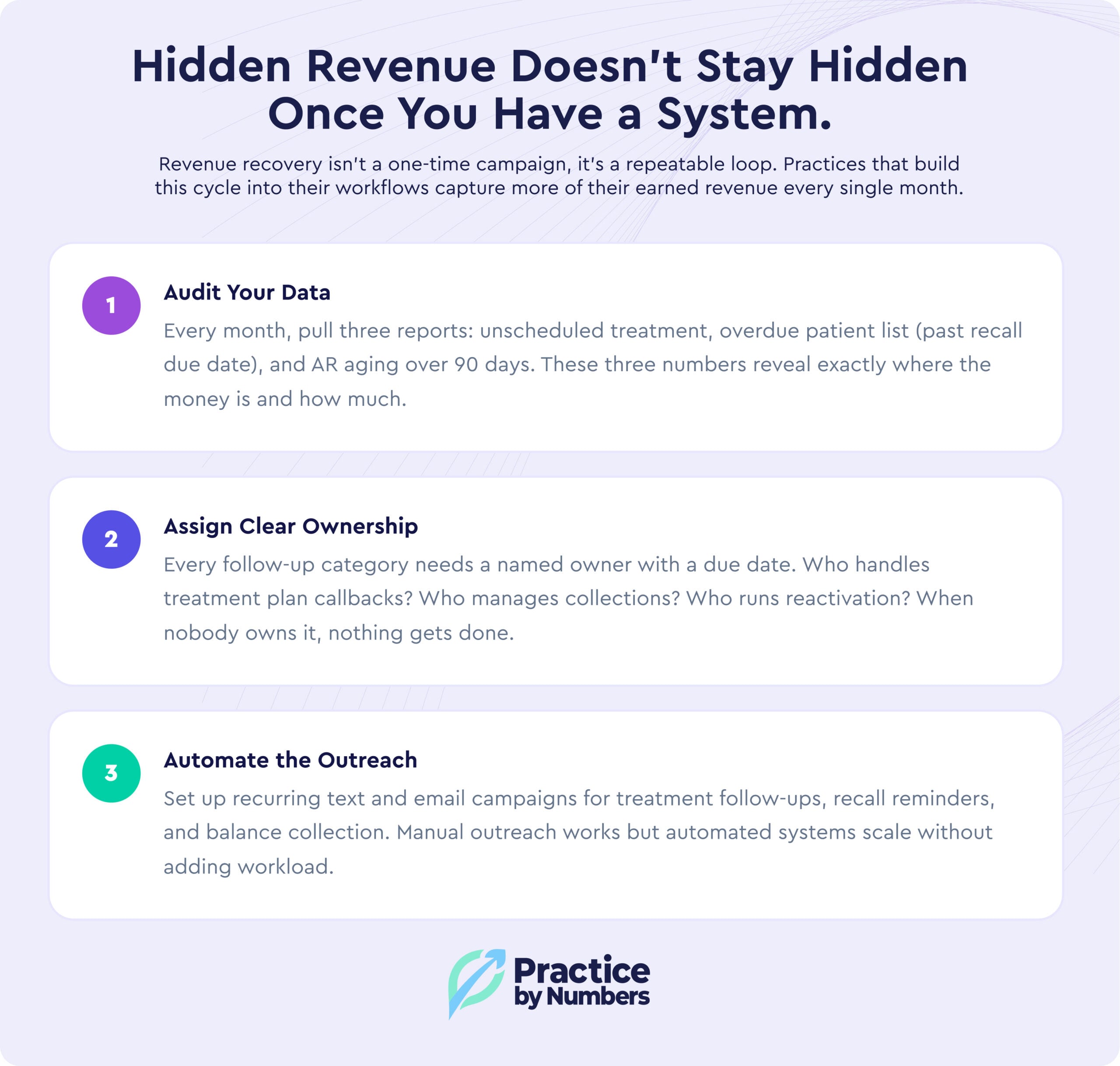
Start with a simple audit. Pull three reports from your system:
- Your unscheduled treatment report
- Overdue patient list (patients past due for hygiene)
- Accounts receivable aging report
These three reports will tell you exactly how much money is hiding inside your practice.
Then, assign ownership. Someone on your team needs to own follow-ups, collections, and own reactivation. When nobody owns it, nobody does it.
Finally, automate what you can. Manual follow-ups work, but they don’t scale. Automated text and email campaigns for treatment follow-up, recare reminders, and payment collection free up your team while keeping the revenue flowing in.
Want a quicker way to estimate the opportunity?
Before digging through reports, use our FREE Recoverable Revenue ROI Calculator to estimate how much production could already be sitting in your unscheduled treatment plans. Just enter a few practice details to get a personalized estimate and see what your practice could potentially recover.
Why Does Hidden Revenue Keep Getting Missed?
Most practice owners are not ignoring these opportunities intentionally. The reality is that modern dental practices are operationally complex. Teams are balancing patient care, staffing challenges, insurance coordination, scheduling, compliance, front desk communication, financial management, and much more.
That’s why visibility matters so much. If you can see the numbers clearly, like how much unscheduled treatment exists, how many patients are overdue, and how much is in aging AR, you can act on it. If it’s buried in your PMS and no one’s looking, it stays hidden.
Automatically identifying them, segmenting them, assigning follow-up tasks, and launching outreach campaigns is transformational.
How Revenue IQ by PbN Helps Practices Recover Hidden Revenue
Revenue IQ by Practice by Numbers is designed to help practices uncover revenue opportunities that already exist inside their patient base and act on them before they slip through the cracks.
Instead of relying on static PMS reports, Revenue IQ gives practices a smarter way to identify, organize, and convert missed opportunities into production.
With features like:
- Patient Finder to segment patients using 40+ filters
- Saved Queries to track recurring revenue opportunities
- Custom Tags for smarter patient targeting
- Task Creation to improve accountability
- Built-in Campaign Activation for text and email outreach
…teams can move from simply viewing data to actually driving action.
That means practices can:
- Recover unscheduled treatment faster
- Reactivate overdue hygiene patients proactively
- Prioritize high-value procedures like implants and crowns
- Reduce manual follow-up work
- Improve treatment acceptance without adding operational complexity
The real value isn’t just better reporting. It’s operationalizing patient intelligence in a way that consistently drives production growth.
FAQs
Q. Why does my dental practice feel busy but still struggle to grow revenue?
Many practices focus heavily on patient volume while overlooking operational inefficiencies that quietly reduce collections and case acceptance. Revenue gaps often come from unscheduled treatment, overdue hygiene patients, delayed follow-ups, and incomplete insurance workflows, not necessarily a lack of new patients.
Q. How can I tell if my dental practice has hidden revenue opportunities?
A few warning signs include:
- Large amounts of unscheduled treatment
- Frequent hygiene gaps
- High patient attrition
- Aging accounts receivable
- Low treatment acceptance rates
- Inconsistent patient follow-up
If these issues exist, your practice likely has revenue opportunities already sitting inside your patient base.
Q. What is the fastest way to increase production without adding more patients?
Improving reactivation and treatment follow-up processes is often faster and more cost-effective than increasing marketing spend. Existing patients already trust your practice, making them more likely to schedule overdue treatment or return for hygiene when communication is timely and personalized.
Q. Why do patients delay diagnosed dental treatment even when they need it?
Treatment delays are often caused by timing, financial concerns, lack of urgency, or simply forgetting after the appointment. Most patients are not actively rejecting treatment, they just need clearer communication, follow-up, and convenient scheduling options to move forward.
Q. How can dental analytics software help recover lost revenue?
Dental analytics platforms help practices identify patterns and opportunities hidden inside patient data. Instead of manually searching through reports, teams can quickly find overdue patients, unscheduled treatment plans, high-value procedures, and collection risks. Then automate follow-ups and outreach to improve conversions and production.