Your mind probably jumps to associate AI in healthcare with robot-assisted surgery or diagnostic imaging. Those applications exist, but they represent a fraction of how AI is actually used day to day.
The truth is, AI is already deeply woven into everyday healthcare in ways you’d never notice. Right now, artificial intelligence is quietly helping doctors make better treatment decisions, freeing up nurses from paperwork, reducing appointment no-shows, and even catching billing errors that cost hospitals millions. These behind-the-scenes applications aren’t as exciting to talk about, but they’re often the ones making the biggest real-world difference.
In this article, we’re going to explore six ways AI is transforming healthcare right now. Ways that directly affect how patients get care and how hospitals operate. These aren’t science fiction. They’re happening today, and they’re worth understanding.
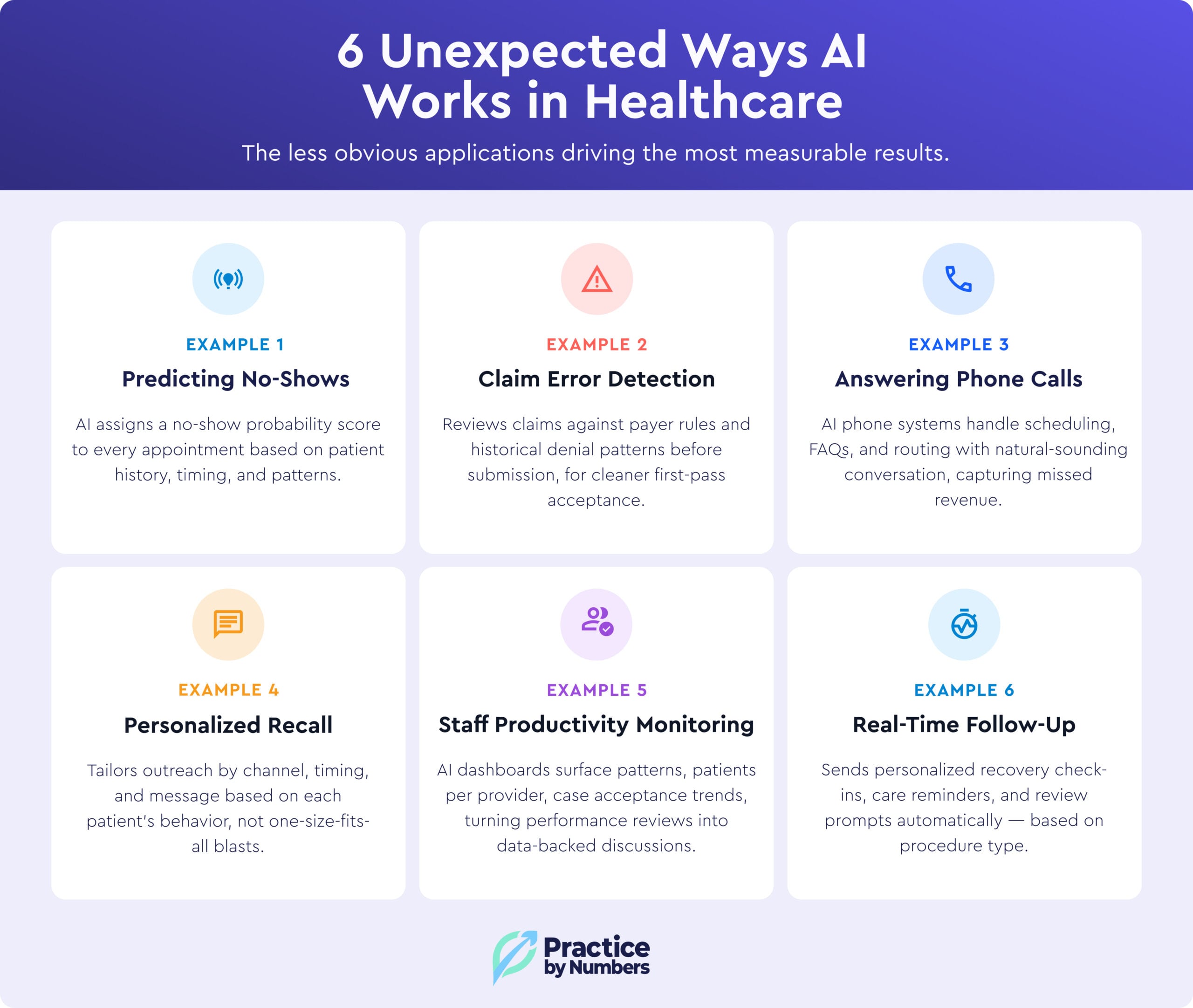
1. Predicting Patient No-Shows Before They Happen
Missed appointments cost the average dental practice thousands of dollars per month. AI analyzes patient history, appointment timing, weather data, and communication patterns to assign a no-show probability score to every appointment on the schedule.
When a patient is flagged as high risk, the system can trigger an extra reminder, offer an easier rescheduling option, or alert the front desk to line up a backup patient. It is proactive scheduling instead of reactive gap-filling.
2. Detecting Insurance Claim Errors Before Submission
Claim denials are expensive, not just in lost revenue, but in the staff time required to rework and resubmit. AI reviews claims before they go out, comparing them against payer rules, coding guidelines, and historical denial patterns.
The result is a cleaner first-pass acceptance rate. Practices using AI-driven claim scrubbing have seen denial rates drop significantly, which directly improves cash flow and reduces accounts receivable aging.
3. Answering Patient Phone Calls Automatically
AI phone systems now handle inbound calls with natural-sounding conversation. They can schedule appointments, answer common questions (office hours, insurance accepted, directions), and route complex calls to the right staff member.
For dental practices that miss 20-30% of incoming calls during peak hours, this is a direct revenue recovery tool. Patients who reach a live response, even an AI-powered one, are far more likely to book than those who hit voicemail.
👉 Explore how a virtual receptionist helps capture every missed opportunity.
4. Personalizing Patient Recall Campaigns
Traditional recall systems blast the same message to every overdue patient. AI-powered recall analyzes each patient’s history, communication preferences, and responsiveness to tailor the outreach.
A patient who always responds to text messages gets a text. A patient who books after phone calls gets a call. A patient who has been unresponsive for 12 months gets a different message than one who missed their last cleaning by two weeks. This personalization increases reactivation rates without increasing the workload for your team.
5. Monitoring Staff Productivity Without Micromanaging
AI dashboards can track operational metrics, like patients seen per provider, average appointment duration, and treatment plan acceptance rates, without requiring managers to hover. The data surfaces patterns automatically.
If a hygienist’s patient load drops on certain days, or if a provider’s case acceptance rate declines, the system highlights it. This turns performance conversations from subjective feelings into objective, data-backed discussions.
6. Automating Post-Visit Patient Follow-Up
After a procedure, AI can send personalized follow-up messages, checking on recovery, reminding about care instructions, and prompting reviews. This happens automatically based on the procedure type and timing.
Patients feel cared for. The practice builds its online reputation. And the front desk does not have to remember to make follow-up calls for every extraction, crown, or implant case.
👉 See How Patient Relationship Management Boosts Practice Revenue
Key Takeaways
AI’s highest-impact healthcare applications are often behind the scenes, not in the operating room. Predicting no-shows, scrubbing claims, and answering phones deliver immediate, measurable ROI. Personalized patient communication outperforms generic outreach. Operational analytics help managers lead with data instead of guesswork. Starting with one or two of these applications gives practices a low-risk entry into AI adoption.
- The most useful AI isn’t flashy. It’s fixing small leaks in your day-to-day operations
- No-shows aren’t random → AI can predict and prevent them
- Denied claims often start with small mistakes → AI catches them early
- If you miss calls, you’re losing patients → AI makes sure every call gets answered
- Generic reminders don’t work → personalized outreach gets patients back in
- You don’t need to “check on staff” → AI shows you what’s actually happening
- Follow-ups don’t have to be manual → AI keeps patients engaged after they leave
- Most of these wins come from front desk + admin workflows, not clinical tools
- You don’t need big changes → these are small fixes with immediate impact
- If it improves time, response, or cash flow, it’s where AI fits best
FAQs
Q. Can AI really answer patient phone calls effectively?
Yes. Modern AI phone systems use natural language processing to hold conversations, not just play pre-recorded menus. They handle scheduling, FAQs, routing, and transfer to a human when needed.
Q. Does AI-powered recall actually increase reactivation rates?
Practices using AI-personalized recall typically see higher response rates than those using generic blast messages, because the timing, channel, and content are tailored to each patient’s behavior.
Q. Is AI monitoring of staff productivity ethical?
When focused on operational metrics rather than surveillance, AI dashboards create transparency that benefits both managers and staff. The key is using data for support and coaching, not punishment.