HIPAA compliance in dental billing is not optional, and it is not only the privacy officer’s job. Every team member who touches billing information, from intake to claim submission, is handling protected patient information. A single misstep can lead to fines and to a loss of trust that takes a long time to rebuild.
This guide focuses on how HIPAA applies specifically to dental billing workflows, and what your practice can do to stay compliant without making the work harder than it needs to be.
- Billing is one of the most information-heavy workflows in a practice.
- HIPAA allows using patient information for treatment, payment, and operations, but it must be handled securely.
- Common issues include unencrypted email, shared logins, and missing BAAs.
- Access controls, encryption, and audit logs are the foundation of compliant billing.
- Billing staff benefit from training specific to their work, plus a breach response plan.
How HIPAA Applies to Dental Billing
Billing is one of the most information-intensive workflows in a practice. It involves patient names, dates of birth, insurance IDs, sometimes Social Security numbers, diagnoses, procedure codes, and financial details. Every one of these is protected under HIPAA.
Each step of the workflow carries an obligation to handle information carefully: collecting details at intake, verifying insurance, documenting treatment, coding and submitting claims, posting payments, following up on denials, and collecting balances. The reassuring part is that HIPAA allows using patient information for treatment, payment, and healthcare operations without separate authorization, so you do not need special consent to submit a claim. You do, however, need to keep that information secure at every step.
Common HIPAA Issues in Dental Billing
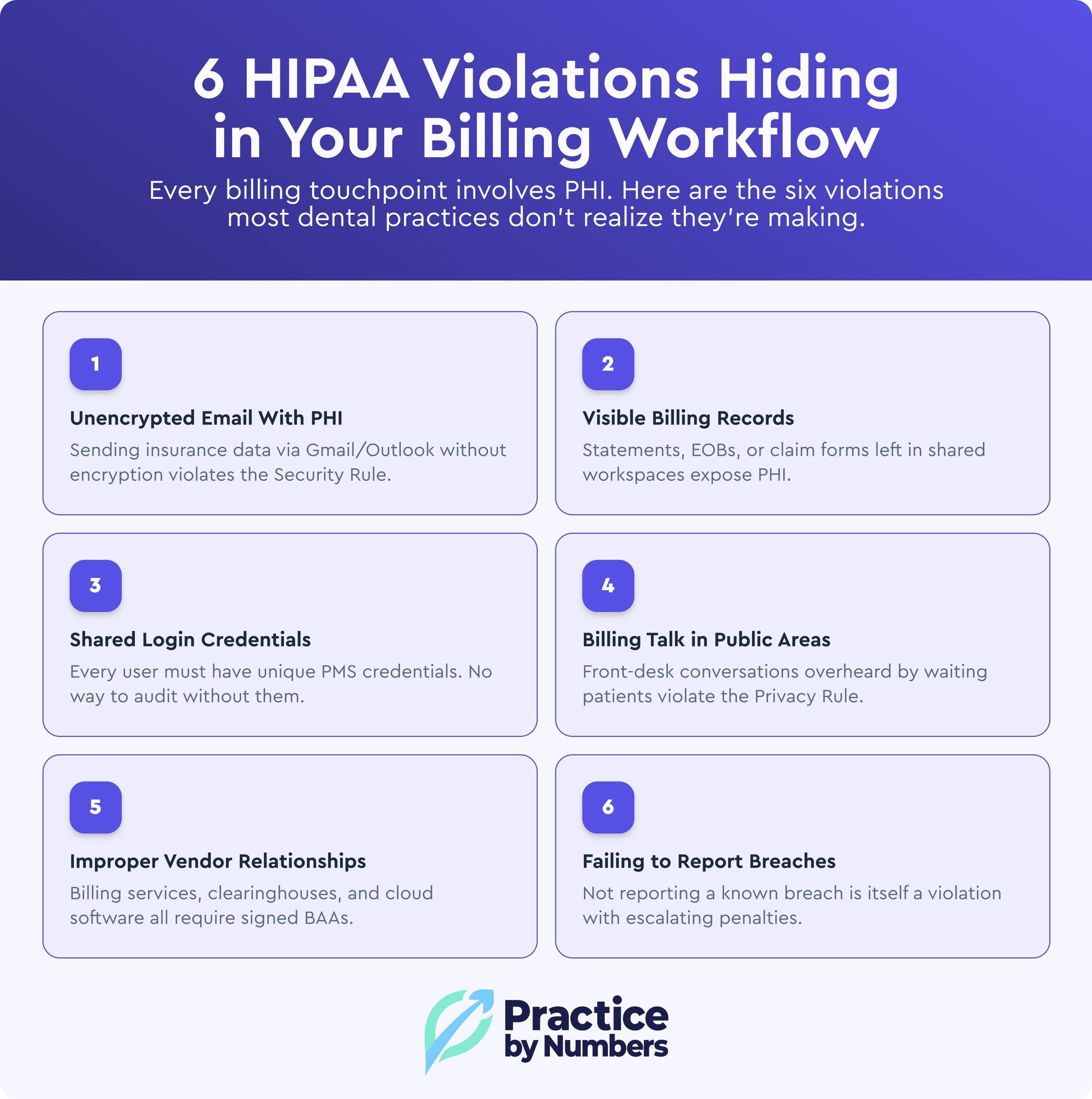
A handful of issues come up most often, and all of them are preventable:
1. Sending patient information by unencrypted email: Standard email to a billing company is a risk. All electronic transmission of patient information should be encrypted.
2. Leaving billing records visible: Statements, EOBs, or claim forms left on a desk or shared printer can be seen by others. Handle billing paperwork in secure areas and file or shred it promptly.
3. Sharing login credentials: When logins are shared, there is no way to track who accessed what. Each person should have their own unique login.
4. Discussing balances where others can hear: Conversations about a patient’s balance that carry into the waiting room are a privacy risk. Use a private area for these talks.
5. Missing Business Associate Agreements: Any outside billing company, clearinghouse, or cloud software that handles patient information needs a signed BAA on file.
6. Not reporting a breach: If billing data is compromised, follow breach notification steps. Not reporting a known breach is itself a violation.
👉 Here Are 10 Dental Practice Management Tips Every Office Should Try
Building HIPAA-Compliant Billing Workflows
A few practices make compliance part of the routine rather than an afterthought.
1. Use encrypted communication for all patient information: Submit claims through encrypted electronic channels, and send patient billing messages through HIPAA-compliant platforms rather than standard email or text.
2. Set access by role: Not everyone needs access to all billing data. Someone focused on scheduling does not need full payment history, and a billing specialist does not need clinical notes beyond what coding requires.
3. Keep audit logs and review them: Your billing software should log who accessed which records and when. Look at these logs periodically, not only after something goes wrong.
4. Train the billing team specifically: General HIPAA training is a good base, but billing staff also benefit from training on secure claim submission, proper disposal of billing records, and handling balance questions without disclosing information to unauthorized callers.
5. Use compliant forms: Any form that collects or displays billing information should be reviewed for compliance, with digital forms on encrypted platforms and paper forms stored securely and retained per your state’s rules.
👉 Learn How to Secure Access Across Your Practice: A Guide to Enterprise Security
If a Billing-Related Breach Occurs
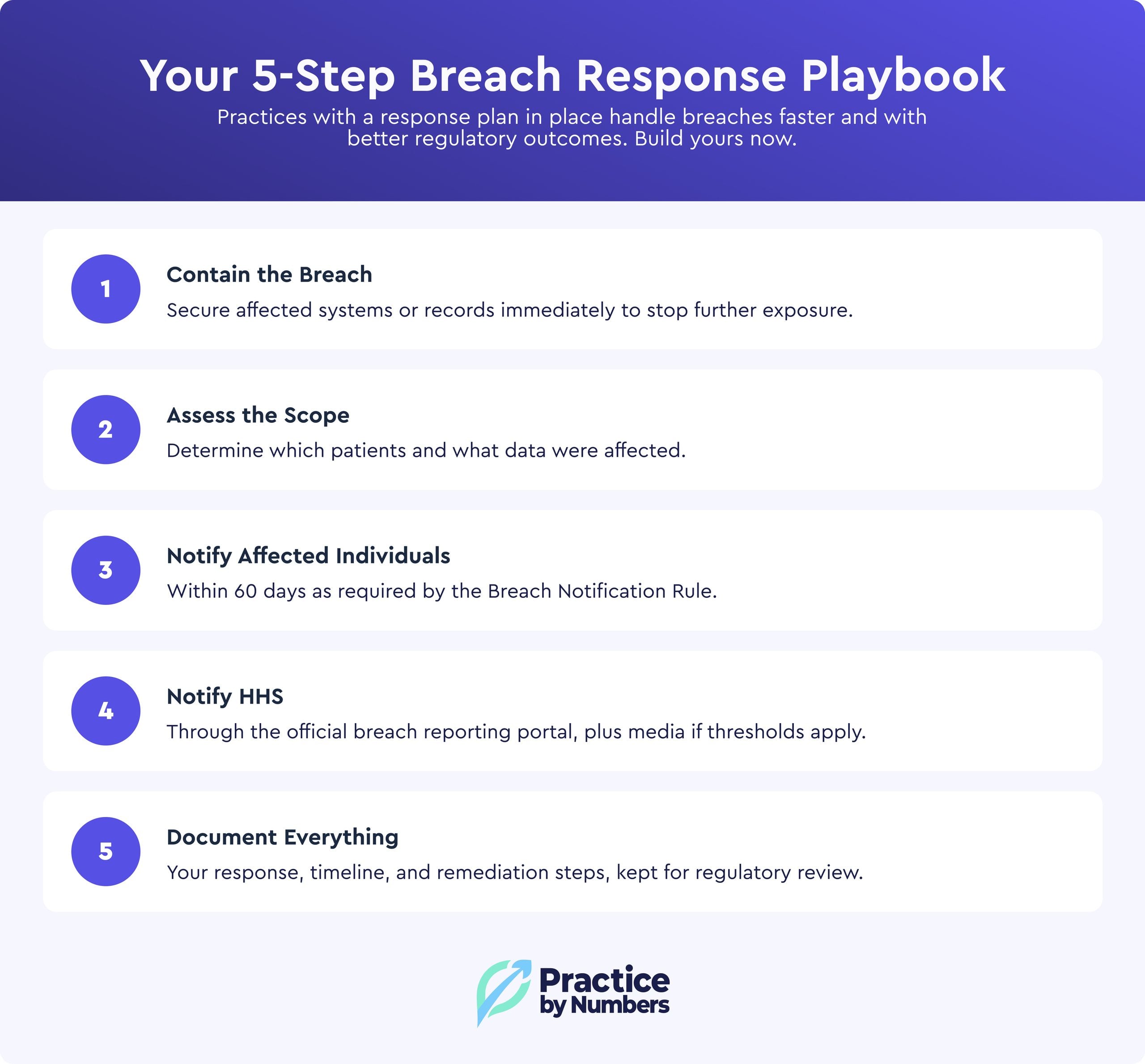
If your practice discovers a billing-related breach, such as unauthorized access to financial records, misdirected claim data, or a cybersecurity incident, follow your incident response plan.
Contain the breach by securing the affected systems or records. Determine the scope by identifying which patients and data were involved. Notify affected individuals within the required window, notify HHS through the breach reporting portal, and document your response, timeline, and remediation. Practices that have a plan ready before anything happens handle these moments faster and with less disruption.
Keeping It Manageable
None of this needs to feel overwhelming. Focus on a few durable habits: encrypt the information you send, give every team member a unique login, keep required BAAs on file, discuss patient balances privately, and train your team at least once a year. Build these practices into your daily workflows, and compliance becomes part of how your office operates, not something you scramble to address when an audit comes up.
👉 See How a Fragmented Tech Stack Holds Dental Practices Back
How Practice by Numbers Supports Compliant Billing
Much of HIPAA-compliant billing comes down to secure systems and clear access. Practice by Numbers is built with both in mind.
- Secure patient payments: Collect and track patient payments through encrypted, purpose-built channels including online, in-office, or by text, instead of loose email or paper.
- Insurance verification: Confirm patient coverage in advance to reduce denials, with data flowing securely between Practice by Numbers and your practice management system.
- Built for HIPAA compliance: Designed as a HIPAA-compliant platform, with security and data protection built into how patient information is handled.
When the platform handles secure payments, insurance verification, and data protection for you, your team can focus on getting claims right instead of managing compliance by hand.