


Make a quick list of every software tool your practice uses. Your PMS. Your reminder system. Your analytics dashboard. Your payment processor. Your online booking tool. Your reviews platform. Your patient forms software. Your VoIP system. Maybe a separate marketing tool.
For most practices, that list lands somewhere between 6 and 10 tools, each with its own login, its own monthly bill, and its own support team.
Every tool on that list probably solved a real problem when you added it. But together, they create a new problem: a fragmented dental practice tech stack that doesn’t talk to itself, costs more than it should, and creates invisible gaps that none of the individual tools can fill. And the larger your practice grows, the more that fragmentation hurts.
TL;DR
- A fragmented tech stack isn’t just annoying, it’s actively limiting your practice’s growth and profitability.
- The real costs of fragmentation are:
- Subscription fees across disconnected tools that most practices have never added up, and probably should
- Staff time lost to switching between systems and re-entering the same data
- Revenue gaps that fall through the cracks between systems that don’t communicate
- Slow, painful onboarding every time you hire someone new
- Near-impossible scaling when you open a second location
- The alternative isn’t fewer features, it’s the same (or better) features in one connected platform where data flows automatically, reporting is unified, and your team only needs one login to run the whole practice.
What Does a Fragmented Dental Tech Stack Actually Look Like?
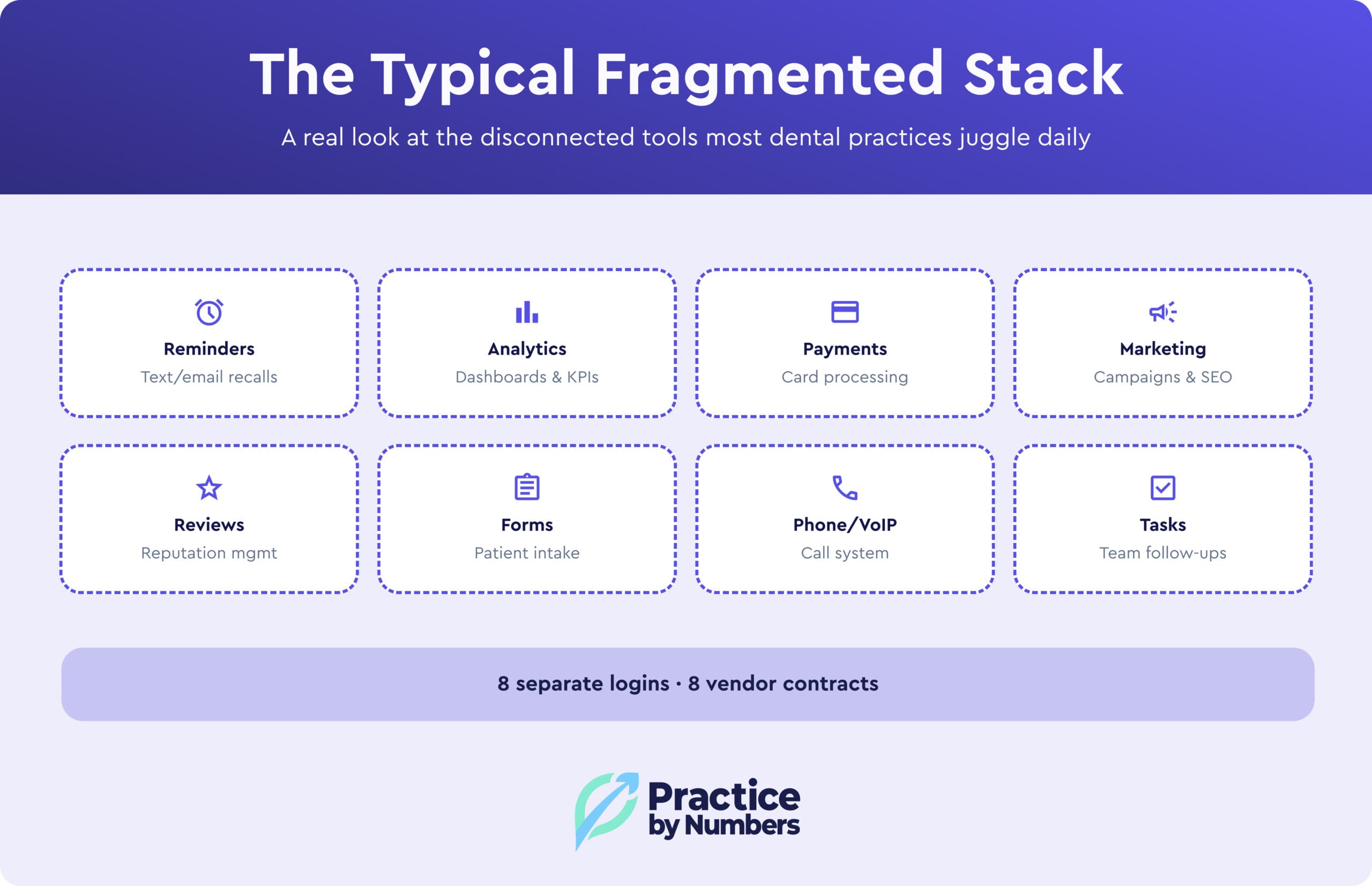
Here’s what a typical fragmented setup looks like in practice. The PMS handles scheduling and charting. A separate tool sends recall reminders and appointment confirmations. Another platform manages online reviews. A different service handles payments and payment plans. A standalone analytics product tries to pull data from the PMS. A form software collects patient intake. A separate VoIP system manages calls. A marketing tool runs email campaigns.
Each of these tools does its job in isolation. But none of them shares data with the others. So when the front desk wants to understand why the schedule is lighter than expected, they’re pulling from three different dashboards and trying to mentally connect dots that no system is connecting for them.
This is what “fragmented” means. Not that the tools are bad. But that they’re islands.
What Does Fragmentation Actually Cost Your Practice?
1. The Subscription Math Alone Is Surprising
Most practice owners have never added up every software subscription they’re paying for at the same time. When they do, the total is almost always more than expected. And that’s before accounting for per-user fees, add-on tiers, or “premium” features that got tacked on quietly over time. The point isn’t a specific number, it’s that each tool felt reasonable on its own, and nobody ever looked at all of them together.
2. Your Team Loses More Time Than You Think
Every time a team member switches between two systems to answer one question, that’s a context switch. Every manual data entry between a form and the PMS, every morning spent pulling three reports that should have been one dashboard. These are small time costs that compound across a whole team, every day.
Some practices track this carefully and find the results surprising. A meaningful chunk of the workday, across multiple team members, quietly disappears into friction between disconnected systems. Multiply that across a full team over a full year, and the payroll cost of working around a fragmented stack is often more significant than the subscription cost of running it.
3. Revenue Falls Through the Gaps Between Systems
This is the hardest cost to see but often the largest. When your reminder tool doesn’t connect to your analytics dashboard, you can’t tell whether recall campaigns are working. When your payment tool isn’t linked to your PMS, reconciliation is manual, and errors are easy to miss. When follow-up tasks live in one tool and patient data live in another, things fall through the seams.
Every gap between systems is a place where a task doesn’t get created, a follow-up doesn’t happen, or a revenue opportunity goes unnoticed. Those gaps are real, and they add up.
4. Scaling Breaks Everything
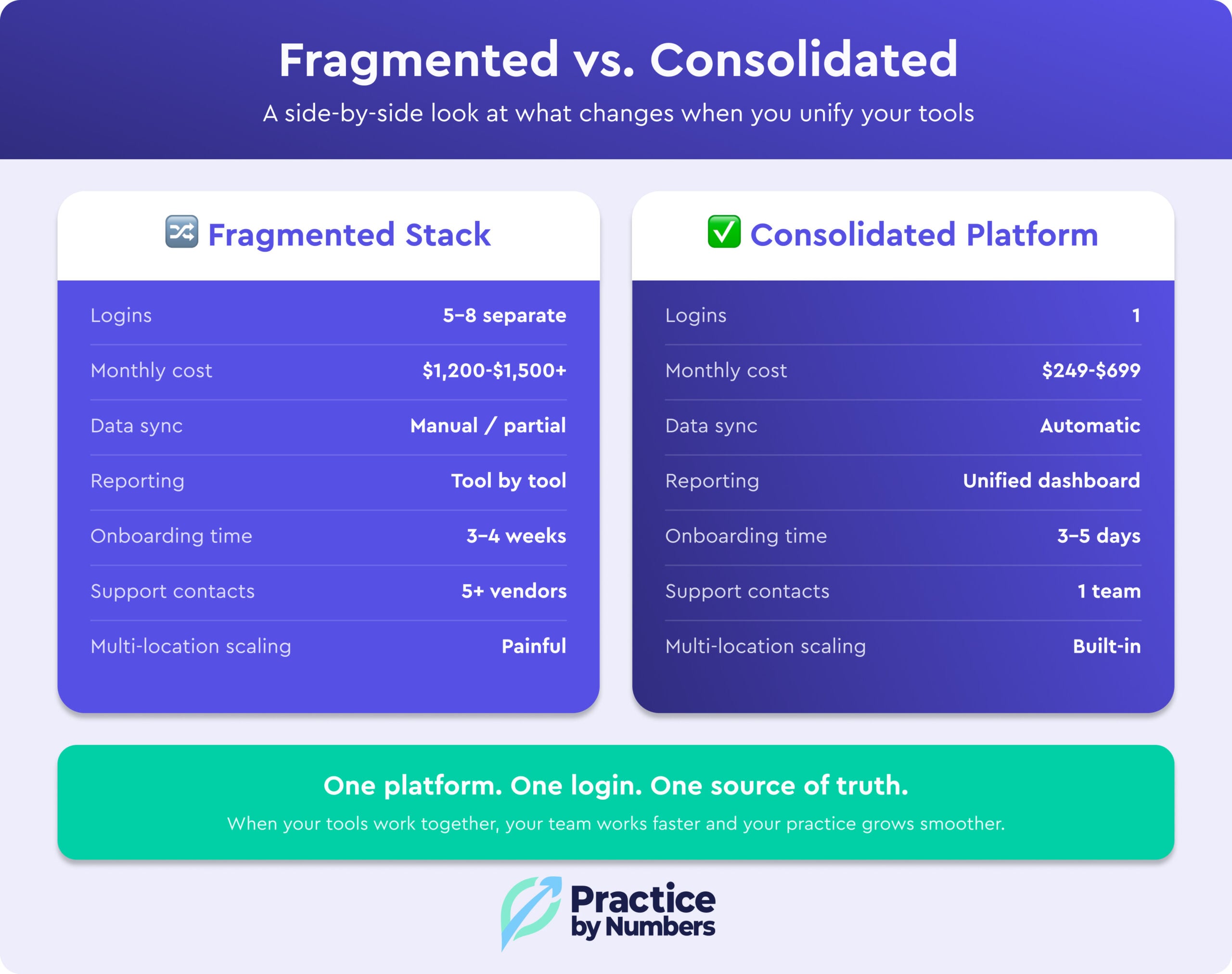
A fragmented stack that barely works for one location falls apart at two. You’d need to duplicate every subscription, train new staff on every system, build cross-location reporting out of multiple disconnected tools, and manage relationships with eight different vendors instead of one. It’s not impossible, plenty of multi-location practices live in this world, but it’s an enormous operational drag.
What Does a Consolidated Stack Look Like?
An integrated platform replaces most of your disconnected tools with a single ecosystem. Analytics, patient communication, reminders, campaigns, payments, forms, task management, VoIP, and marketing analytics all live in one place and share the same data.
Your team has one login. Reporting pulls from one source. When a patient cancels, a follow-up task appears automatically because the scheduling system and the task system are the same system. When a campaign goes out, you can see exactly how many patients booked and what production it generated because the campaign tool and the analytics tool are connected.
This isn’t about having fewer features. It’s about having the same features working together instead of against each other.
How Do You Consolidate Without Disrupting the Practice?
You don’t have to do it all at once. Start by auditing your current stack, write down every tool, what it costs, and what it actually does. Then look for the tools with the most overlap, the highest cost, or the most friction. Those are your first candidates to replace.
Migrate one function at a time. Start with whichever tool causes the most day-to-day frustration or whichever subscription is up for renewal first. Once your team experiences working in an integrated workflow, where data flows and tools connect, they’ll push for consolidation faster than you will.
How Practice by Numbers Replaces the Fragmented Stack
Practice by Numbers is built to replace the scattered collection of tools most dental practices use with one connected platform, designed specifically for dentistry and integrated directly with your PMS.
Here’s what that looks like in practice:
- Know your numbers without hunting for them: Practice IQ and Revenue IQ pull KPIs, production data, and revenue gaps directly from your PMS. No report-building, no spreadsheets.
- Keep patients coming back automatically: Reminders, recall campaigns, two-way texting, and online booking work together so patients hear from you at the right time without your team doing it manually.
- Get paid faster and with less friction: In-office, online, and Payment Plan Options are built in, so collections improve without adding a separate payment tool.
- Cut front desk admin in half: Digital Forms, Kiosk Check-in, and Insurance Verification replace paper-based workflows that waste time every single day.
- Keep your team accountable without micromanaging: Daily Huddle and Advanced Task Management make sure every follow-up gets assigned, tracked, and closed, not forgotten.
- See what your marketing is actually doing: Marketing IQ and Call Tracking show you which channels bring in patients and which ones don’t, so you stop spending blind.
One login. One dashboard. One support team.
FAQs
Q. What is a fragmented tech stack in a dental practice?
It’s when a practice uses multiple separate, disconnected software tools to handle different functions like reminders from one company, analytics from another, payments from a third, and so on. Each tool works on its own, but they don’t share data, which creates gaps, duplication, and significant time waste across the team.
Q. How much does a fragmented dental tech stack typically cost per year?
It varies by practice, but the honest answer is: most practice owners don’t know because they’ve never added it all up. When they do, the total subscription cost across 6–10 tools is almost always more than expected. On top of that, there’s the harder-to-measure cost of staff time lost to switching between systems, manual data re-entry, and workarounds that shouldn’t need to exist. Both costs are real. Neither shows up clearly until you look for them.
Q. Why is a fragmented stack especially harmful for multi-location dental practices?
Because every problem multiplies with each location. More subscriptions, more training time, more vendor relationships, and no unified reporting across locations. Practices using fragmented tools at one location often find their operational complexity becomes nearly unmanageable at two or three. An integrated platform built for multi-location management eliminates most of that friction.
Q. How do I know if my dental practice needs to consolidate its tools?
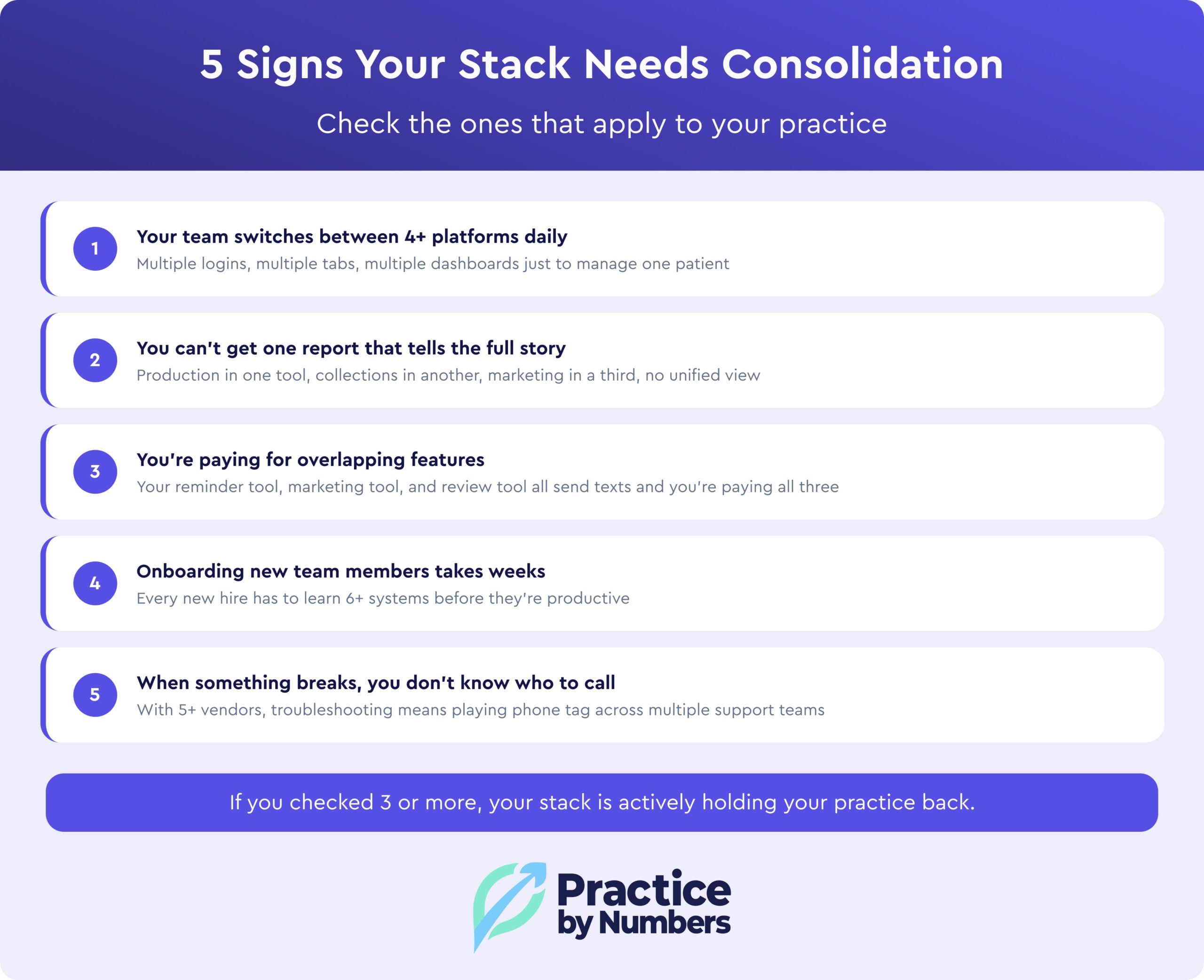
Five clear signs: your team logs into 4+ systems to answer one patient question; you can’t pull a single report showing full practice performance; you’re paying for overlapping features in multiple tools; onboarding new staff takes weeks because of how many systems they need to learn; and when something breaks, you’re not sure which vendor to call first.
Q. Is it risky to switch from multiple tools to one integrated platform?
The short answer is: much less risky than staying fragmented. The transition period requires planning, but modern dental platforms are built to migrate data carefully and provide onboarding support. Most practices report that within 60–90 days, the efficiency gains far outweigh any short-term adjustment. The bigger risk is continuing to run a growing practice on tools that weren’t designed to work together.
Q. What should a dental practice look for in an integrated software platform?
First, PMS compatibility. It needs to work with Dentrix, EagleSoft, OpenDental, or whatever you use. Second, coverage. Does it handle the functions you’d be replacing, without introducing new gaps? Third, unified reporting. Can you see all your performance data in one place? Fourth, scalability. Will it work if you open a second location? And fifth, support. One team you can call instead of five vendor relationships to manage.


