Buying software is the easy part. Turning it into an operating habit is where value is created.
For a Curve Dental practice adding Practice by Numbers, the first 30 days should have one objective: create a repeatable connection between data, decisions, and action. The team does not need to review every dashboard or change every workflow at once. It needs a focused rollout.
Here is a practical four-week plan to getting the best of Practice by Numbers and Curve Dental Integration.
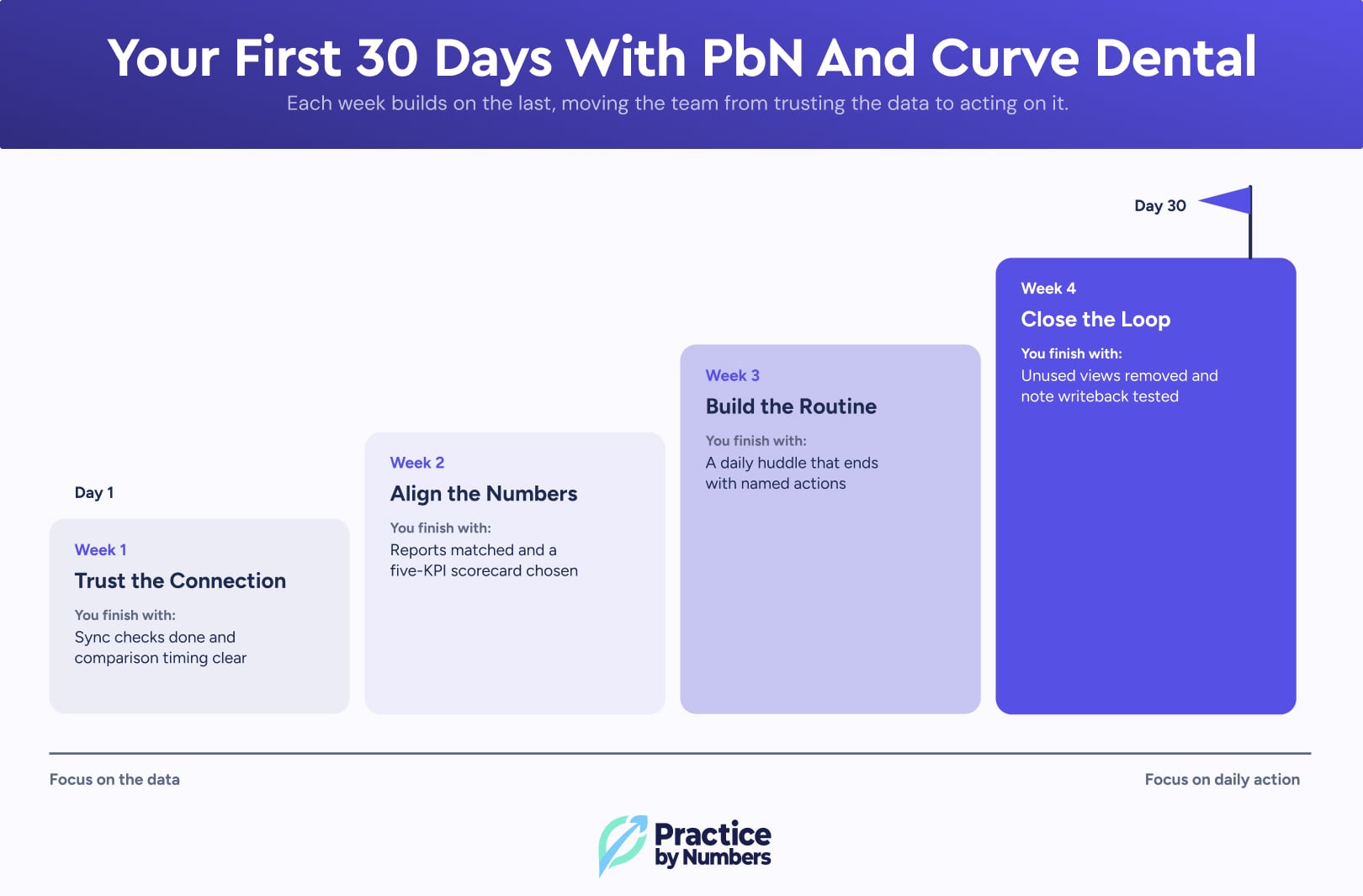
- The first 30 days with Practice by Numbers and Curve Dental should focus on turning connected data into consistent team workflows, not exploring every feature at once.
- Week 1: Validate patient, appointment, and financial data syncing between Curve Dental and PbN.
- Week 2: Align financial reports and establish a focused scorecard of five key performance indicators.
- Week 3: Introduce daily huddles, identify revenue opportunities, and assign clear follow-up responsibilities.
- Week 4: Review what works, simplify dashboards, and test patient note writeback.
- Understand which information is available in PbN and which details remain in Curve Dental.
- Measure success through clearer reporting, daily priorities, and consistent follow-through.
Week 1: Establish Trust in the Connection
The first week is about understanding how information moves.
PbN’s Curve Dental integration supports patient syncing, appointment and scheduling visibility, ledger and financial data for reporting, patient notes, and core reporting through Practice IQ and Revenue IQ. Patients, appointments, and ledger entries incrementally sync every 60 minutes. Other information refreshes in the full sync that runs daily at midnight in the practice’s PMS time zone.
Start with three checks:
1. Confirm that patients and appointments appear as expected.
2. Review the latest ledger activity after the incremental sync window.
3. Confirm that the overnight full sync has completed before reviewing data outside the incremental set.
For financial comparison, run the AR Daily Sync each morning so the prior day’s production, adjustments, collections, accounts receivable, and patient balances are updated in PbN.
Do not judge the integration by comparing two screens at random times. Compare the same period, clinics, and providers after the relevant sync has completed.
Week 2: Align the Numbers that Drive Decisions
Once the flow is understood, align the financial view.
Curve Hero provides multiple financial reporting experiences. PbN’s official guidance recommends comparing its metrics with reports under Curve Hero’s Financial Reports area:
- Production in PbN with Production Summary
- Adjustments in PbN with Adjustment Summary
- Collections in PbN with Collection Summary
- Accounts receivable in PbN with Responsible Party Aging Summary
Use the same date range, clinic selection, and provider filters in both systems.
One important detail is that collections are not always identical to the total payment line someone first notices. In Curve’s Collection Summary, collections account for payments, overpayments, and refunds. The purpose of this alignment exercise is not to decide which screen is “right.” It is to compare matching definitions and views.
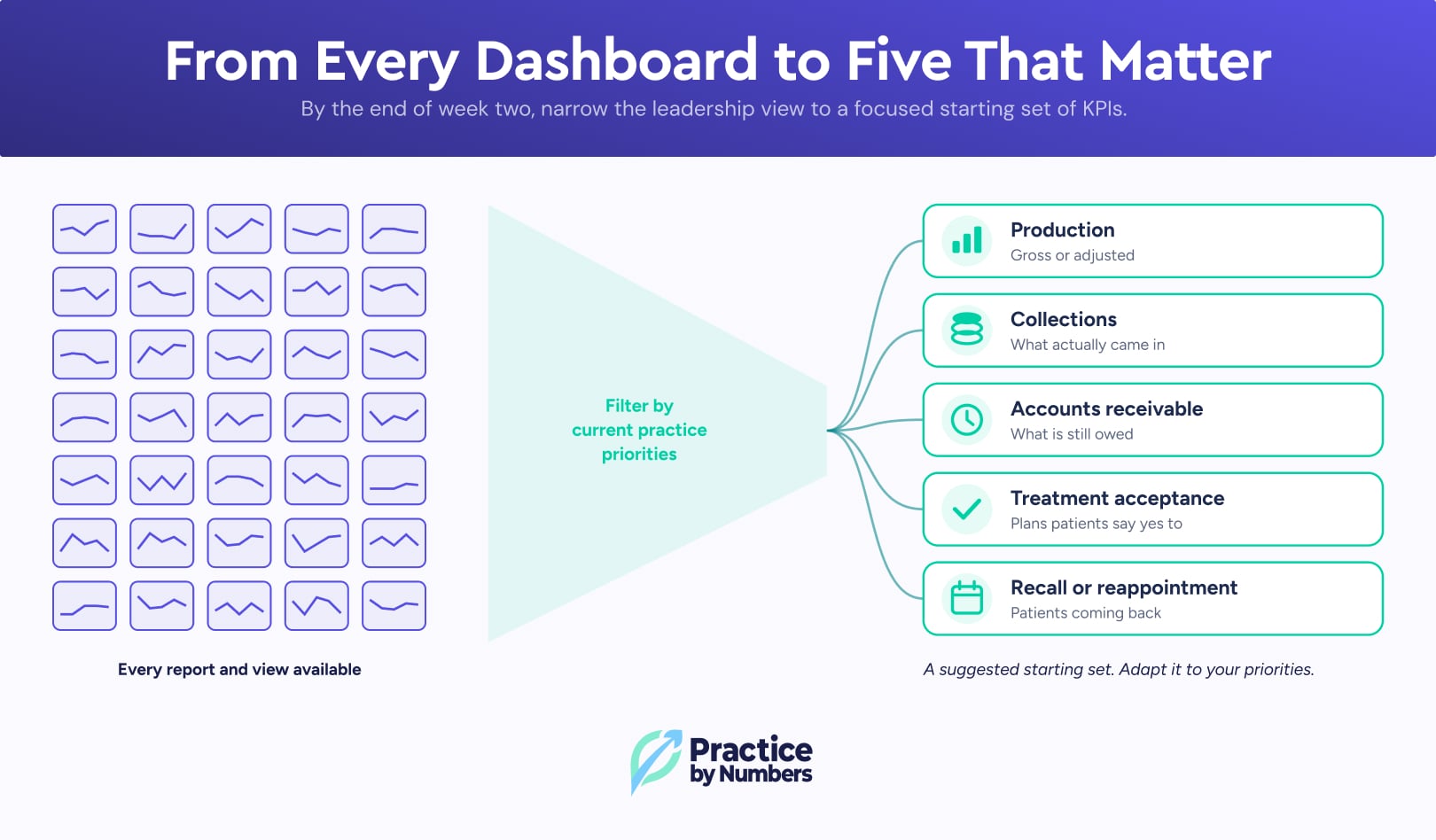
By the end of week two, choose five KPIs for the leadership view. A practical starting set is:
1. Gross or adjusted production
2. Collections
3. Accounts receivable
4. Treatment acceptance
5. Recall or reappointment performance
The exact scorecard should reflect the practice’s current priorities. Five useful metrics beat 50 metrics nobody acts on.
👉 See How Curve Dental and Practice by Numbers Work Together to Grow Your Dental Practice
Week 3: Turn the Dashboard Into a Team Routine
Now move from validation to behavior.
Use PbN’s Huddle to structure a short daily review. The conversation can follow four questions:
1. What changed since yesterday?
2. Where is today’s schedule exposed?
3. Which patients or opportunities need follow-up?
4. Who owns each action?
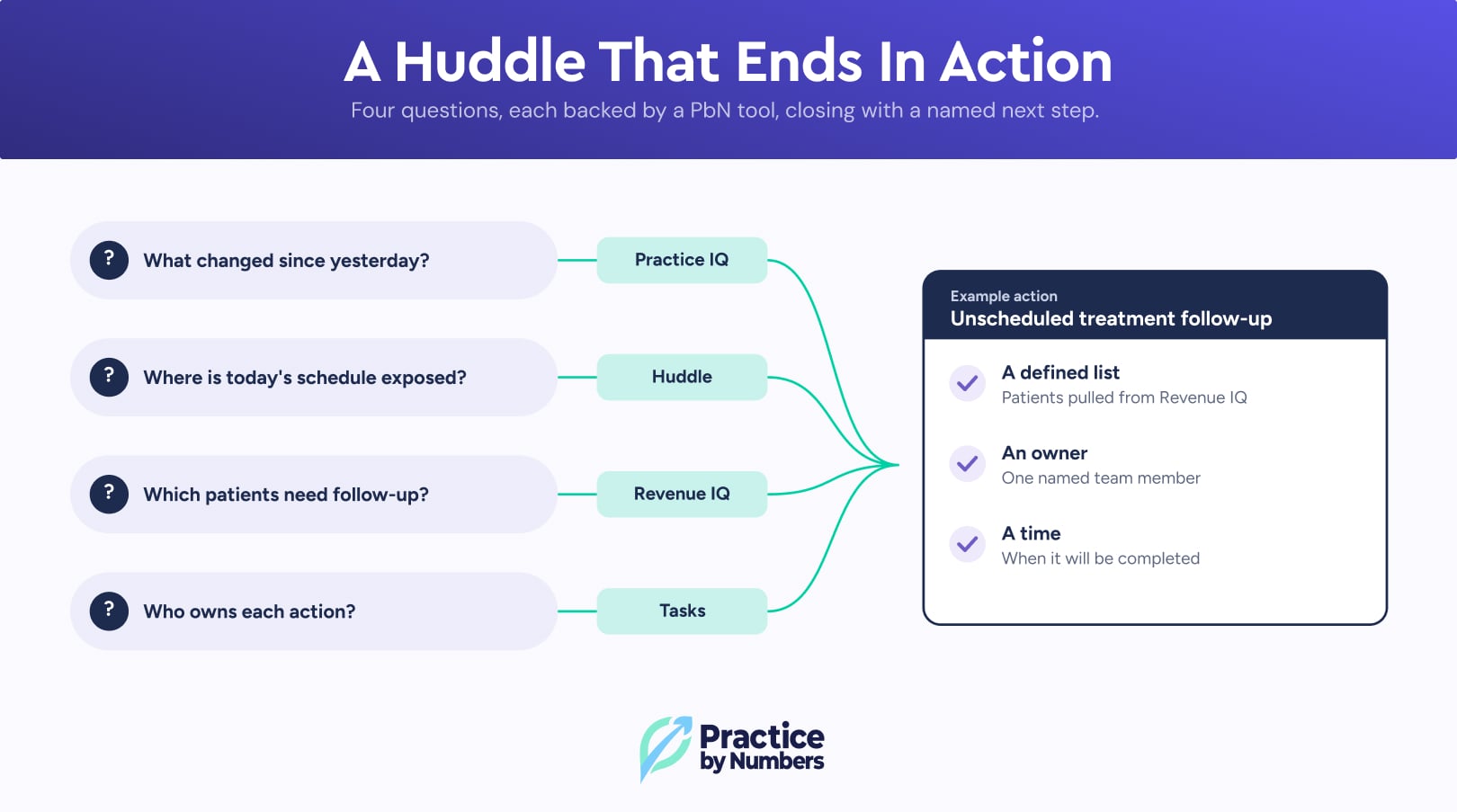
Practice IQ provides the performance view. Revenue IQ helps teams identify revenue opportunities and patient lists. Tasks create accountability. Together, those capabilities allow the huddle to end with named actions rather than general observations.
For example, if the team sees an opportunity in unscheduled treatment, the next step should not be “follow up when possible.” It should be a defined list, an owner, and a time for completion.
This is where PbN adds more than another report. It creates a bridge between Curve Dental data and the team’s daily execution.
Week 4: Close the Loop and Simplify
In week four, review what the team actually used.
Ask each role one question:
- Owner or dentist: Which view helped you make a better decision?
- Office manager: Which workflow improved visibility or follow-through?
- Front desk or billing team: Which patient list or task helped prioritize work?
Remove dashboards that do not support an active decision. Keep the core scorecard, daily huddle, and one or two focused revenue workflows.
Also test note writeback. Patient Notes and Task Notes created in PbN can be written back to the patient’s Notes section within Curve Dental. Those notes arrive untagged, which allows the practice to apply its preferred Curve Dental category if needed. This provides a sensible balance: connected documentation without imposing a generic tagging structure on the office.
Know What Stays in Curve Dental
A mature workflow also defines boundaries.
Some data is not currently available to PbN through Curve Dental’s API. Remaining insurance benefits, payment method details, patient referral sources, documents, recall types, dental conditions, and certain provider-to-fee-schedule relationships have specific availability limitations.
These do not prevent core PbN analytics, production and collection reporting, Revenue IQ, patient syncing, or KPI use. They simply tell the team where to look for deeper system-specific detail. For example, payment-type breakdowns and remaining benefits continue to be referenced in Curve Dental.
This is not a reason to avoid the integration. It is a reason to implement it intelligently.
The 30-day Success Test
At the end of the month, PbN should have changed the practice in four observable ways:
1. Leaders can see a focused set of performance measures without assembling reports manually.
2. The team begins the day with clearer priorities.
3. Revenue opportunities are connected to named follow-up actions.
4. The practice knows which information is viewed in PbN and which deeper details remain in Curve Dental.
If those four changes are visible, the integration is doing its job.
Practice by Numbers is a strong choice for Curve Dental because it respects the PMS workflow while giving the team a more actionable way to use its data. The first 30 days should not be a tour of features. They should be the beginning of a better operating system for the practice
👉 See 7 Reasons Why PbN Is a Strong Integration Choice for Curve Dental