As dental practices grow, roles that once overlapped often need to become more specialized. One of the most common areas of confusion is the difference between a dental office manager and a dental treatment coordinator.
In many solo or startup practices, one person may successfully handle both responsibilities. They answer phones, manage the schedule, discuss treatment plans, oversee billing, and keep the office running.
But as patient volume increases and the practice adds providers, combining these positions can create bottlenecks. Operational tasks become more urgent than revenue-generating conversations, patients delay treatment, and valuable production remains unscheduled.
Understanding where each role begins and ends helps practices improve efficiency, increase case acceptance, and create a better patient experience.
- The dental office manager oversees daily operations, team performance, billing, scheduling, compliance, and business systems.
- The treatment coordinator focuses on patient education, financial discussions, case acceptance, and converting diagnosed treatment into scheduled production.
- Small practices often combine both roles, but growing practices benefit from separating them.
- When responsibilities overlap, treatment conversations are frequently interrupted by operational issues, leading to lower case acceptance.
What Does a Dental Office Manager Do?
A dental office manager is responsible for keeping the business side of the practice running efficiently. Their role is less about individual patient treatment decisions and more about ensuring every part of the practice operates smoothly.
On any given day, an office manager may coordinate schedules, supervise administrative staff, resolve patient concerns, monitor collections, manage vendor relationships, and ensure compliance with healthcare regulations. They are also responsible for identifying operational inefficiencies and implementing systems that improve productivity.
Typical responsibilities include:
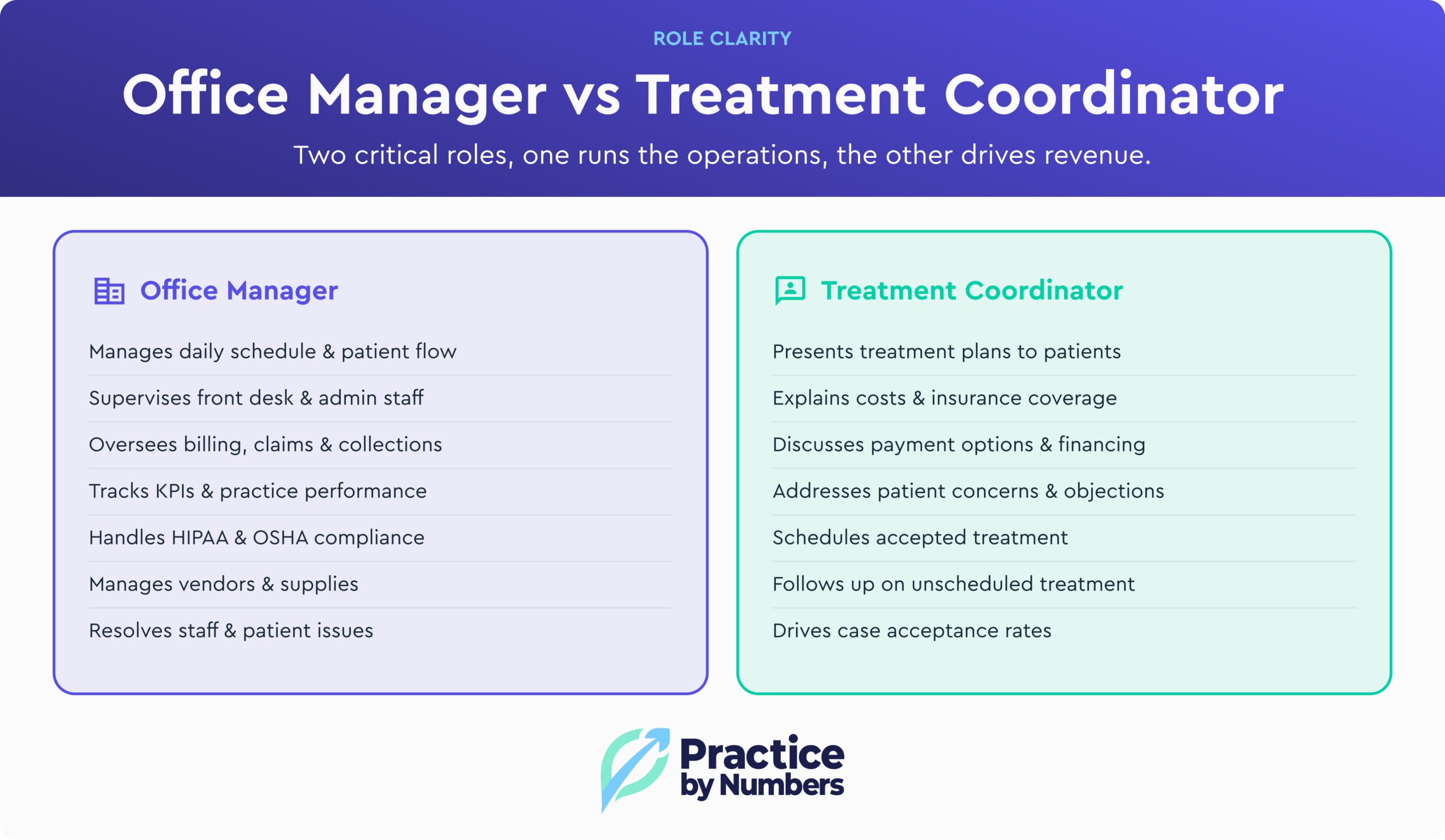
- Managing daily schedules and patient flow
- Supervising front desk and administrative teams
- Overseeing billing, insurance processes, and collections
- Monitoring operational KPIs and financial performance
- Maintaining compliance with OSHA, HIPAA, and other regulations
- Managing inventory, vendors, and office supplies
- Resolving staffing and patient service issues
- Supporting hiring, onboarding, and team development
Because the office manager influences nearly every department, their success is measured by how efficiently the practice operates.
Common KPIs include:
- Collection rate
- Schedule utilization
- Staff productivity
- Accounts receivable
- Patient wait times
- Overall operational efficiency
Simply put, the office manager keeps the practice organized so providers and staff can focus on delivering excellent patient care.
👉 How Do You Reactivate Lapsed Dental Patients? A Step-by-Step Playbook
What Does a Dental Treatment Coordinator Do?
While the office manager focuses on operations, the dental treatment coordinator focuses on helping patients move forward with care. After the dentist diagnoses treatment, the coordinator becomes the patient’s primary guide. Their job is to ensure patients understand their recommended care, feel confident in their decisions, and have a clear financial path to treatment.
This role requires a combination of communication skills, empathy, financial knowledge, and follow-up discipline.
Typical responsibilities include:
- Reviewing treatment plans after the doctor’s diagnosis
- Explaining procedures in patient-friendly language
- Discussing insurance estimates and out-of-pocket costs
- Presenting financing and payment options
- Addressing patient questions and concerns
- Scheduling accepted treatment
- Following up with patients who postpone or delay care
- Keeping diagnosed treatment from remaining unscheduled
Unlike an office manager, whose work focuses on keeping the practice running efficiently, a treatment coordinator directly influences production by helping patients move from diagnosis to scheduled care.

Common KPIs include:
- Case acceptance rate
- Dollar value of scheduled treatment
- Unscheduled treatment value
- Treatment follow-up conversion rate
- Average time from diagnosis to scheduling
An effective treatment coordinator doesn’t pressure patients into treatment, they remove uncertainty, answer questions, and help patients make informed decisions.
Where the Roles Overlap
Although these positions have different primary objectives, there are several areas where they naturally intersect. Both roles regularly communicate with patients, coordinate appointments, understand insurance benefits, and work closely with the front office team. In many smaller practices, one employee successfully manages both responsibilities.
The challenge appears as the practice grows. Operational responsibilities are reactive. Staffing issues, phone calls, insurance questions, schedule changes, and patient concerns require immediate attention.
Treatment coordination is proactive. It requires uninterrupted conversations, thoughtful follow-up, and consistent communication with patients who may need time to make financial decisions.
When one person is responsible for both, urgent operational demands almost always take priority.
A phone rings. An insurance claim is denied. A staff member calls out sick. A scheduling conflict appears. Meanwhile, the patient who needed a 20-minute treatment consultation leaves without scheduling.
Over time, these missed conversations create a growing backlog of diagnosed but unscheduled treatment, one of the largest sources of lost production for many dental practices. This is why many growing practices eventually separate the two positions.
👉 See How Patient Relationship Management Boosts Practice Revenue
When to Split the Roles
For many solo practices with modest patient volume, combining both positions is perfectly reasonable. However, certain signs indicate it’s time to separate the responsibilities.
Consider hiring a dedicated treatment coordinator if:
- Your case acceptance rate consistently falls below 60%
- Large amounts of diagnosed treatment remain unscheduled
- Your office manager rarely has uninterrupted time for financial conversations
- Patients frequently leave without booking recommended treatment
- Your practice has grown to multiple providers or higher patient volume
- Follow-up on pending treatment is inconsistent or rarely happens
For many practices, this decision becomes a financial investment rather than an added expense.
Imagine your practice diagnoses $500,000 in treatment annually. If your case acceptance improves from 55% to 70%, that’s an additional $75,000 in scheduled production, often exceeding the annual cost of employing a dedicated treatment coordinator.
More importantly, patients receive recommended care sooner, creating better clinical outcomes alongside stronger practice performance.
👉 How Top Practices Turn More Calls Into Appointments
How Practice by Numbers Supports Both Roles
Whether one person wears both hats or your practice has separate office managers and treatment coordinators, success depends on visibility. Without clear reporting, it’s difficult to know whether declining production is caused by fewer diagnoses, lower case acceptance, or treatment simply sitting unscheduled.
Practice by Numbers helps both roles focus on what matters most.
Practice IQ tracks critical production metrics, including:
- Case acceptance rate
- Value of unscheduled treatment
- Production trends
- Scheduling performance
Instead of relying on assumptions, teams can quickly identify exactly how much diagnosed treatment remains unbooked and where follow-up is needed.
Daily Huddle prepares the team before patients even arrive.
It highlights patients with existing treatment plans, outstanding balances, or pending follow-up opportunities so the team can plan meaningful financial conversations instead of discovering missed opportunities after the appointment ends.
When office managers have operational visibility and treatment coordinators have actionable patient insights, both roles can perform more effectively without competing for time.