A dental management information system (DMIS) is the layer of your practice technology that collects, organizes, and presents operational data. While a standard PMS handles day-to-day tasks like scheduling and billing, a DMIS focuses on what the data from those tasks is telling you about the health and direction of your practice.
In modern dentistry, practices generate enormous amounts of operational data every day, from patient scheduling patterns and insurance reimbursements to provider productivity and treatment acceptance trends. The challenge is not collecting the data. The challenge is turning it into useful insight.
That is where a DMIS becomes critical.
Practices that operate without meaningful analytics often discover problems too late: declining collections, rising cancellations, underperforming providers, or shrinking recall effectiveness. A DMIS helps practices detect those patterns early, understand why they are happening, and take corrective action before profitability suffers.
For practices focused on sustainable growth, operational visibility is no longer optional. It is a competitive advantage.
TL;DR
A dental management information system (DMIS) helps practices move beyond basic reporting and into true operational intelligence. Unlike a traditional practice management system (PMS), which records transactions, a DMIS analyzes practice data to uncover trends, inefficiencies, growth opportunities, and revenue risks.
With the right DMIS, dental practices can:
- Identify production and collection gaps earlier
- Improve scheduling efficiency and chair utilization
- Understand patient retention and case acceptance trends
- Forecast cash flow and future performance
- Benchmark performance against industry standards
- Make proactive, data-driven business decisions instead of reactive ones
As dentistry becomes increasingly data-driven in 2026, practices using operational analytics consistently outperform those relying solely on static monthly reports or intuition.
What a DMIS Does Differently Than a PMS
A practice management system records transactions: appointments booked, procedures completed, claims submitted, payments received. A management information system analyzes those transactions to surface patterns, trends, and insights.
The distinction matters because running a practice on transaction data alone is like driving by only looking at the speedometer. You know how fast you are going, but you have no visibility into fuel level, engine temperature, or the road ahead.
A DMIS provides that broader view: how production is trending month over month, which providers are most efficient, where revenue is leaking in the billing cycle, which patient segments are growing or shrinking, and how scheduling utilization compares to capacity.
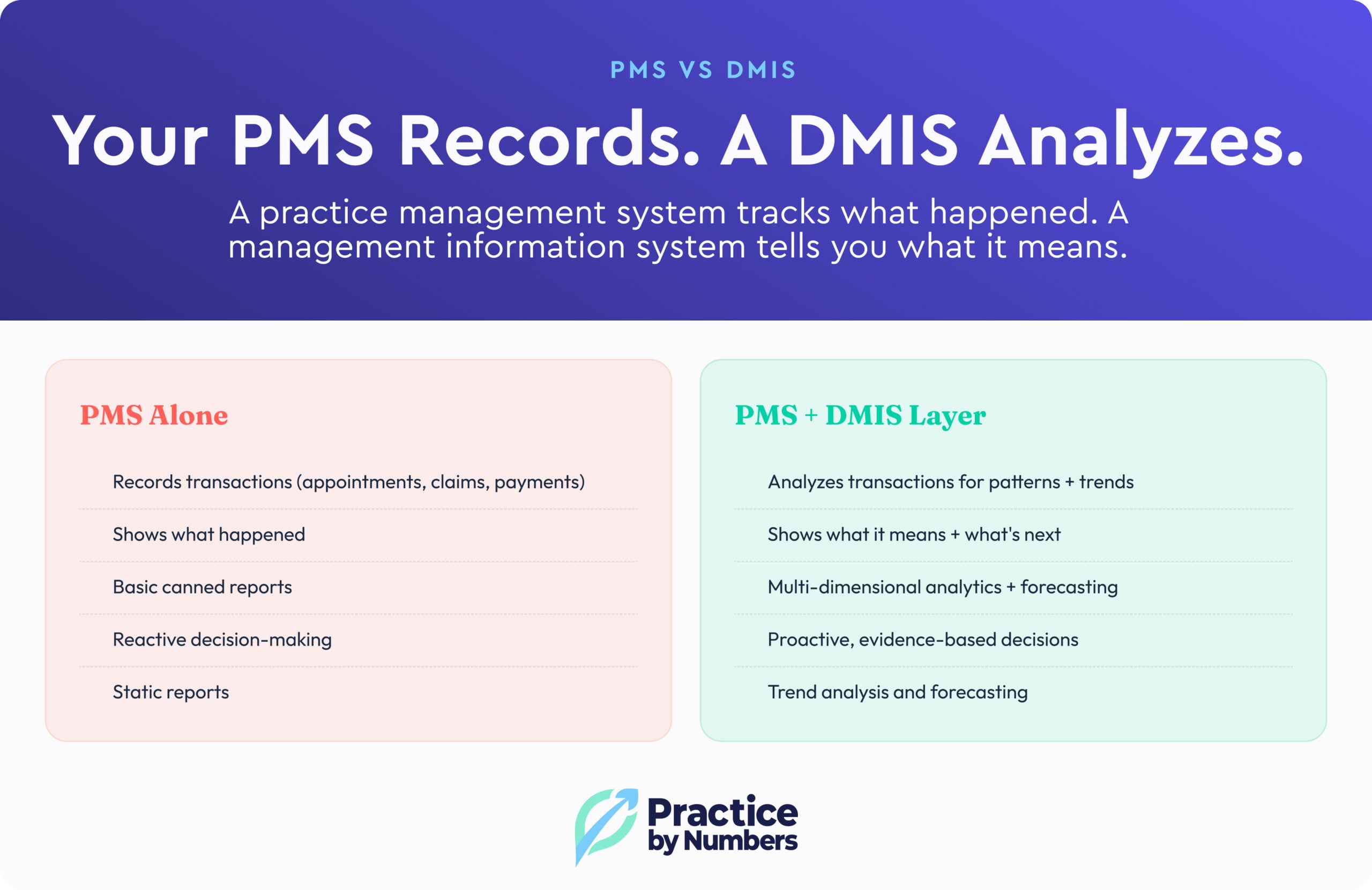
A PMS tells you what happened. A DMIS helps explain why it happened, whether it matters, and what to do next.
That distinction becomes increasingly important as practices scale, add providers, expand locations, or try to improve profitability in a competitive market.
Key Capabilities of a Dental Management Information System
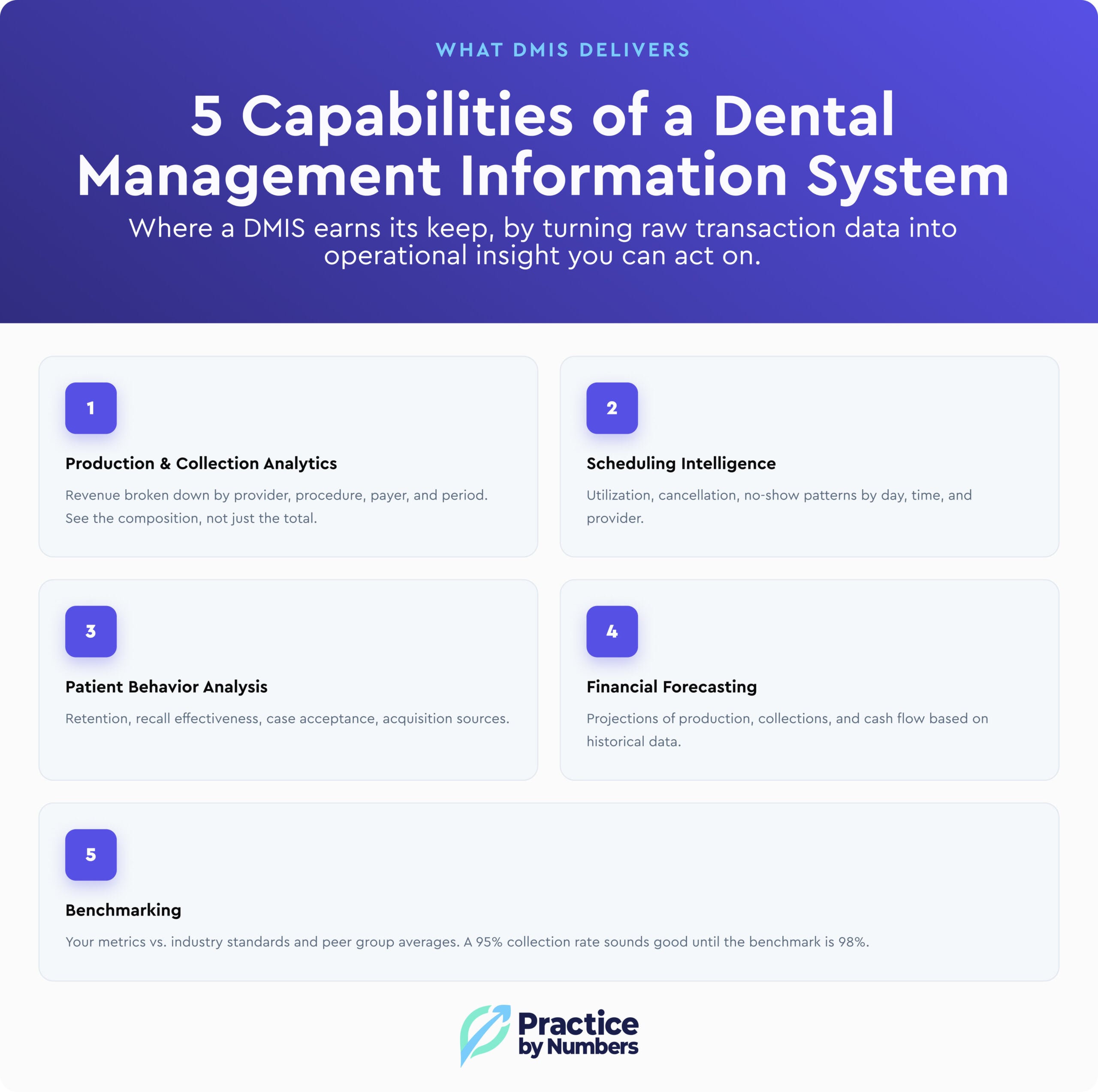
A dental management information system does more than generate reports, it helps practices understand the operational story behind their data. From revenue performance and scheduling efficiency to patient retention and financial forecasting, these capabilities give practices the visibility needed to improve decision-making, reduce inefficiencies, and drive long-term growth.
1. Production and Collection Analytics
Production and collection analytics break down revenue by provider, procedure, payer, and time period. Instead of a single monthly production number, you see the composition behind it, which services drive revenue, which underperform, and where collection rates lag.
Advanced analytics also help practices identify:
- High-value procedures with low case acceptance
- Insurance plans with poor reimbursement performance
- Providers with unusually high adjustment rates
- Revenue concentration risks tied to specific procedure categories
- Seasonal fluctuations in production patterns
This level of visibility allows owners and office managers to make operational adjustments with far greater precision.
For example, if restorative production remains high but collections decline, the issue may not be clinical productivity at all, it may be insurance follow-up inefficiencies or delayed claim submissions.
2. Scheduling Intelligence
Scheduling intelligence shows utilization rates, cancellation patterns, and no-show frequencies by day, time, and provider. This data helps optimize the schedule for maximum production rather than just maximum bookings.
A strong scheduling analytics system can reveal:
- Underutilized provider hours
- Peak cancellation windows
- Appointment types that consistently run over time
- Hygiene gaps affecting restorative opportunities
- Seasonal demand fluctuations
- Chair utilization inefficiencies
Many practices unknowingly operate below optimal schedule efficiency. Even a small increase in chair utilization can significantly impact annual revenue without adding additional providers or operatories.
Scheduling insight also improves patient experience. By understanding appointment flow and timing trends, practices can reduce delays, improve patient punctuality, and create more predictable clinical operations.
👉 Streamline Dental Office Communication & Scheduling
3. Patient Behavior Analysis
Patient behavior analysis reveals retention rates, recall effectiveness, case acceptance by procedure type, and patient acquisition sources. Understanding how patients move through your practice and where they drop off drives targeted improvements.
This area is especially valuable because patient behavior directly impacts long-term profitability.
A DMIS can help practices answer questions such as:
- Which marketing channels attract the highest-value patients?
- What percentage of patients fail to return after their first visit?
- Which providers achieve the highest treatment acceptance rates?
- How effective are recall campaigns?
- Which patient demographics show the strongest retention?
- Where in the patient journey does attrition occur most frequently?
For example, if hygiene recall compliance begins declining, restorative production may decline several months later. A DMIS helps practices identify these leading indicators before revenue is affected.
4. Financial Forecasting
Financial forecasting uses historical data to project future production, collections, and cash flow. Practices using forecasting can anticipate slow periods, plan for capital expenditures, and set realistic growth targets.
Forecasting improves financial stability by helping practices:
- Predict future revenue trends
- Prepare for seasonal fluctuations
- Manage payroll and staffing decisions
- Plan equipment purchases strategically
- Evaluate expansion opportunities with more confidence
- Monitor profitability projections in real time
Instead of reacting to cash flow issues after they occur, practices can proactively prepare for them.
Forecasting also becomes increasingly important for multi-location practices and DSOs, where operational complexity makes manual planning difficult.
👉 See How to Fight Back The Economic Squeeze on Dental Practices
5. Benchmarking
Benchmarking compares your metrics against industry standards or peer group averages. A 95% collection rate sounds good in isolation. Against a peer benchmark of 98%, it highlights an improvement opportunity worth tens of thousands of dollars annually.
Benchmarking helps practices evaluate performance objectively rather than emotionally.
Important benchmark categories include:
- Production per provider
- Collection percentage
- Hygiene reappointment rate
- Treatment acceptance rate
- Overhead percentage
- Accounts receivable aging
- New patient conversion rate
- Cancellation and no-show percentages
Benchmarking also creates accountability across teams because performance is measured against measurable standards rather than assumptions.
Platforms like Practice by Numbers are built around this information layer, providing analytics depth that legacy PMS platforms typically cannot match without third-party add-ons.
How Operational Insight Changes Decision-Making
Without a DMIS, practice decisions rely on gut feeling, anecdote, and end-of-month surprises. With one, decisions are evidence-based and proactive.
A practice owner who sees a declining case acceptance trend over three months can investigate and intervene before it becomes a revenue problem. A manager who notices that Tuesday mornings consistently underperform can restructure the schedule or marketing to address the gap. A billing team that identifies a specific payer with a 15% denial rate can adjust coding or verification practices for that payer.
The shift from reactive to proactive management is the primary value of a DMIS. Problems get smaller when you catch them early. Opportunities get bigger when you spot them before your competitors do.
Common Signs Your Practice Needs a Better Information System
Many practices already have access to data but still lack actionable insight. Common indicators include:
- You rely heavily on spreadsheets for reporting
- Monthly reports feel outdated by the time you review them
- You cannot easily identify why production fluctuates
- Scheduling inefficiencies continue unresolved
- Insurance collections feel inconsistent
- Patient retention trends are unclear
- Team accountability is difficult to measure
- Operational decisions rely mostly on instinct
If any of these issues sound familiar, your practice likely needs stronger management information capabilities.
👉 The Complete Guide to AI in Dentistry: How PbN AI Transforms Practice Management
Key Takeaways
- A DMIS analyzes practice data to provide operational insight beyond what a standard PMS shows.
- Core capabilities include production analytics, scheduling intelligence, patient behavior analysis, and financial forecasting.
- Benchmarking puts your metrics in context against industry standards and peers.
- The primary value is proactive, evidence-based decision-making.
- Practices using management information systems consistently outperform those relying on gut feeling and monthly reports alone.
Frequently Asked Questions
Q. Do I need a separate DMIS or does my PMS include this?
Most PMS platforms include basic reporting. True management information system capabilities includes trend analysis, forecasting, benchmarking, and multi-dimensional analytics, typically require either an advanced PMS or a dedicated analytics layer.
Q. Is a DMIS only useful for large practices or DSOs?
No. Solo practices benefit from the same data-driven insights. The scale of the data differs, but the value of understanding trends, benchmarks, and operational patterns applies regardless of practice size.
Q. How long does it take to see value from a DMIS?
Most practices start seeing actionable insights within the first month. The compounding value: catching trends, preventing revenue leaks, optimizing operations, builds over 3-6 months as historical data accumulates.