The front desk is where first impressions are made. It’s also where most practices lack visibility. There’s no daily metrics dashboard. No real-time feedback on call answer times or appointment booking rates. No data showing which team members are excelling and which are struggling. So management becomes reactive: a patient complains about wait times, a provider notices appointment no-shows are up, or a team member seems overwhelmed.
By then, the problem is already costing money. Here’s why that happens, and how to shift to proactive management.
- Most dental practices manage front-desk performance reactively because they lack daily visibility into key operational metrics.
- Problems often surface only after patients complain, appointments go unbooked, or production declines.
- Delayed response increases lost revenue, missed opportunities, and staff frustration.
- Proactive practices track key front-desk KPIs daily, including call handling, booking rates, no-shows, and patient experience metrics.
- Individual coaching based on data is more effective than relying on assumptions or anecdotal feedback.
- Consistent review rhythms including daily huddles, weekly coaching, and monthly performance reviews, help identify issues before they become costly.
- AI-powered call intelligence and operational analytics can help practices uncover coaching opportunities, monitor trends, and improve team performance at scale.
How Most Practices End Up Managing Front Desk Reactively
It’s not intentional. It usually goes like this:
Year 1: Practice is small. The owner or manager sees and hears the front desk every day. Problems are obvious and get addressed immediately.
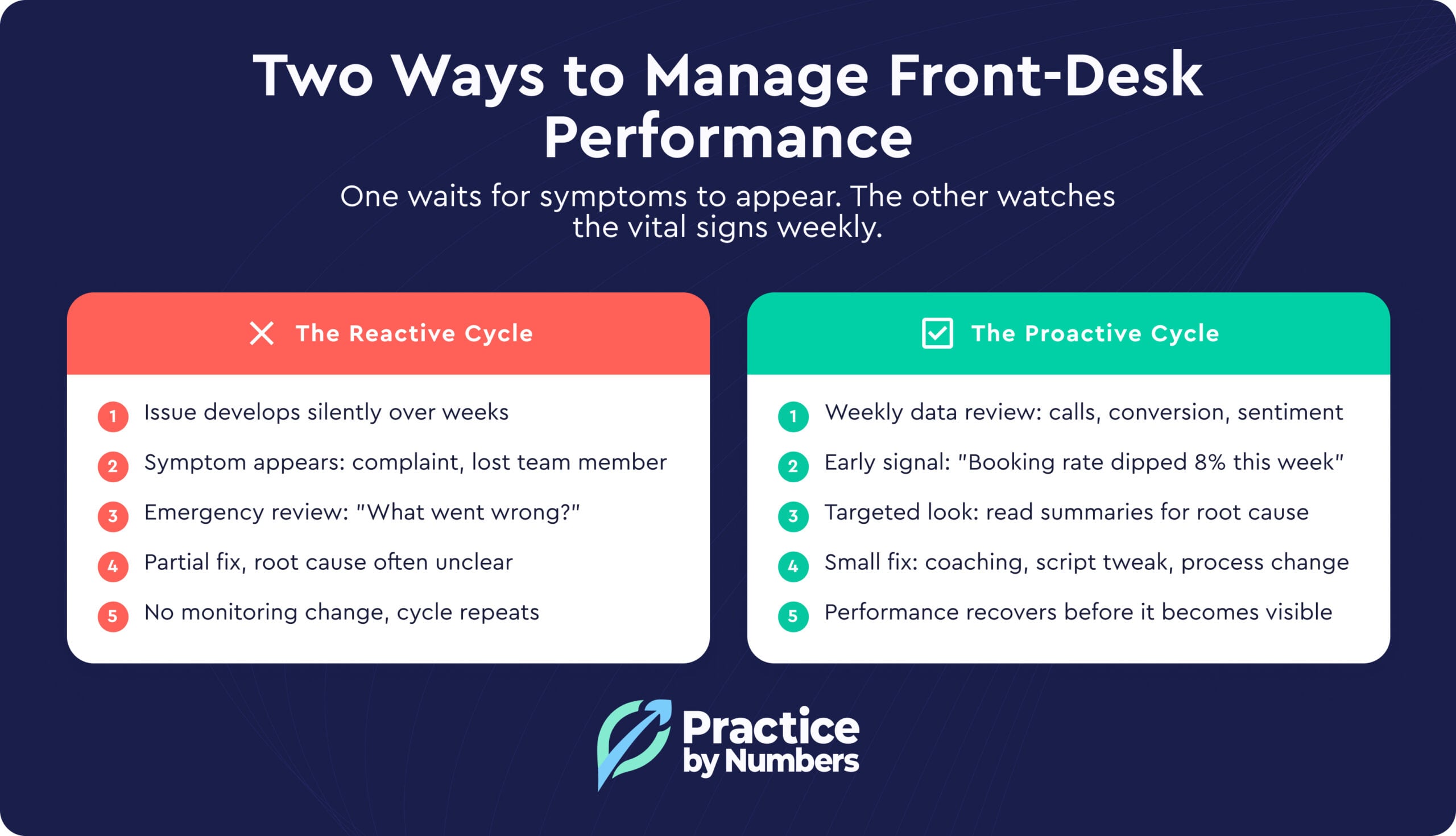
Year 2-3: Practice grows. Providers are busier. Management spends more time on treatment. The front desk operates without daily oversight. Nobody is tracking call metrics. Performance management becomes “I heard from a patient…” or “That was a tough day, someone didn’t book enough calls.”
Year 4+: Front desk team is bigger. Performance is inconsistent. The owner/manager has no idea which team members are strong and which are struggling. Problems bubble up as complaints, not as metrics. By then, it’s too late to address the behavior before the damage is done.
This is reactive management. It works when everything is going well, but catastrophically fails when someone underperforms.
What Reactive Front Desk Management Cost Practices?
The greatest cost of reactive management is not the problem itself. It’s the delay. Every day a performance issue goes unnoticed creates additional operational loss. Common hidden costs include:
Lost New Patients: Slow response times, missed calls, and weak scheduling conversations reduce appointment conversions. Patients increasingly expect immediate access and quick communication. If they don’t receive it, they often move on.
Increased No-Shows: Breakdowns in confirmation workflows and patient communication contribute to empty chair time. Without visibility, these trends can continue for weeks before being noticed.
Team Burnout: When performance issues aren’t identified early, stronger team members often compensate for weaker processes. This creates frustration, inconsistency, and eventually turnover.
Revenue Leakage: Small inefficiencies compound quickly:
- Missed calls
- Unscheduled treatment
- Poor follow-up processes
- Lost reactivation opportunities
- Underutilized provider schedules
Individually, these issues appear minor. Collectively they can significantly affect practice growth.
Let’s look at a simple example: Answer speed.
If your front desk is answering calls after the 4th ring instead of the 2nd, you’re losing about 20-30% of conversions just from that. A practice sees approximately 200 inbound calls per month. 30% of those is 60 calls. If the average new patient value is $800, you’re leaving $48,000 on the table annually from slow answer times alone.
And if you find this problem after three months, you’ve already lost $12,000. If you catch it in week one because you’re tracking answer speed daily, you lose maybe $500 before fixing it.
That’s the cost of reactive management. By the time you notice the problem, revenue has disappeared.
👉 How Do You Reactivate Lapsed Dental Patients? A Step-by-Step Playbook
The Shift From Reactive to Proactive Front Desk Management
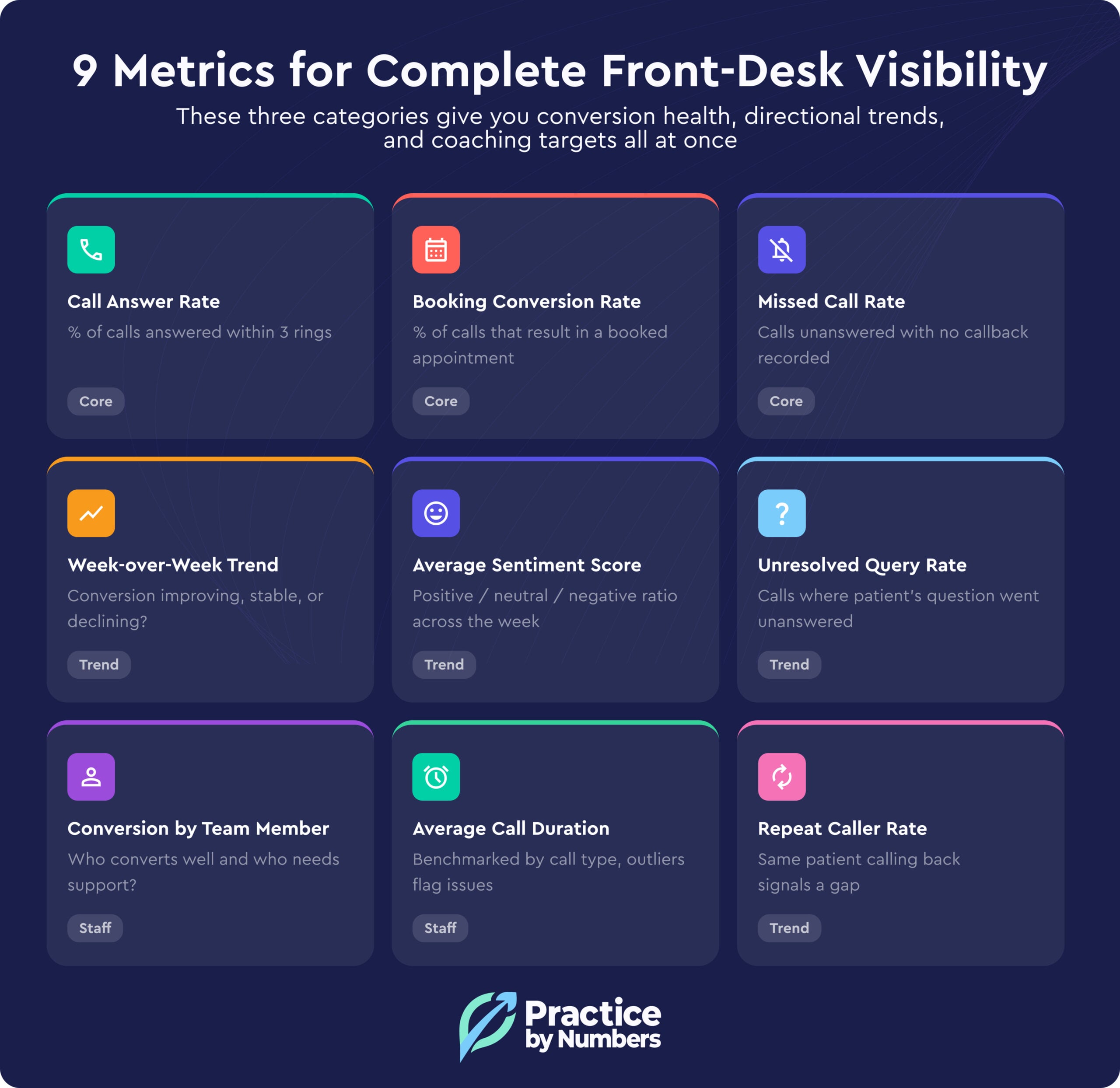
Proactive management is not about monitoring every action. It’s about creating systems that reveal trends early.
1. Start With Visibility
Start by identifying the metrics that directly affect patient experience and revenue. These include:
- Call answer rate
- Missed call volume
- Appointment booking rate
- Call-to-appointment conversion rate
- No-show percentage
- Schedule fill rate
- Patient wait time during check-in
- Unscheduled treatment follow-up performance
These metrics provide an objective view of performance rather than relying on assumptions.
Then get these metrics visible daily, in a dashboard, a team huddle report, or a simple spreadsheet. Not weekly. Daily. So you catch trends immediately.
👉 What Are the 5 Benchmarks Every Dental Practice Should Know and Set?
2. Make It Personal
Team goals are important. Individual clarity is more powerful.
Instead of saying: “We need to improve booking performance.”
Say: “Your booking rate is currently 72%. Our target is 80%. Let’s identify what support will help you get there.”
Specific goals drive measurable improvement. They also make coaching more constructive because discussions focus on behaviors rather than opinions.
When metrics are attached to specific people, behavior changes. And it’s all about enhancing clarity. Most front desk staff have no idea how they’re actually performing. Show them the numbers, and they care about improving them.
3. Coach, Don’t Judge
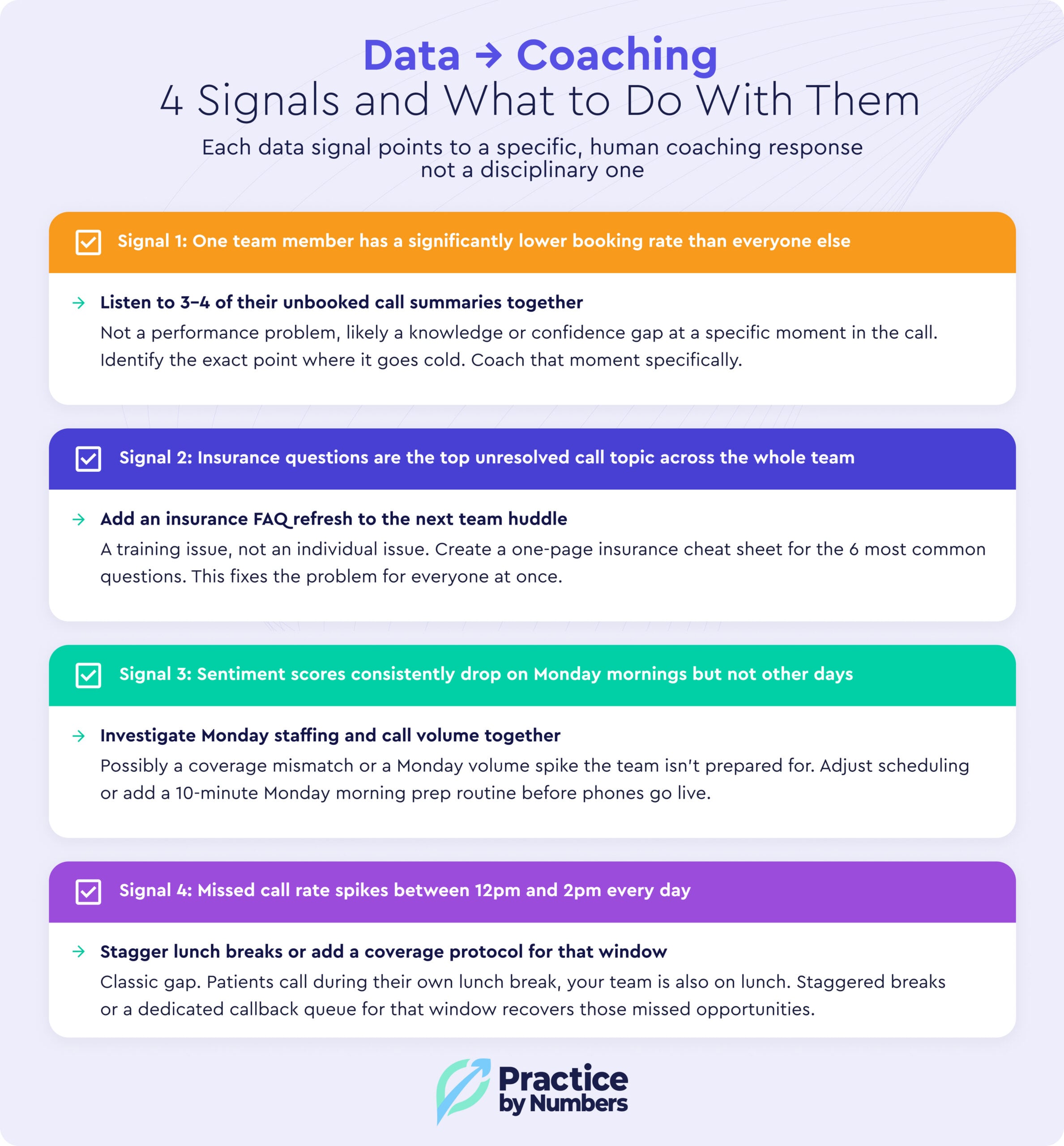
Data should start conversations, not end them. When performance declines, avoid assumptions. Instead ask:
- What obstacles are slowing response times?
- Are staffing levels adequate?
- Are workflows creating bottlenecks?
- Are certain call types more challenging?
- Does additional training help?
The goal is to uncover root causes and remove barriers. Strong coaching improves performance while maintaining trust.
If someone’s answer speed is slow, the conversation isn’t “you’re taking too long to answer.” It’s “I noticed answer times are dipping, and I want to understand why.
Different root causes have different solutions.
What Does a Proactive System Actually Look Like?
The difference between reactive and proactive management isn’t the quality of the team, it’s the quality of the system. High-performing dental practices don’t wait for patient complaints or production declines to reveal problems. They follow a structured process for reviewing metrics, coaching staff, and monitoring trends on an ongoing basis.
Daily huddle (5 minutes): Team reviews yesterday’s metrics. “We had 23 calls, booked 18. Answer speed was 2.1 rings average. No-shows were 2. Today’s goal: 20+ calls, 16+ bookings.” That’s it. Visibility. Accountability. Direction.
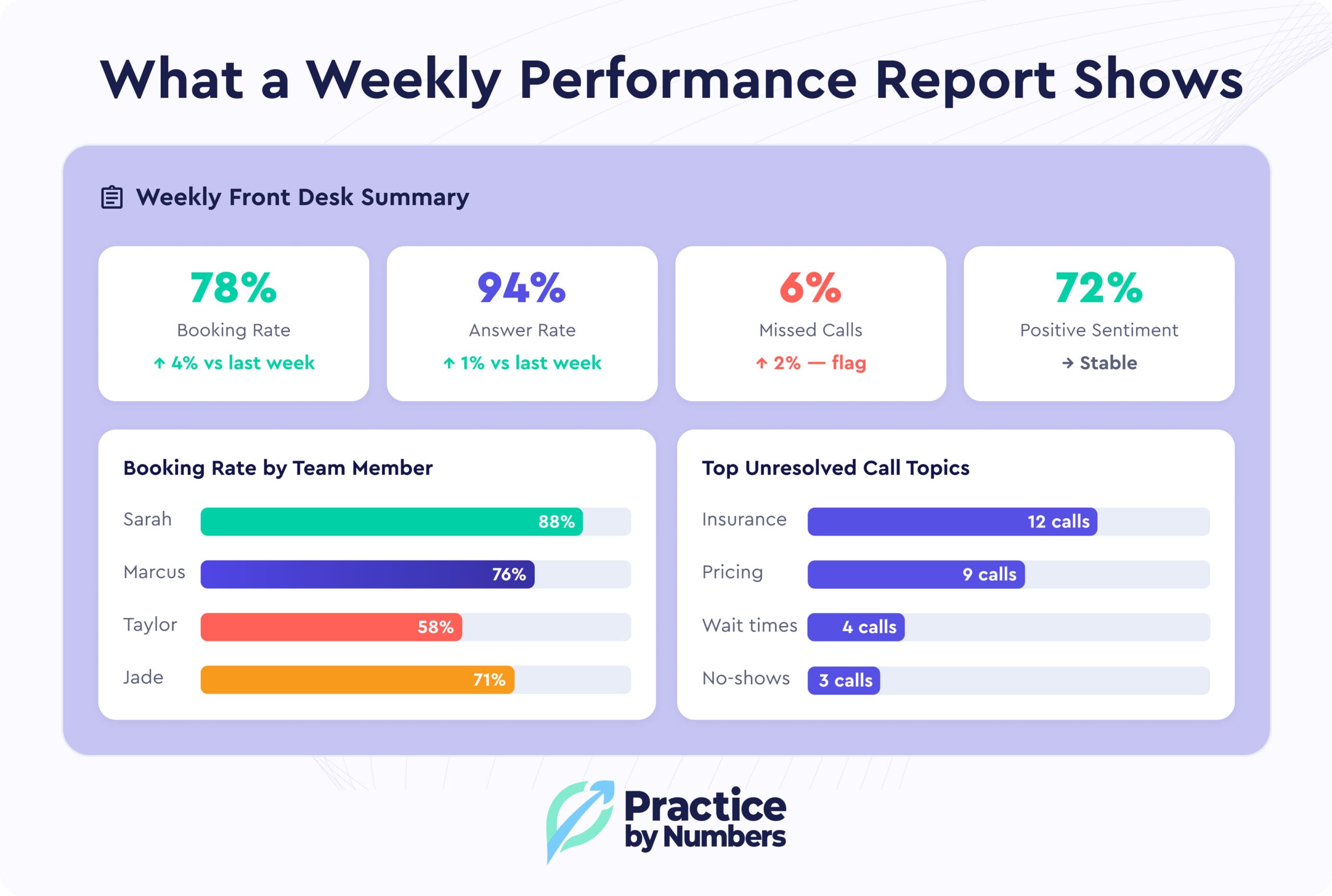
Weekly one-on-ones: Manager reviews individual metrics with each front desk staff member. Celebrates wins, addresses trends, removes barriers. “Hey Marcus, I noticed your booking rate jumped to 85% this week. What changed? Let’s keep that going.”
Monthly coaching: Deeper conversation on patterns. “Over the past month, we’re seeing a drop-off in calls on Tuesdays and Thursdays. Let’s brainstorm what that might be. Is it scheduling-dependent? Staffing?”
Monthly review with leadership: Production, no-show trends, team turnover, and insights from front desk data. How is front desk performance affecting overall practice production?
👉 How to Diagnose Front-Desk Conversion Loss Without Listening to a Single Recording
The Biggest Obstacle to Proactive Management
Time. Managers think they don’t have time to track metrics or have daily standups. But reactive management takes more time. You’re troubleshooting problems after they’ve already damaged the practice.
A 5-minute daily standup that catches issues early saves hours of firefighting later.
The other obstacle: You don’t have the data easily accessible. If getting your call metrics requires pulling reports from three different systems, it won’t happen daily. That’s why the tool matters. Data visibility solves half of this problem.
How Practice by Numbers Enables Proactive Front-Desk Management
Moving from reactive to proactive management requires more than good intentions, it requires visibility into what’s happening at the front desk every day.
Practice by Numbers helps practices gain that visibility through Call AI, Performance Reporting, and Call Outcome Tracking. Together, these capabilities help teams understand how patient calls are being handled, monitor booking performance, identify trends, and uncover coaching opportunities before they impact production or patient experience.
With better insight into call activity and outcomes, practices can:
- Spot performance trends before they become bigger issues
- Identify missed opportunities and scheduling gaps
- Support front-desk staff with data-driven coaching
- Measure improvement over time, not just isolated incidents
- Make decisions based on objective performance data instead of assumptions
The goal isn’t to monitor every interaction, it’s to create enough visibility to catch problems early, recognize what’s working, and help the front desk operate more consistently.