Your billing looks fine on the surface. You’re seeing patients. You’re treating them. Production numbers are solid. But somewhere between treatment completion and collection, revenue is disappearing.
Not from bad decisions. From complexity. Dental billing has more moving parts than most business owners realize, including insurance rules, treatment codes, claim timelines, patient balances, and coordination of benefits. When you’re managing all of that manually, things fall through the cracks. Money slips away quietly.
Here’s where it happens, and how to find it.
TL;DR
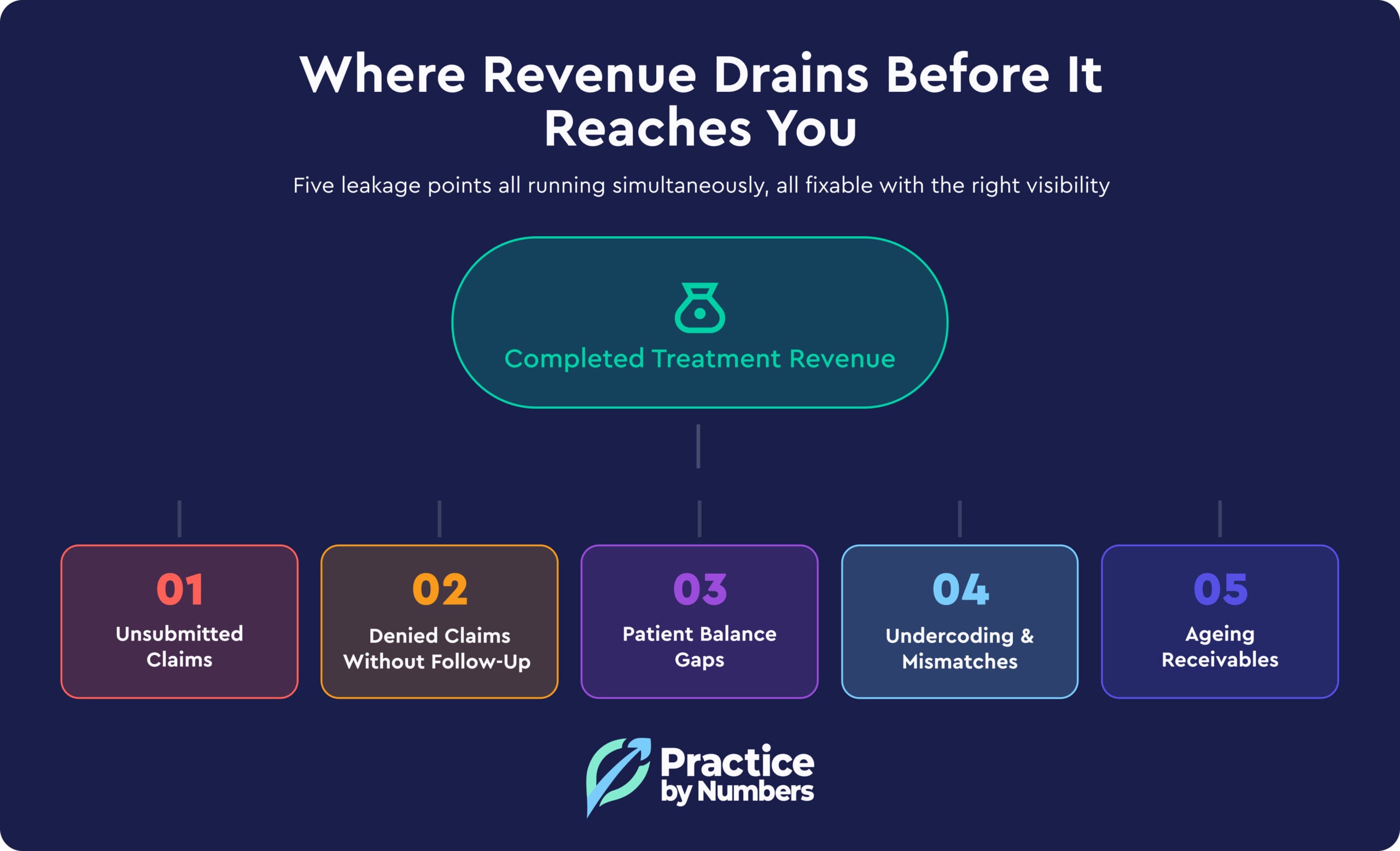
- Revenue leakage in dental practices isn’t usually one big problem. It’s five small ones happening at the same time, all fixable once you know what to look for.
- The 5 most common leakage points are:
- Unsubmitted claims that never enter the collection pipeline
- Denied claims with no follow-up or resubmission
- Patient balances that remain unpaid after treatment
- Undercoding or billing mismatches that reduce collections
- Aging receivables that sit too long without action
- Each leak seems small individually. Together, they typically cost a mid-size practice a lot per month in uncollected revenue. The fix isn’t harder billing processes, it’s visibility into where money is actually going.
Your Revenue Pipeline Has More Exit Points Than You Think
Revenue should move predictably from completed treatment to collected payment. In reality, it rarely does.
Between providing care and collecting revenue, every practice moves through a series of operational steps like insurance verification, claim creation, claim submission, patient billing, collections, follow-ups, payment posting, and reconciliation. Each step introduces opportunities for delays, mistakes, or missed actions that slow down cash flow.
More often, it comes from small inefficiencies happening repeatedly across multiple stages of the billing process. Individually, these issues may seem minor. Collectively, they create significant revenue loss.
This is what makes billing leakage particularly difficult to solve. The problem is not simply that leaks exist. It is that many practices lack visibility into where they are happening, how frequently they occur, and which processes are creating the largest financial impact.
Understanding where revenue exits your pipeline is the first step toward building a healthier and more predictable collections process.
👉 Learn How to Streamline Collections and Cash Flow
What Are the 5 Most Common Leakage Patterns?
Revenue leakage becomes easier to solve when viewed as a systems problem rather than isolated incidents. Most collection issues tend to fall into a few predictable categories that create friction throughout the revenue cycle.
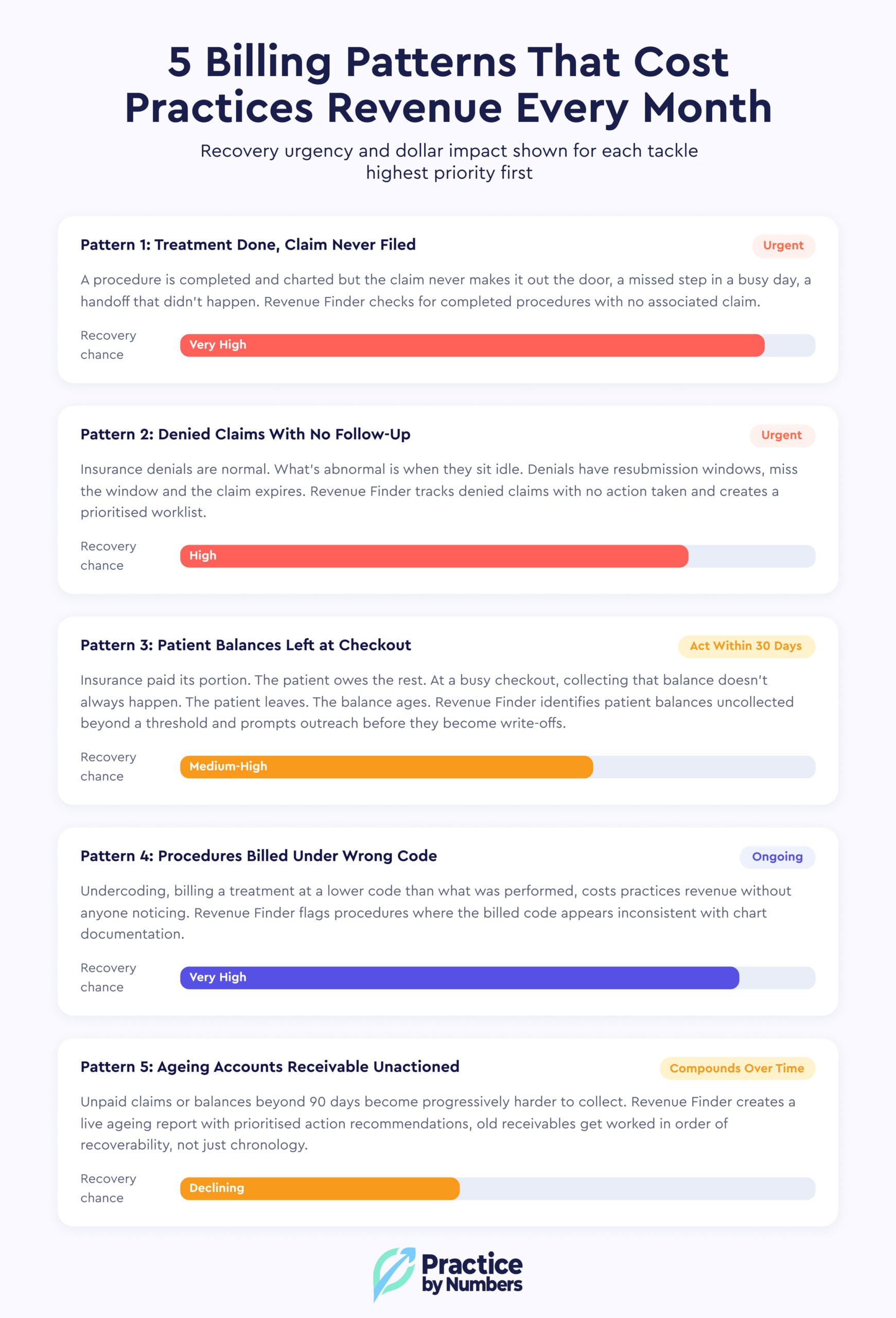
Leak #1: Unsubmitted Claims
The problem: Treatment gets completed, charted, and closed, but the associated insurance claim never gets submitted. Sometimes ownership is unclear. Sometimes the claim gets buried inside daily operational work. Either way, production exists without a path to collection.
Why this happens: Most missed claims are process problems, not insurance problems. When claim submission relies heavily on manual workflows or unclear ownership, things inevitably slip.
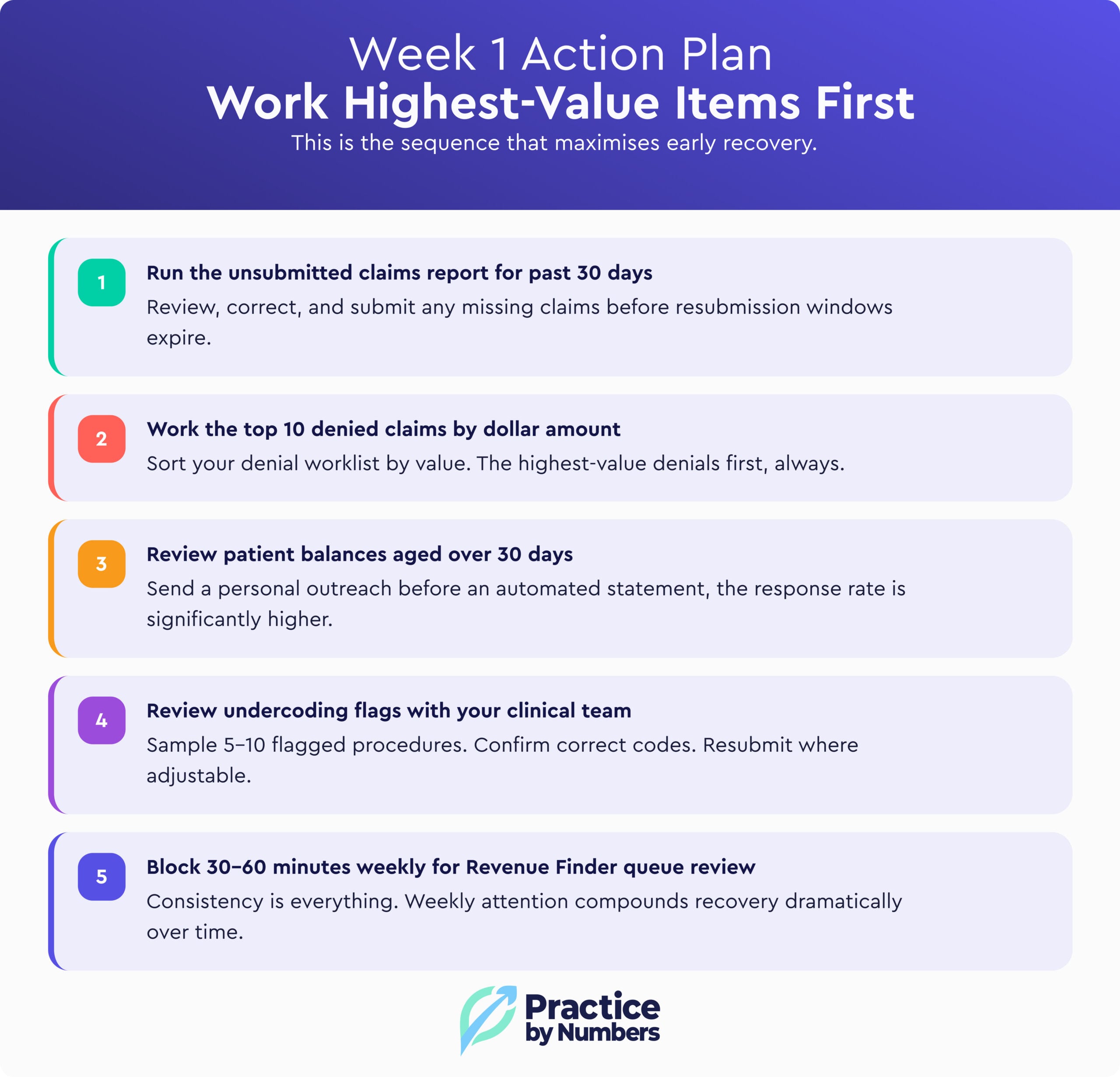
The fix: Create operational standards where every completed treatment automatically triggers claim review and submission workflows. The faster claims move out the door, the faster revenue starts moving back.
Leak #2: Denied Claims With No Follow-Up
The problem: Claims get denied because of coding errors, missing documentation, or coverage issues. Instead of being corrected and resubmitted, they remain sitting in the system marked as denied while revenue stays uncollected.
Why this happens: Many practices focus heavily on submitting claims but lack a structured process for managing denials after they occur. Without active monitoring, denied claims quietly accumulate.
The fix: Build a workflow specifically for denial management. Track denied claims separately, assign responsibility for follow-up, and create regular review cycles. Most denied claims are recoverable when addressed quickly.
Leak #3: Patient Balances That Never Get Collected
The problem: After insurance payments are processed, remaining balances are pushed to patient collections. Over time, unpaid balances pile up and eventually become write-offs.
Why this happens: Collecting after treatment is significantly harder than collecting during or immediately after treatment. Delays reduce urgency and make follow-up increasingly difficult.
The fix: Build collection processes earlier into the patient journey. Verify estimated balances beforehand, collect whenever possible at checkout, and use automated reminders or payment workflows to reduce outstanding balances.
Leak #4: Undercoding and Billing Mismatches
The problem: Revenue leakage sometimes happens before claims are even submitted. Procedures may be billed under lower-value codes, incomplete code combinations, or documentation that does not fully reflect treatment delivered.
Why this happens: Coding decisions happen quickly and under operational pressure. Without visibility, undercoding becomes difficult to detect because production appears normal while collections quietly suffer.
The fix: Regularly review coding patterns, audit high-value procedures, and compare documentation against submitted claims. Small coding inconsistencies repeated frequently create meaningful revenue loss.
Leak #5: Aging Accounts Receivable That Stop Getting Attention
The problem: Unpaid claims and patient balances slowly move from current receivables into aging reports. As balances age, recovery becomes increasingly difficult.
Why this happens: Many teams work on aging reports reactively. Older receivables remain untouched while newer work continuously enters the queue.
The fix: Create structured workflows for reviewing aging balances regularly and prioritize follow-up based on recoverability instead of chronology.
👉 Learn About The Economic Squeeze on Dental Practices and How to Fight Back
How Do You Find Your Revenue Leaks?
Most billing teams feel like they’re doing everything right. But without visibility into the full picture, small gaps become big problems.
Start by looking at these numbers monthly:
- How many claims are pending after 7 days of treatment completion?
- How many claims are currently denied, and how long have they been sitting?
- What’s your average number of days from claim submission to claim paid?
- How many patient balances are more than 30 days old?
- How many treatments were done before coverage was verified?
If you don’t know these numbers off the top of your head, that’s the problem. These are the signals that tell you where money is leaking.
What’s the Actual Impact of Revenue Leakage on Your Practice?
Revenue leakage does not usually appear as one massive mistake or a single missing payment. Instead, it shows up as small amounts lost repeatedly across claims, collections, verification, and follow-ups. That is what makes it expensive.
Let’s look at a simple example:
If your practice produces $15,000 per month and just 5% leaks through these operational gaps, that equals $750 lost every month. Over a year, that becomes $9,000 in lost revenue.
For a practice producing $40,000 per month, the numbers become much larger. A 5% leak means $2,000 lost every month and $24,000 lost annually.
And for many practices, the leakage is not limited to one area.
A delayed claim here, an unpaid patient balance there, a denied claim that never gets reworked. Individually, these issues may seem small. Collectively, they create a significant revenue problem.
Most practices do not realize how much money is slipping away because the losses happen gradually and across multiple workflows.
Once you start measuring these gaps, the opportunity becomes much easier to see, and fixing them becomes much harder to ignore.
👉 See How Smart Practices Keep More Revenue With Dental Payment Plans
How Practice by Numbers’ Ops AI Helps Identify Revenue Leakage Faster
The challenge with revenue leakage is not that practices do not have data. It is that the signals are buried inside reports, patient records, insurance information, and disconnected workflows.
PbN Ops AI helps surface these hidden opportunities faster through the RiQ Assistant by turning practice data into clear, actionable insights.
With RiQ Assistant, teams can:
- Get AI-generated revenue summaries that highlight the KPIs that need attention
- Identify trends, dips, and revenue opportunities before they become larger problems
- Instantly generate targeted patient lists to act on collections, unscheduled treatment, reactivation opportunities, and more
- Make revenue decisions faster without manually digging through reports
Instead of spending hours trying to find revenue problems, teams can focus on fixing them sooner.
FAQs
Q. What is revenue leakage in dental billing?
Revenue leakage is money your practice earned but never collected, usually because of gaps in your billing process. It includes denied claims that don’t get reworked, patient balances that don’t get collected, insurance payments posted to the wrong place, and claims that get submitted late or not at all. Most practices lose 3-8% of their potential revenue to these leaks without realizing it.
Q. What’s the difference between production and collection in dental billing?
Production is the value of the treatment you delivered. Collection is the money you actually received. In perfect billing, they’d be the same. In reality, there’s usually a gap because of insurance denials, patient balances, claim delays, and other billing friction. That gap is revenue leakage.
Q. How long should insurance claims take to be paid?
Most claims should be paid within 30 days of submission. Claims taking longer than 45 days should be flagged for follow-up. If you have claims sitting unpaid for 60+ days, something went wrong, either the claim was rejected, needs additional information, or got lost in the insurance company’s system.
Q. What’s the best way to catch billing errors before they become big problems?
Review your aging report weekly, patient balances, and insurance balances both. Look for anything over 30 days and investigate. Also track metrics like claim approval rate, days from submission to payment, and patient collection rate. When these metrics start trending wrong, you catch problems early before they compound.