Your dental practice’s money flows like a patient’s journey through treatment. Just as a broken step in a treatment plan affects the whole outcome, a hiccup anywhere in how you bill, collect, and get paid can drain thousands from your practice each month.
Revenue cycle management in dentistry covers every step between a patient scheduling an appointment and the practice receiving full payment. When the cycle runs smoothly, cash flow is predictable, and collections stay high. When it breaks down, at any point, revenue leaks out in the form of denied claims, aging receivables, and uncollected patient balances.
This guide walks through each stage of the dental revenue cycle, identifies the most common breakdown points, and explains how to fix them.
TL;DR
Dental revenue cycle management covers everything from scheduling to final payment. Most revenue leaks happen at insurance verification, claim follow-up, and patient billing. Tightening these steps with same-day claims, weekly AR tracking, and easier payment options leads to faster collections and more predictable cash flow.
What is Revenue Cycle Management?
Revenue Cycle Management (RCM) is the process of tracking and collecting money from the moment a patient schedules an appointment until your practice receives full payment.
It covers everything in between:
- Before the visit: Verifying the patient’s insurance and eligibility
- During the visit: Recording what services were provided
- After the visit: Submitting insurance claims, following up on denials, and collecting patient copays or balances
- The end: Getting paid by insurance and patients, then closing out the account
Just like clinical work follows a process (exam → diagnosis → treatment), billing also follows a process. When that process works smoothly, money flows in predictably. When it breaks down at any point, revenue gets stuck or lost.
Why it matters for dental practices?
RCM isn’t just about administration, it’s about keeping your practice financially healthy. Poor RCM leads to:
- Delayed payments
- Uncollected patient balances
- Denied insurance claims
- Cash flow problems
- Staff spending time chasing money instead of seeing patients
Good RCM means fewer headaches, faster payments, and more predictable income.
The 7 Stages of the Dental Revenue Cycle
The revenue cycle isn’t a single process, it’s a sequence of dependent steps. A breakdown in any one stage can delay or reduce payment. That’s why it’s important to understand each stage, not in isolation, but as part of a connected system.
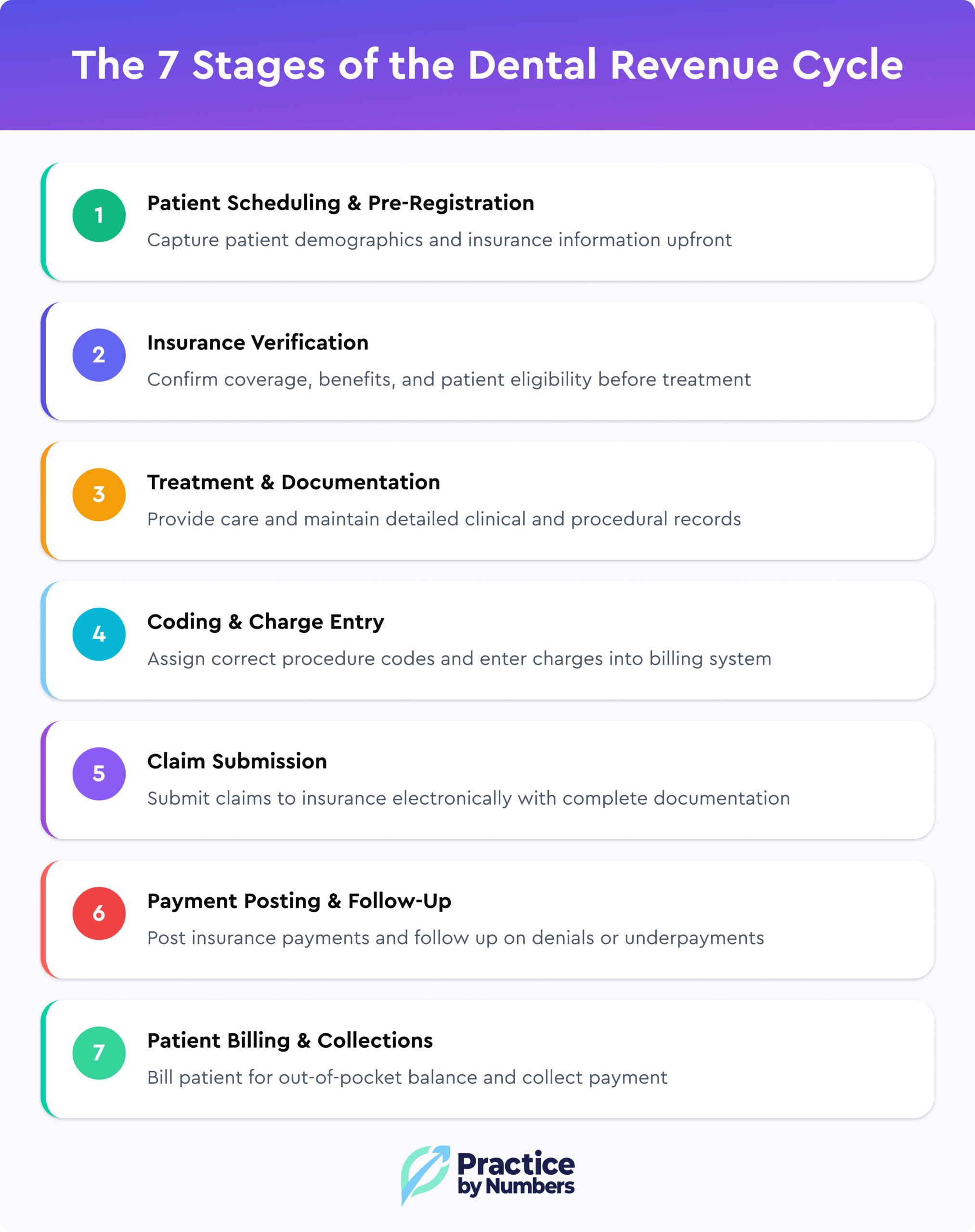
Stage 1: Patient Scheduling and Pre-Registration
The cycle begins before the patient walks in.
At this stage, you collect:
- Demographics
- Insurance details
- Reason for visit
This is also your first opportunity to reduce friction. Practices that use digital intake forms before the appointment:
- Minimize front desk bottlenecks
- Reduce data entry errors
- Improve overall patient experience
Insight: Errors at this stage don’t stay here, they move downstream into claims, billing, and collections.
Stage 2: Insurance Verification
Verification is where most revenue cycles either stay clean or start breaking.
Before the appointment, your team should confirm:
- Eligibility
- Coverage limits
- Waiting periods
- Frequency restrictions
- Remaining annual maximums
Skipping this step leads to:
- Claim denials
- Unexpected patient balances
- Frustrated patients and staff
Insight: Verification is not administrative work, it’s financial risk control.
Stage 3: Treatment and Documentation
Once care is delivered, documentation becomes the foundation for everything that follows.
Accurate documentation includes:
- Procedures performed
- Clinical notes
- Supporting details for insurance
Incomplete or vague documentation leads to:
- Claim rejections
- Delays in payment
- Increased back-and-forth with payers
Insight: Clean claims start chairside, not at billing.
Stage 4: Coding and Charge Entry
This is where clinical work is translated into billable data.
Common issues include:
- Incorrect CDT codes
- Missing modifiers
- Mismatches between notes and codes
Best practices:
- Enter charges same day
- Standardize coding protocols
- Audit regularly for accuracy
Insight: Even small coding errors can delay payment by weeks.
Stage 5: Claim Submission
Speed matters. Claims should be submitted within 24–48 hours of treatment. Delays here directly extend your revenue cycle.
To improve this stage:
- Use electronic claim submission
- Implement claim scrubbing tools
- Batch and automate where possible
Insight: The faster you submit, the faster the clock starts on getting paid.
Stage 6: Payment Posting and Follow-Up
This is where revenue is either recovered or quietly lost.
Key responsibilities:
- Post payments accurately
- Reconcile against expected amounts
- Identify underpayments or denials
Without consistent follow-up:
- Claims age unnecessarily
- Filing deadlines are missed
- Revenue turns into write-offs
Insight: Most AR problems are not about volume, they’re about lack of follow-up discipline.
Stage 7: Patient Billing and Collections
Insurance rarely covers everything. The final step is collecting the patient’s portion.
Practices that collect faster typically:
- Send clear, timely statements
- Offer multiple payment options (text-to-pay, online portals, plans)
- Communicate balances proactively
Insight: The longer a balance sits, the less likely it is to be paid.
👉Discover 10 Dental Practice Management Tips Every Office Should Try
Where Revenue Cycles Break Down
The most common breakdowns happen at three places:
1. Verification Gaps: Unverified benefits lead to avoidable denials and unexpected balances.
2. Follow-Up Delays: Denied or underpaid claims sit untouched, aging past recovery windows.
3. Patient Billing Friction: Late statements and limited payment options slow collections.
Across all three, the real issue is not effort, it’s system design.
- No clear ownership
- No tracking visibility
- No defined timelines
Revenue doesn’t leak because people aren’t working hard, it leaks because of a lack of tracking systems, which let things fall through the cracks.

👉See Top AI Applications in Healthcare
How to Improve Your Dental Revenue Cycle
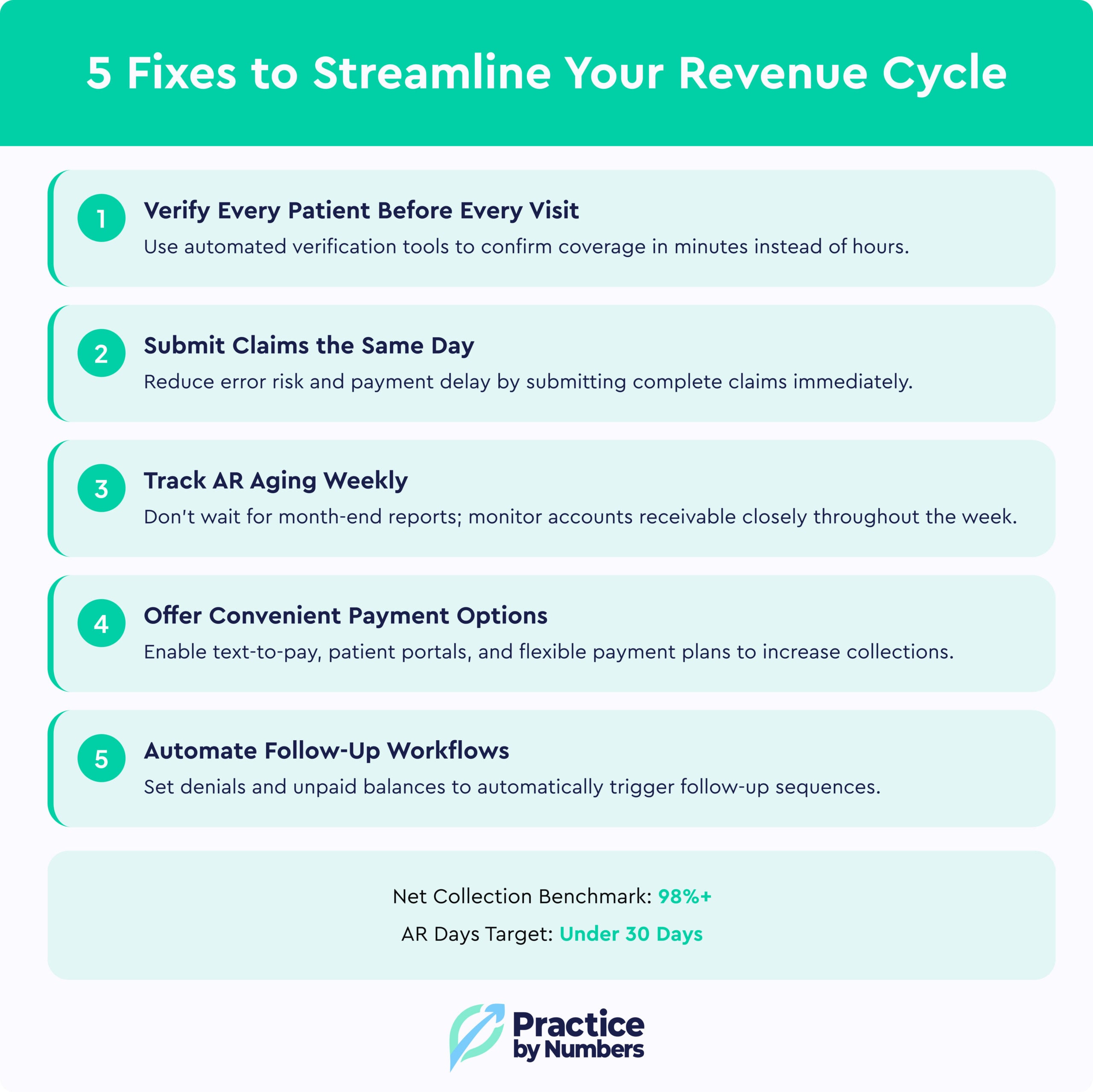
Improvement doesn’t require a complete overhaul. It requires tightening key points in the system.
- Verify every patient before every visit. Make insurance verification a non-negotiable part of your pre-appointment workflow. Automated verification tools cut this task from minutes to seconds per patient.
- Submit claims the same day. The longer a claim sits between treatment and submission, the higher the error risk and the longer the payment delay.
- Track AR aging weekly. Do not wait for month-end to discover that 60-day receivables spiked. A weekly AR report gives you time to act before balances age into write-off territory.
- Offer convenient patient payment options. Text-to-pay, online portals, and payment plans make it easier for patients to pay their portion promptly. Friction in the payment process directly increases bad debt.
- Automate follow-up workflows. Claim denials and unpaid balances should trigger automatic follow-up sequences rather than relying on staff to remember to check.
What Strong Revenue Cycle Management Looks Like
When your RCM system is working well:
- Claims go out quickly and cleanly
- AR stays under control
- Patient balances don’t linger
- Cash flow becomes predictable
- Your team spends less time chasing payments
RCM isn’t just about collecting money faster, it’s about building a reliable financial engine for your practice.
👉Learn How You Can Fight Back The Economic Squeeze on Dental Practices
Key Takeaways
- Revenue cycle management spans 7 stages, from scheduling to final payment
- Most revenue loss happens at verification, follow-up, and patient billing
- Same-day claim submission and weekly AR tracking are critical
- Automation reduces errors and speeds up collections
- Strong RCM leads to predictable cash flow and better profitability
FAQs
Q. What is a good net collection rate for a dental practice?
A net collection rate of 98% or higher is the industry benchmark. If your practice consistently falls below 95%, there are likely issues in your billing, follow-up, or patient payment collection processes.
Q. How many AR days should a dental practice have?
Best-in-class dental practices maintain AR days under 30. If your AR days are above 45-50, it indicates slow follow-up on outstanding claims and patient balances.
Q. Should dental practices outsource revenue cycle management?
It depends on practice size and internal capabilities. Smaller practices may benefit from outsourcing RCM to specialized companies. Larger practices and DSOs often keep RCM in-house with AI-assisted tools for better control and visibility.