Artificial intelligence has moved beyond the boardroom and into the operatory. Today’s healthcare providers, from large hospital systems to independent dental practices, are using AI to work smarter, not just harder.
Dentists use AI to predict patient no-shows or detect cavities and periodontal disease before they turn into serious issues. Medical providers leverage it to streamline patient intake and reduce administrative overhead. Both are using it to predict patient behavior, improve clinical outcomes, and reclaim time for what matters: patient care.
AI isn’t just another software update. It’s reshaping the entire patient journey, from the first touchpoint through treatment completion and long-term retention.
This guide explores:
- What AI in healthcare and dentistry looks like today
- Where the industry is heading
- What you need to know to stay ahead, whether you’re a solo practitioner or leading a multi-location enterprise.
What AI in Healthcare Actually Means
AI in healthcare is the use of smart software that can analyze large amounts of medical data, spot patterns, and support better decisions, both clinical and operational. It’s not just one tool. AI includes technologies like machine learning, natural language processing, computer vision, and predictive analytics, but what matters is what it helps you do.
In practice, AI helps healthcare teams:
- Diagnose conditions earlier
- Run operations more efficiently
- Communicate better with patients
Unlike basic automation (which follows fixed rules), AI systems learn from data. They improve over time. For example, a system that learns from past appointment patterns can predict no-shows far more accurately than a simple reminder system.
How AI Is Used Across Healthcare Today
AI applications in healthcare span clinical, administrative, and patient-facing functions.
- Clinical applications include diagnostic imaging (detecting tumors, cavities, or fractures), pathology analysis, drug interaction checks, and treatment planning. In dentistry, AI-powered imaging tools can flag early-stage periodontal disease or caries that might be missed by the human eye alone.
- Administrative applications include automated insurance verification, claims processing, revenue cycle management, appointment scheduling, and staff workload balancing. These are where most practices see the fastest ROI because the tasks are repetitive and data-heavy.
- Patient-facing applications include AI chatbots for appointment booking, automated recall and reactivation campaigns, post-treatment follow-up messaging, and digital intake forms that adapt based on patient responses.
Why AI Adoption Is Accelerating in Healthcare
AI isn’t gaining traction in healthcare by chance. It’s being driven by real, everyday challenges. From staffing gaps to rising patient expectations, several forces are pushing practices to adopt smarter, more efficient ways of working.
1. Staffing shortages
This is pushing practices to automate tasks that previously required full-time employees. Front desk staff, billers, and even hygienists are in short supply. AI fills gaps by handling phone calls, verifying insurance, and managing recall lists without adding headcount.
2. Rising patient expectations
Patients now expect the same digital convenience from their healthcare provider that they get from retail and banking, such as online booking, instant responses, and paperless experiences.
3. Data availability
This has exploded. Electronic health records, practice management systems, and patient communication platforms generate enormous volumes of structured data. AI thrives on this data, and practices that have been digital for several years are in the best position to benefit.
4. Cost pressure
Healthcare demands efficiency. AI helps practices collect more revenue with fewer resources by reducing claim denials, shortening accounts receivable cycles, and improving case acceptance through better patient communication.
What AI Means for Dental Practices Specifically
Dental practices operate at a unique intersection of clinical care and small business management. That makes them ideal candidates for AI adoption.
A typical dental practice deals with high volumes of insurance claims, appointment scheduling, patient communication, and clinical documentation, all areas where AI delivers measurable improvement.
For example, AI-driven phone systems can answer patient calls, schedule appointments, and route emergencies, reducing missed calls and the revenue they represent. Predictive analytics can flag patients likely to cancel so the front desk can proactively fill the schedule. And automated AR follow-up can recover revenue that would otherwise sit in aging buckets for months.
Practices that adopt these tools are not replacing their teams. They are giving their teams more time for high-value work:
- Chairside care
- Treatment coordination
- Patient relationships
The Risks of Not Adopting AI
The competitive gap between AI-adopting and non-adopting practices is widening. Practices using AI-powered tools report higher collection rates, lower overhead ratios, and better patient satisfaction scores.
Meanwhile, practices relying entirely on manual processes face growing challenges like
- Longer hold times
- Slower claims processing
- Higher staff turnover
- Declining patient retention
The risk is not that AI will replace dental professionals. The risk is that practices using AI will outperform those that don’t and patients will notice the difference.
Where AI in Healthcare Is Heading
So, let’s understand this in a simple way:
If the last few years were about adoption, the next few will be about integration. AI will move from being a helpful add-on to becoming a core part of how healthcare practices run.
Over the next few years, we’ll see AI move beyond isolated use cases and become more deeply embedded in how practices operate, make decisions, and deliver care.
- Predictive care models will shift healthcare from reactive to preventive. Instead of treating disease, AI will help identify risk factors early enough to intervene — whether that means flagging a patient for periodontal treatment before bone loss progresses, or identifying revenue trends before cash flow tightens.
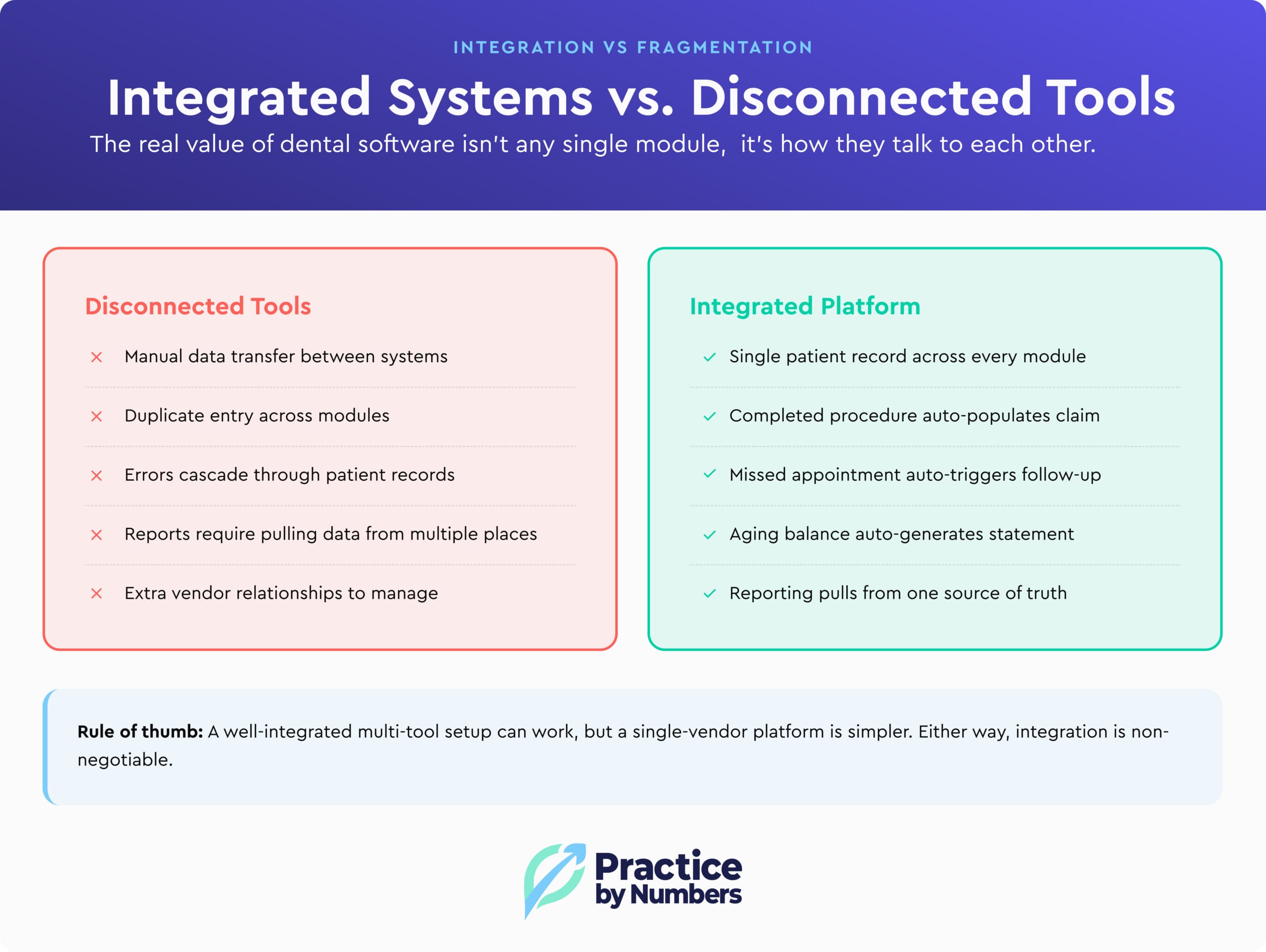
- Interoperability between AI systems and existing practice management software will improve, reducing the friction of adoption. The best AI tools will integrate directly into the workflows providers already use.
- Regulation will catch up. Expect clearer guidelines on AI use in clinical diagnostics, patient data handling, and automated decision-making. Practices that adopt AI now with strong data governance will be ahead when these regulations arrive.
Also read:The Complete Guide to AI in Dentistry: How PbN AI Transforms Practice Management
Key Takeaways
Think of AI like a really helpful assistant for your practice. It doesn’t replace people, it just takes care of the repetitive stuff so your team can focus on patients. The reason everyone’s talking about it now is simple: running a practice is getting more and more competitive, and AI makes it a little easier. Some practices are already using it and moving faster. Others are still catching up. Here’s what actually matters:
- AI is already being used every day
It’s helping with things like spotting issues, handling admin work, and talking to patients. - It makes daily tasks easier for dental teams
Scheduling, billing, insurance checks, follow-ups, AI can handle a lot of this in the background. - There’s a reason adoption is speeding up
Teams are short-staffed, patients expect quick service, and costs are rising. - Some practices are pulling ahead
The ones using AI are saving time and running smoother. Others risk falling behind. - Choosing the right AI matters
The best tools fit into your system easily, show clear results, and actually improve the patient experience.
FAQs
Q. What is AI in healthcare used for?
AI in healthcare is used for diagnostic imaging, predictive analytics, automated scheduling, insurance verification, patient communication, and revenue cycle management. It handles both clinical and administrative functions.
Q. Is AI replacing healthcare workers?
No. AI automates repetitive, data-heavy tasks so that clinical and administrative staff can focus on higher-value work like patient care, treatment coordination, and relationship building.
Q. How does AI apply to dental practices?
Dental practices use AI for call answering, appointment scheduling, insurance verification, claims processing, patient recall, and diagnostic imaging analysis. These tools improve efficiency without adding headcount.
Q. What should a dental practice look for when choosing AI tools?
Look for tools that integrate with your existing practice management software, offer measurable ROI within 90 days, comply with HIPAA regulations, and reduce rather than add complexity for your team.