“AI” and “automation” are used interchangeably in healthcare conversations. And that confusion can be costly. For many practices, especially in dentistry, choosing the right technology isn’t just about what sounds advanced. It’s about understanding what problem you’re trying to solve. Do you need something that simply follows a set process every time? Or something that can learn, adapt, and make decisions?
That’s where the difference between AI and automation really matters.
When you understand how each one works, it becomes much easier to invest wisely, avoid unnecessary complexity, and choose tools that actually improve your day-to-day operations, not just look impressive on paper.
In this article, we’ll break down what AI and automation are, when to use them, and how they can work together to make your practice run smoother, so you can confidently decide what’s right for your practice. By the end, you’ll know exactly which tool fits your needs and which to skip.
TL;DR
The core difference:
- Automation = fixed rules, same action every time (e.g., send reminder 48hrs before appointment)
- AI = learns from data, adapts, predicts (e.g., adjusts reminder timing based on each patient’s no-show history)
Use automation for: repetitive, consistent tasks like billing, standard reminders, form routing
Use AI for: prediction, personalization, pattern recognition like no-show risk, treatment acceptance, smart scheduling
The real point: Most tools blend both. The mistake is mismatching the tool to the problem using basic automation, where you need pattern recognition, or paying for AI when a simple rule would do. Diagnose the bottleneck first, then choose.
Quick test for any vendor: Does it follow the same logic every time, or does it improve based on your data? That tells you what you’re actually buying.
The Core Difference Between AI & Automation
Automation follows fixed rules to perform repetitive tasks. If X happens, do Y. There is no learning, no adaptation, and no judgment. A reminder text sent 48 hours before every appointment is automation. It does the same thing every time. It’s like setting a rule on autopilot. Once you set it up, it follows the exact same steps every single time, without thinking or adapting.
Artificial intelligence analyzes data, identifies patterns, and makes decisions or recommendations that improve over time. An AI system that predicts which patients are likely to no-show and adjusts reminder timing, frequency, and channel based on each patient’s behavior is fundamentally different from a fixed reminder.
The distinction matters because automation solves efficiency problems, while AI solves decision-making problems. Most practices need both.
Where Automation Works Best in Healthcare
Automation excels at high-volume, low-variability tasks where consistency is the priority.
Common tasks include:
- Sending appointment reminders at scheduled times
- Running billing processes and submitting claims
- Sending standard patient messages (welcome emails, post-visit surveys)
- Moving data between systems using set rules
Why automation works well here:
- These tasks don’t require decision-making
- The process stays the same every time
- Speed and consistency matter more than flexibility
What automation helps with:
- Saves time on routine work
- Reduces human errors
- Keeps operations running smoothly
- Lowers costs compared to manual work
These tasks do not require judgment. They require reliability and speed. Automation delivers both at a fraction of the cost of manual labor.
Where AI Works Best in Healthcare
AI earns its value when the task involves variability, pattern recognition, or prediction.
Common tasks include:
- Predicting patient behavior (no-shows, treatment acceptance, attrition risk)
- Understanding which treatments a patient is likely to accept
- Analyzing diagnostic images that need careful interpretation
- Adjusting schedules based on changing factors (availability, cancellations, urgency)
- Personalizing outreach based on what works for each patient
Why AI works well here:
- These tasks involve variation and uncertainty
- The “right” answer can change from case to case
- Patterns are not always obvious to humans
- Fixed rules are not enough to handle the complexity
What AI helps with:
- Makes smarter predictions over time
- Learns from past data and improves
- Helps with better decision-making
- Adapts to different situations instead of following one fixed path
AI handles the tasks where “it depends” is the honest answer to how it should be done. Fixed rules cannot capture that nuance. Algorithms can.
The Spectrum Between AI and Automation
Most modern healthcare tools are not purely one or the other. They sit on a spectrum.
A basic online booking system is automation. A smart scheduling system that factors in provider productivity, procedure types, and patient preferences uses AI. A standard claim submission workflow is automation. A claim scrubbing tool that learns from historical denial patterns to prevent errors uses AI.
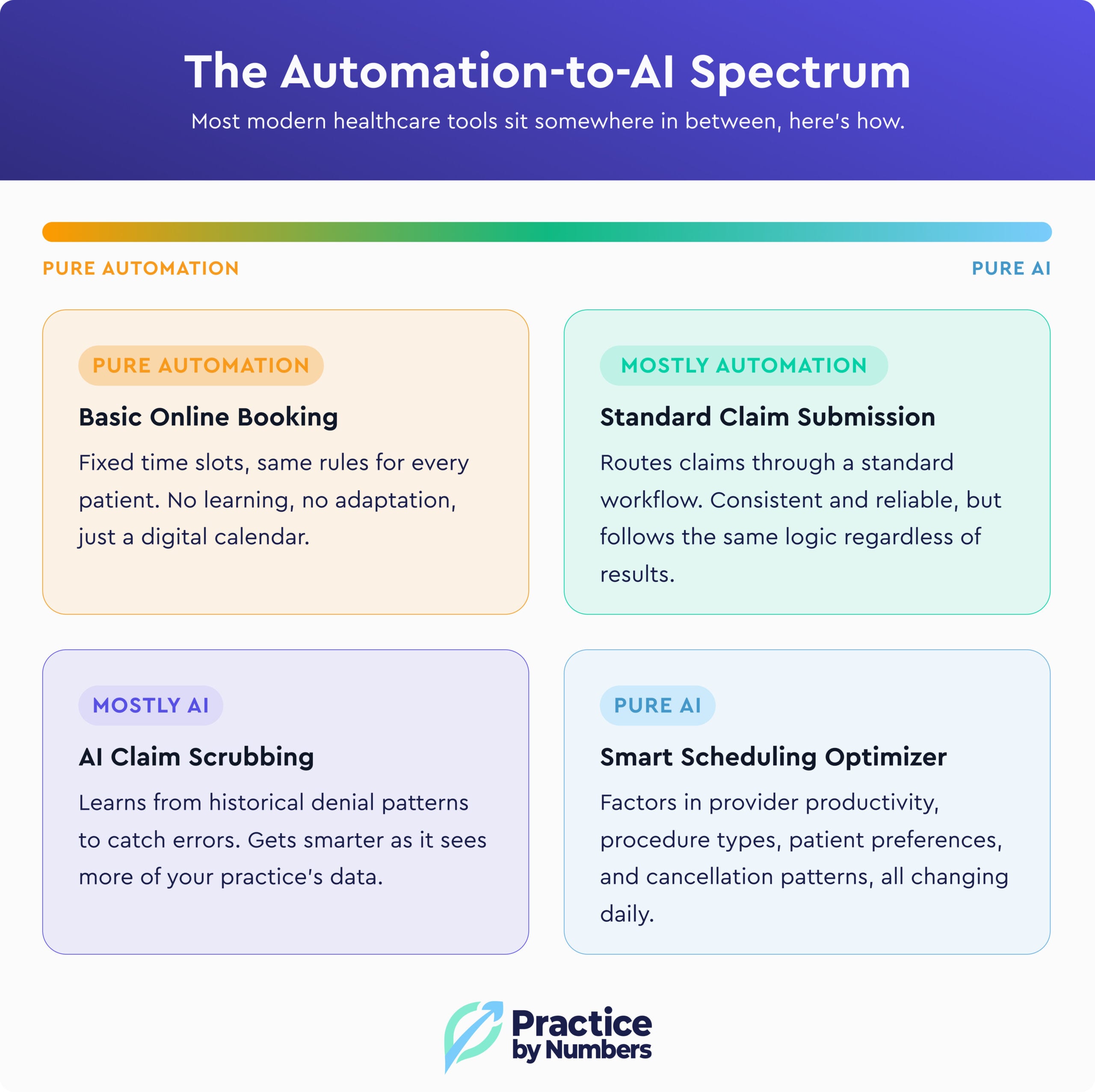
Understanding where a tool sits on this spectrum helps you set the right expectations.
- Automation improves consistency and efficiency
- AI improves decision-making and outcomes
If you expect an automation tool to “think,” you’ll be disappointed. If you invest in AI where simple automation would do, you may end up paying for unnecessary complexity.
A simple way to evaluate any tool is to ask: Does this follow the same rules every time, or does it learn and adapt based on new information?
That tells you where it sits on the spectrum.
Why This Matters for Dental Practices
For many dental practices, the real challenge isn’t a lack of technology, it’s choosing the right kind. A lot of tools are marketed as “AI-powered,” even when the problem at hand doesn’t actually require AI. On the flip side, some practices try to solve complex, pattern-based issues with basic automation and end up stuck with the same inefficiencies.
The Hidden Costs of Getting It Wrong
When you choose the wrong technology, you’re not just overspending, you’re also spending time on implementation, training, and integration that doesn’t pay off. Your team learns a new system. You migrate data. You wait weeks or months for results. And if it turns out you picked the wrong tool, you’re back to square one.
A dental practice with 15 employees losing just 2 hours per week to inefficient workflows is losing roughly $15,600 a year in productivity. Scale that across the practice, add the cost of failed software investments, and the impact is significant.
The Real Advantage of Matching Technology to Your Actual Bottleneck
The practices that see real improvement don’t chase buzzwords. They diagnose first, then choose.
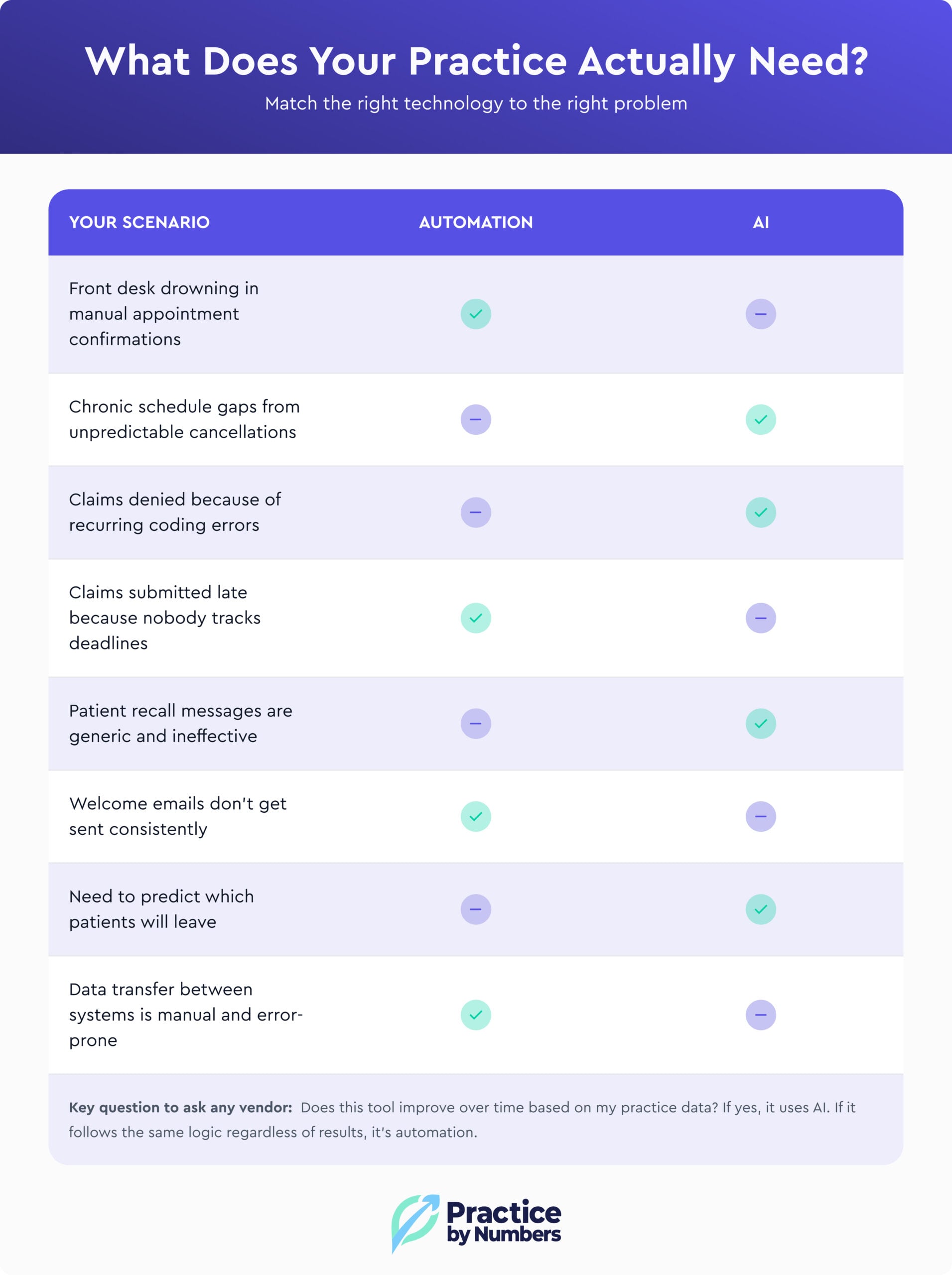
Start by asking: What’s actually broken?
- Is your team spending time on work that’s always the same? (Automation opportunity)
- Is your practice leaving money on the table because you can’t predict or respond to patterns? (AI opportunity)
- Are you making decisions reactively instead of strategically? (Likely AI)
Once you know which bucket your problem falls into, the solution becomes obvious and affordable.
When you align the right technology with the right problem, two things happen:
- You avoid overspending on tools you don’t need
- You start seeing real, measurable improvements in how your practice runs
And that’s the ultimate goal. Not just adopting new technology, but making your day-to-day operations smoother, smarter, and more predictable.
👉 See How PbN AI Transforms Practice Management Completely
Key Takeaways
- Automation follows fixed rules. AI learns from data and adapts over time.
- Most healthcare tools combine elements of both.
- Automation is best for high-volume, repetitive tasks.
- AI is best for prediction, personalization, and complex decision support.
- Dental practices should match the technology to the problem rather than chasing the buzzword.
FAQs
Q. Is AI always better than automation?
No. For simple, rule-based tasks like sending standard reminders or routing form submissions, automation is more cost-effective and equally reliable. AI adds value when the task requires learning, adaptation, or prediction.
Q. Can a dental practice use both AI and automation?
Absolutely. Most practices benefit from a combination. Automation handles the predictable workflows. AI handles the areas where variability and decision-making are involved. The two work together.
Q. How do I know if a vendor’s tool is actually AI or just automation?
Ask whether the tool improves over time based on your practice data. If it follows the same logic regardless of results, it is automation. If it adapts its behavior based on outcomes and patterns, it uses AI.