You’ve done everything right.
You invested in modern equipment. You hired and trained a solid team. You’ve built a clinic that patients should love walking into. And yet… there are still empty slots in your schedule. Some days feel unpredictable. Growth feels slower than it should.
Sounds familiar?
The uncomfortable truth is that great dentistry doesn’t automatically translate into a busy practice. Patients don’t just appear because you’re good at what you do. They choose what they can see, what they can trust, and what stays top of mind.
That’s exactly where dental marketing steps in. Not as a gimmick, but as the bridge between the quality you deliver and the patients who need it. Dental marketing is how you make your practice visible, attract the right patients, and turn one-time visits into long-term relationships. Without it, even the best clinical work goes unnoticed.
This article is for dental practice owners, office managers, and DSOs who want growth without drowning in complex strategies.
In this article, we’ll cover:
- What dental marketing actually means
- Why it directly impacts revenue and collections
- The core components every practice needs
- What happens when marketing is done right (and wrong)
So, what is dental marketing?
Dental marketing is the process of attracting, converting, and retaining patients using online and offline strategies like SEO, ads, reviews, and communication systems. It matters because it directly influences how many new patients you get, how often they return, and how much your practice grows.
At its core, dental marketing is not just “running ads” or “posting on Instagram.” It’s a system that moves patients from awareness to appointment to loyalty.
Think of it like a patient journey:
- They discover you
- They evaluate you
- They choose you
- They return (or don’t)
Every step is influenced by your marketing.
This includes:
- Your website (your digital front desk)
- Google presence (search results + reviews)
- Paid ads (Google, Meta)
- Patient communication (SMS, email, recalls)
- Reputation management (reviews and testimonials)
The most important thing to understand is that dental marketing is not a tactic, it’s a connected system that drives the entire patient flow.
Why does dental marketing matter more than ever today?
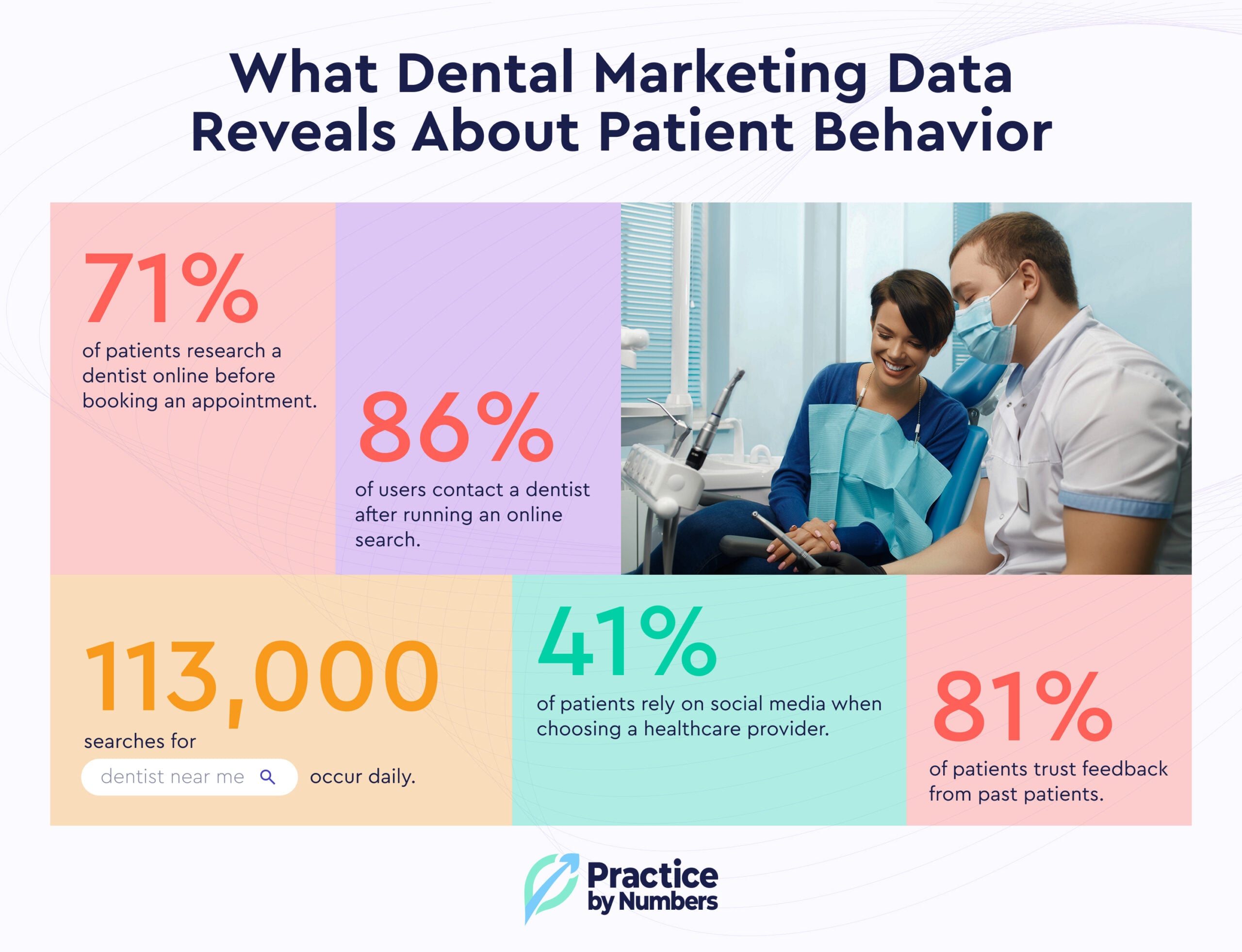
Patients don’t choose dentists the way they used to. They Google. They compare. They read reviews. They hesitate. If you’re not visible or credible online, you simply don’t exist to them. Even referrals behave differently now. Patients still search your name before calling. Your online presence is your first impression, and it decides whether patients even consider you.
Dental marketing also impacts:
- Chair utilization (how full your schedule is)
- Case acceptance (how much treatment patients agree to)
- Patient retention (how often they come back)
Without consistent marketing, growth becomes unpredictable.
How does dental marketing actually drive revenue?
Let’s understand this.
Revenue in a dental practice depends on three things:
- New patients: how many people walk into your clinic for the first time
- Case acceptance: how many of them actually say “yes” to treatment
- Patient retention: how often they come back, continue care, and refer others
Most practices tend to focus heavily on the first one, getting more patients in. But if the other two aren’t strong, growth becomes harder to sustain.
This is where dental marketing plays a much bigger role than people assume. It starts with visibility.
If your practice consistently shows up on search, maps, and social platforms, you naturally attract more new patients. No visibility means fewer discovery moments, no matter how good your clinic is.
But visibility alone isn’t enough.
Once a patient finds you, your messaging takes over. Your website, reviews, photos, and content shape that critical first impression. This is where trust is either built or lost. Clear, confident communication about treatments, pricing transparency, and patient outcomes directly influences whether a patient moves forward or hesitates. Better messaging doesn’t just “look good,” it improves case acceptance.
Then comes what most practices overlook: what happens after the first visit.
This is where follow-ups, reminders, and ongoing communication matter. Appointment reminders, post-treatment check-ins, recall systems, and even simple educational content all play a role in bringing patients back consistently. Strong follow-ups don’t just improve retention, they stabilize your revenue.
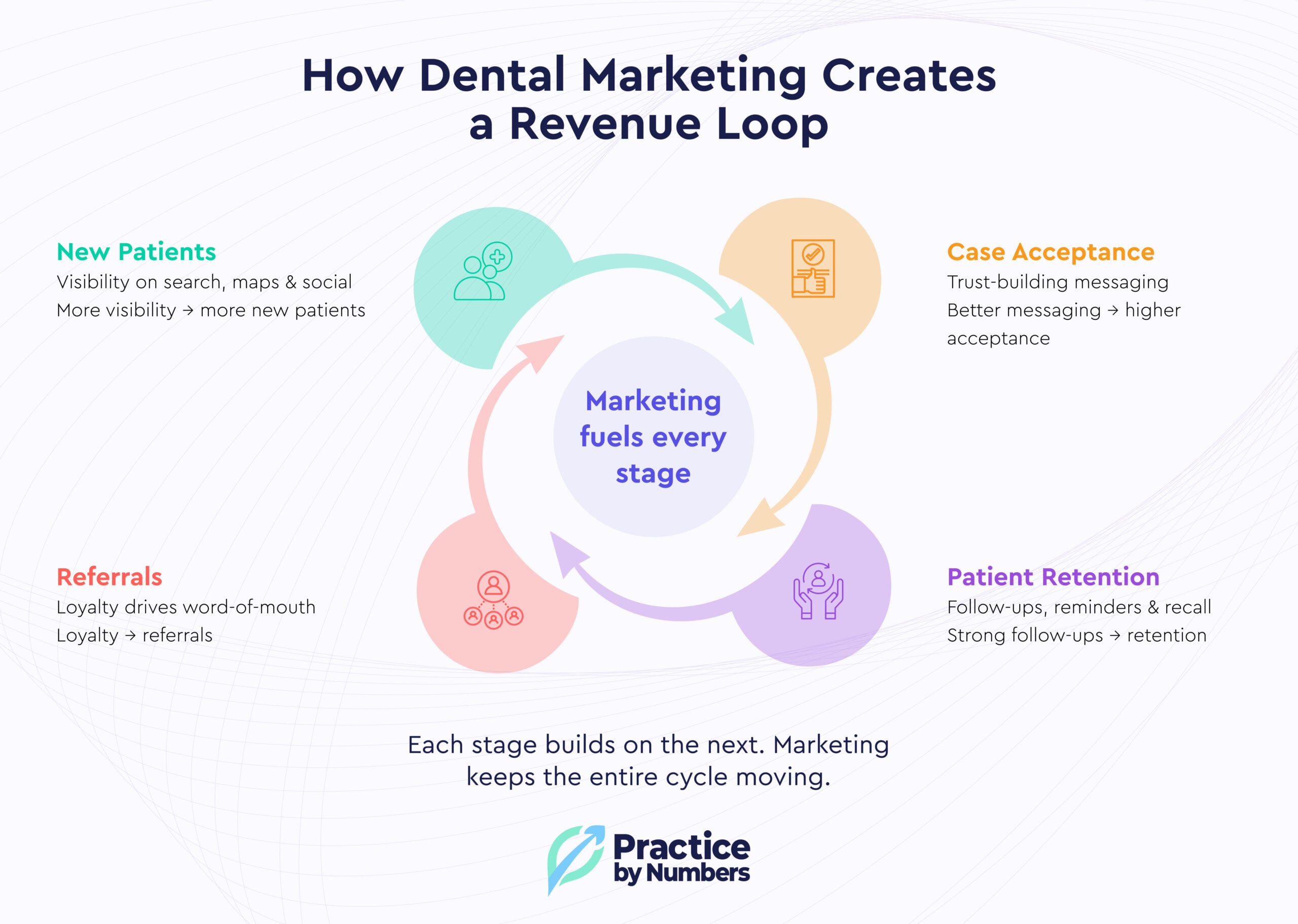
So when you connect the dots, it looks like this:
- More visibility → more new patients
- Better messaging → stronger trust → higher case acceptance
- Consistent follow-ups → more repeat visits and long-term loyalty
The most important insight? Marketing doesn’t just influence how many patients you get, it directly impacts how much value each patient brings over time. A well-marketed practice doesn’t just stay busy, it grows predictably, with patients who trust you, accept treatment, and keep coming back.
What is dental patient marketing and how is it different?
Most practices focus heavily on new patient acquisition. And that makes sense. New patients mean growth. But what happens after that first visit? That’s where most practices unintentionally leave money on the table.
Dental patient marketing is about what happens after the first visit. Instead of constantly chasing new leads, it focuses on building relationships, increasing repeat visits, and making sure patients actually follow through with their treatment plans.
It includes:
- Recall systems (bringing patients back)
- Reactivation campaigns (win-back inactive patients)
- Personalized communication
- Treatment follow-ups
Individually, these might seem like small actions. But together, they create consistency like fewer gaps in your schedule, better case acceptance, and stronger patient relationships. This is where the real growth lies.
What most practices underestimate is that acquiring a new patient is expensive. You’re spending on ads, visibility, and conversions just to get them in once. But retaining an existing patient? That costs far less and often brings in far more value over time.
A patient who trusts you is more likely to return, accept treatment, and even refer others.
What does a simple dental marketing system look like?
Now that you understand why marketing matters, the next question is usually: Okay, but what do I actually need?
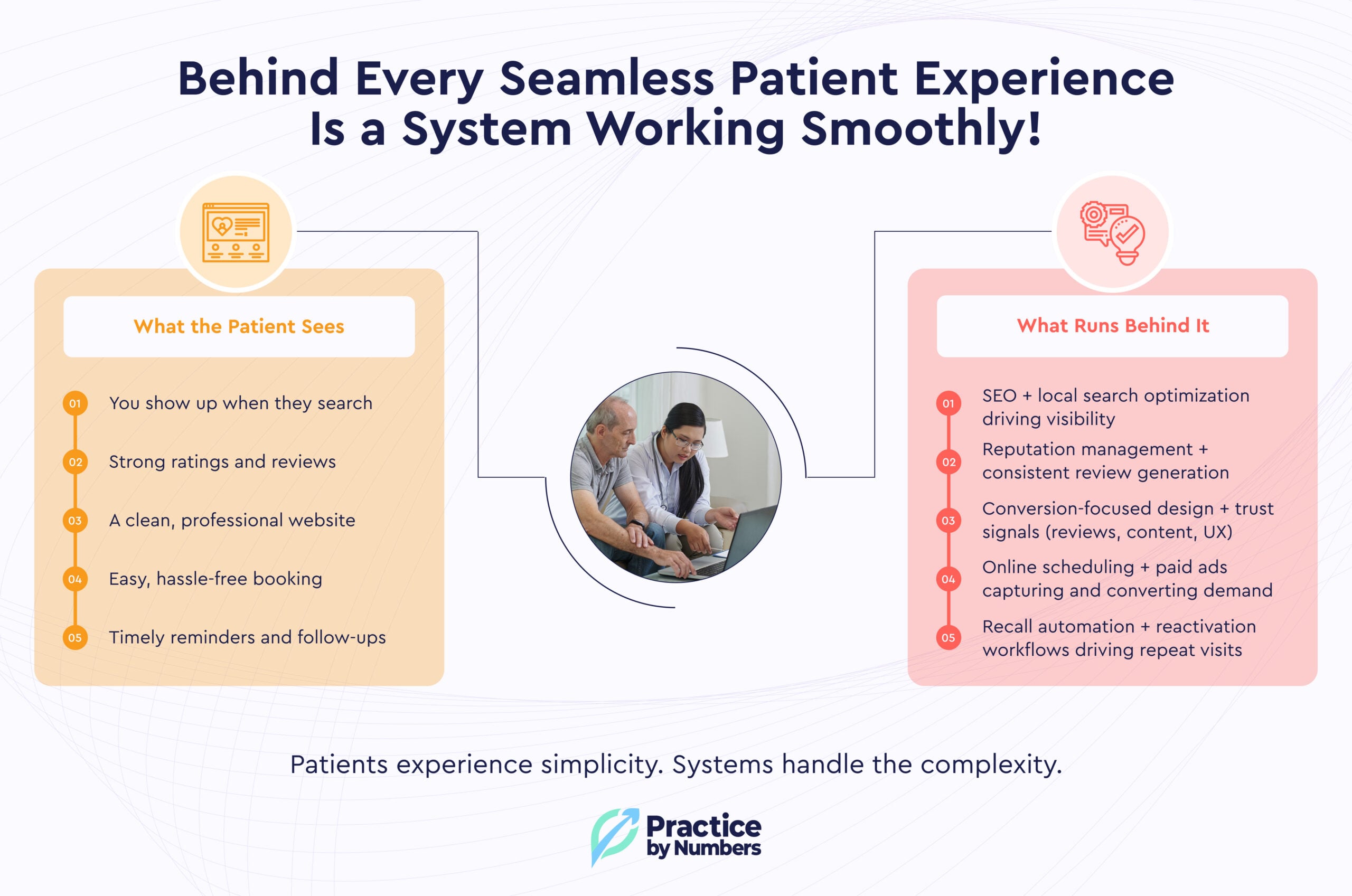
A good marketing system doesn’t feel like marketing to the person on the other side of it. It just feels like a practice that’s easy to find, easy to trust, and easy to stay with. Practically speaking, that means four things need to work:
1. They need to find you when they search: This means Google presence, your maps listing, and your basic SEO are doing their job quietly in the background, every day.
2. They need to trust you before they’ve met you: Your website is clear, your reviews are real, and your first impression doesn’t raise any questions you haven’t already answered.
3. They need to choose you over competitors: This, for most people, comes down to convenience, communication, and whether the whole thing felt easy.
4. They need to come back: Not because they remembered on their own, but because your system reminded them, checked in on them, and made it simple to rebook.
That’s it. That’s the whole system.
- Visibility: SEO + Google presence
- Conversion: Website + reviews
- Acquisition: Paid ads (if needed)
- Retention: Recall and communication
Not four separate tools running independently. One connected experience that a patient moves through without ever noticing the machinery behind it.
How do you know if your dental marketing is working?
Most practices don’t really know. They go by gut feeling, like more calls this week, fewer next week, and assume something is (or isn’t) working.
But marketing should be measurable. If you’re investing money into marketing, you deserve clear answers on what you’re getting in return.
At a basic level, every dental practice should keep an eye on a few key numbers:
- Cost per new patient: How much are you spending to bring in one new patient?
- Conversion rate: Out of the people who call or enquire, how many actually book an appointment?
- Patient lifetime value: How much revenue does one patient generate over time, not just in a single visit?
- Retention rate: How many patients come back instead of disappearing after their first treatment?
These numbers tell you what’s really happening behind the scenes.
For example, you might be getting a lot of calls, but if very few turn into bookings, the problem isn’t marketing, it’s conversion. Or you might be getting new patients, but if they don’t return, you’re leaking revenue.
This is why measurement matters so much. Because if you can’t measure what’s happening, you can’t fix it. And if you can’t fix it, you end up spending more without actually growing.
What should you take away from this, and where should you start?
Dental marketing is not optional. It’s foundational to how your practice grows.
Start small but start right.
Focus on:
- Your Google presence (reviews + profile)
- Your website clarity (clear services, easy booking)
- Your recall system (don’t lose existing patients)
You don’t need everything at once. You need momentum. The best marketing strategy is the one you actually execute consistently.
Here are the three things that matter most:
- Marketing is a system, not a single tactic
- Retention is as important as acquisition
- Consistency beats complexity every time
If you want predictable growth, start by building a simple, measurable marketing system.
Next step: Audit your current patient journey, from discovery to recall, and identify where patients are dropping off. That’s where your biggest growth opportunity is hiding.If you’re looking to simplify all of this, take a look at the PbN Dental Marketing Suite, a unified platform designed to help dental practices manage, track, and grow their marketing with clarity.
People Also Ask
Q. What is the best marketing strategy for a dental clinic?
The best strategy combines strong local SEO, positive patient reviews, a clear website, and consistent patient communication systems.
Q. How much should a dental practice spend on marketing?
Most practices spend 3–7% of revenue on marketing, depending on growth goals and competition.
Q. Is digital marketing necessary for dentists?
Yes. Most patients search online before choosing a dentist, making a digital presence essential.
Q. How do dentists attract more patients?
By improving visibility (SEO, ads), building trust (reviews), and simplifying booking and communication.
Q. What is the difference between dental marketing and branding?
Dental marketing drives patient acquisition and retention, while branding shapes how your practice is perceived.