For most dental practices, the phone remains the highest-impact communication channel. New patient inquiries, appointment confirmations, treatment follow-ups, billing conversations, emergency calls, and reactivation efforts, all start or end with a phone call. Yet many dental offices still rely on legacy phone systems that were never designed for modern dental practices. These systems operate in isolation from practice management software, offer little visibility into call outcomes, and place unnecessary strain on front desk teams. This disconnect creates real consequences. Missed calls go untracked. Voicemails pile up without accountability. Staff lack context during patient conversations. Leadership has no clear insight into call performance or lost opportunities.
This is where modern VoIP system for dental offices changes the equation.
In this article, we’ll discuss how cloud-based VoIP phone systems for dental practices work, why traditional systems fall short, and how PbN Voice functions as a fully integrated dental VoIP solution designed specifically for dentistry. The focus is practical, workflow-driven, and decision-oriented, so you can determine whether this is the right phone system for your dental practice.
How Traditional Phone Systems Quietly Undermine Dental Practice Performance
1. Disconnected Communication Tools
Most legacy phone systems were built to handle calls, not to support patient journeys. In dentistry, that distinction matters. With fragmented communication ecosystems like desk phone for calls, separate texting platforms for reminders, standalone fax machines for insurance documentation, and practice management software that remains completely disconnected from all patient conversations, creates expensive inefficiencies:
- No integration with patient data
Staff answer calls without visibility into patient history, treatment plans, or previous conversations. - Missed calls with no accountability
Busy front desks cannot answer every call, but most systems provide no structured way to track or recover missed opportunities. - Manual voicemail management
Dental office voicemail management often relies on sticky notes, memory, or inconsistent follow-up habits. - No call tracking or attribution
Practices cannot see which calls led to booked appointments or which marketing efforts generated phone leads. - Limited flexibility for modern teams
Remote staff, overflow scheduling support, or multi-location teams struggle with on-premise phone systems. - Compliance risks
Many generic phone platforms are not designed as HIPAA compliant phone systems for healthcare environments.
These challenges compound as practices grow, adding providers, locations, and patient volume without improving communication infrastructure.
2. New Patient Acquisition Gaps
Dental practices invest heavily in marketing to generate new patient inquiries. Google Ads, SEO, direct mail, and community outreach drive prospective patients to call the practice. Then the traditional phone system undermines these investments.
During peak hours, new patient calls encounter busy signals or extended hold times. If they reach voicemail, generic greetings provide no differentiation or urgency for callback. When staff finally connects with the prospect, they have no visibility into which marketing source generated the call, preventing accurate ROI analysis on advertising spend.
Dental practices that respond to new patient inquiries within five minutes achieve better conversion rates than those taking over an hour, where conversion drops significantly Traditional phone systems provide no mechanism to prioritize new patient calls or track response time performance.
3. Treatment Acceptance Drop-Offs
Complex treatment cases require coordinated follow-up. Treatment coordinators must contact patients multiple times, addressing financial questions, explaining procedures, and overcoming objections.
Traditional phone systems provide no structure for tracking these campaigns. Coordinators maintain manual spreadsheets noting which patients require calls, what was discussed, and when next contact should occur. There’s no accountability mechanism ensuring follow-through, no call recording to review effective conversation techniques, and no analytics showing which approaches drive acceptance.
Practices lose treatment revenue not because patients reject care, but because inconsistent follow-up allows interested patients to forget, postpone, or choose competitors.
4. Compliance and Training Blind Spots
Every patient conversation represents potential compliance exposure and training opportunity. Did the financial coordinator clearly explain payment policies? Did the scheduler confirm the patient understood pre-appointment instructions? Did the treatment coordinator document informed consent discussions?
Traditional phone systems leave these questions unanswered. Without call recording, practices rely on staff memory and manual notes. When billing disputes arise or patient complaints occur, there’s no objective record of what was actually communicated.
Similarly, training new staff becomes speculation rather than science. Managers cannot review actual patient interactions to identify effective techniques or correct problematic approaches.
What Modern VoIP Phone Systems for Dentistry Actually Do
Voice over Internet Protocol (VoIP) technology routes phone calls through internet connections rather than traditional telephone lines. While this technical distinction enables cost savings, the strategic value lies in capabilities that older systems fundamentally cannot deliver.
VoIP transforms phones from isolated communication devices into integrated software applications. This shift enables real-time data integration, location-independent access, multi-channel communication, and comprehensive analytics.
For dental practices, these capabilities address the operational challenges that traditional systems create.
Core VoIP Advantages for Dentistry
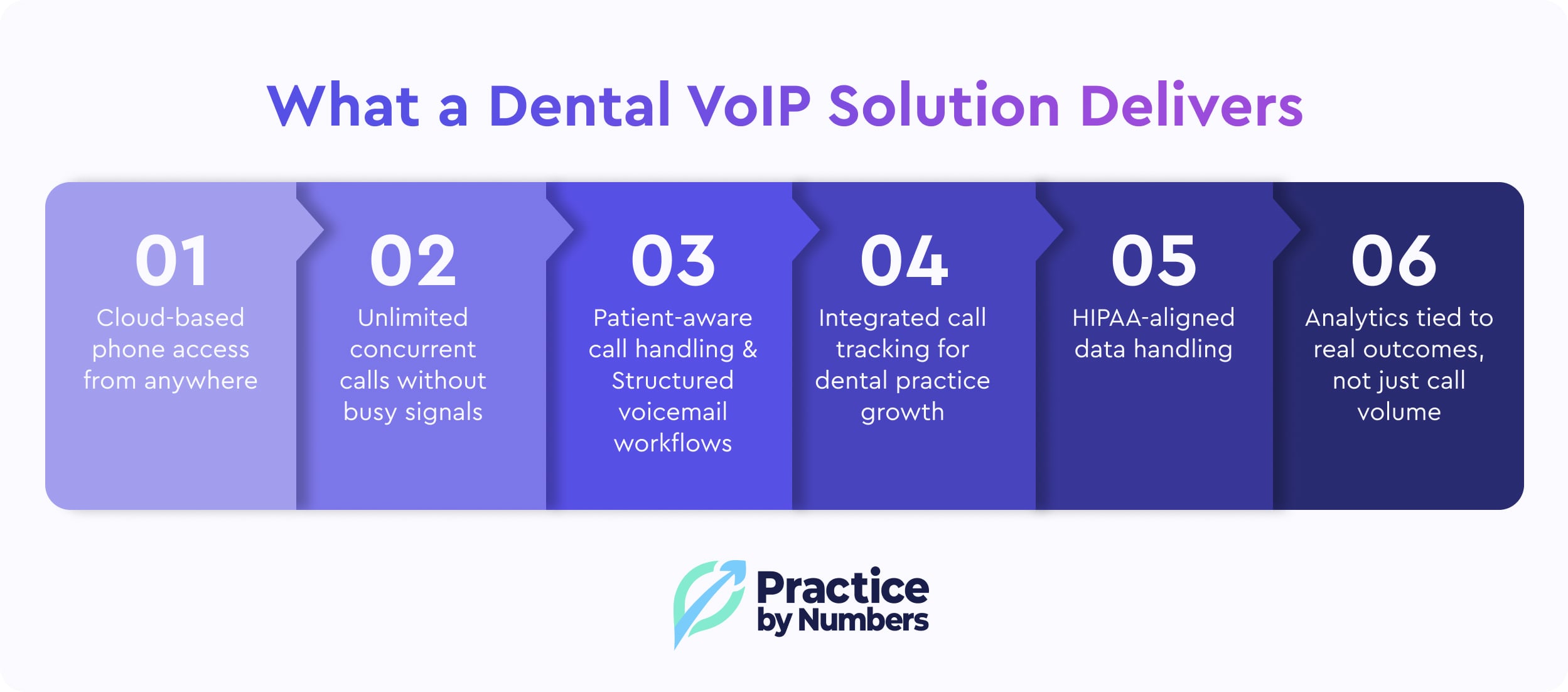
– Unified Communication Platforms: Cloud-based phone systems for dental practices integrate voice, text, fax, and data into single interfaces. Staff access all communication channels from one application rather than juggling separate tools.
– Practice Management Integration: VoIP for dental offices connects directly to PMS databases, surfacing patient information during calls and automatically syncing conversations back to patient records.
– Location Flexibility: Remote team members, multi-location practices, and mobile staff can access identical phone system functionality from any internet-connected device.
– Scalability Without Infrastructure: Adding users, expanding locations, or handling volume spikes requires no hardware installation or capacity upgrades. Cloud-based architecture scales automatically.
– Data-Driven Insights: Every call generates trackable data such as volume patterns, missed call analysis, conversation duration, follow-up completion, and team performance metrics.
Generic VoIP systems provide basic calling features. Dental-specific VoIP platforms are built to work directly with how practices operate. That difference determines whether your phones just handle calls or actively improve patient communication. Dental VoIP solutions understand scheduling patterns, insurance workflows, treatment coordination, and recall campaigns because they sync directly to your practice management system. When a patient calls, the system instantly pulls up their records, like appointments, treatment history, balances, and notes, before the call is answered. Instead of a generic phone conversation, every call becomes informed, personal, and efficient.
What to Look for in VoIP Phone Systems for Dental Clinics
Not all VoIP providers deliver equal value for dental practice operations. Generic business phone systems often lack healthcare compliance requirements, fail to integrate dental-specific workflows, and offer features optimized for sales teams or customer service centers rather than treatment coordination and patient care.
When evaluating phone systems for dentists, prioritize these essential capabilities:
1. HIPAA Compliance
- Encrypted calls and recordings
- Role-based access controls
- Detailed audit logs
- Signed Business Associate Agreement (BAA)
2. Deep PMS Integration
- Two-way sync between phone system and PMS
- Instant caller ID with patient details
- Automatic call notes, recordings, and transcriptions in patient charts
- Calls linked to recalls, treatment plans, and balances
3. Smart Call Routing
- Time-based call flows (office hours, after-hours)
- Custom IVR for new patients, emergencies, billing
- Unlimited simultaneous calls
- Call queues with hold messages and callbacks
4. Dental-Focused Call Analytics
- Missed and unanswered call tracking
- New patient vs. existing patient call metrics
- Call volume trends for staffing
- Team and individual performance insights
- Tracking for recalls, reactivation, and treatment follow-ups
5. Multi-Device Support
- Web-based softphones
- iOS and Android mobile apps
- Desk phone compatibility
- Headset and computer-only setups
6. Multi-Channel Communication
- Built-in SMS for reminders and confirmations
- Digital fax for insurance and referrals
- One unified platform for calls, texts, and faxes
Introducing PbN Voice: Purpose-Built for Dental Practices
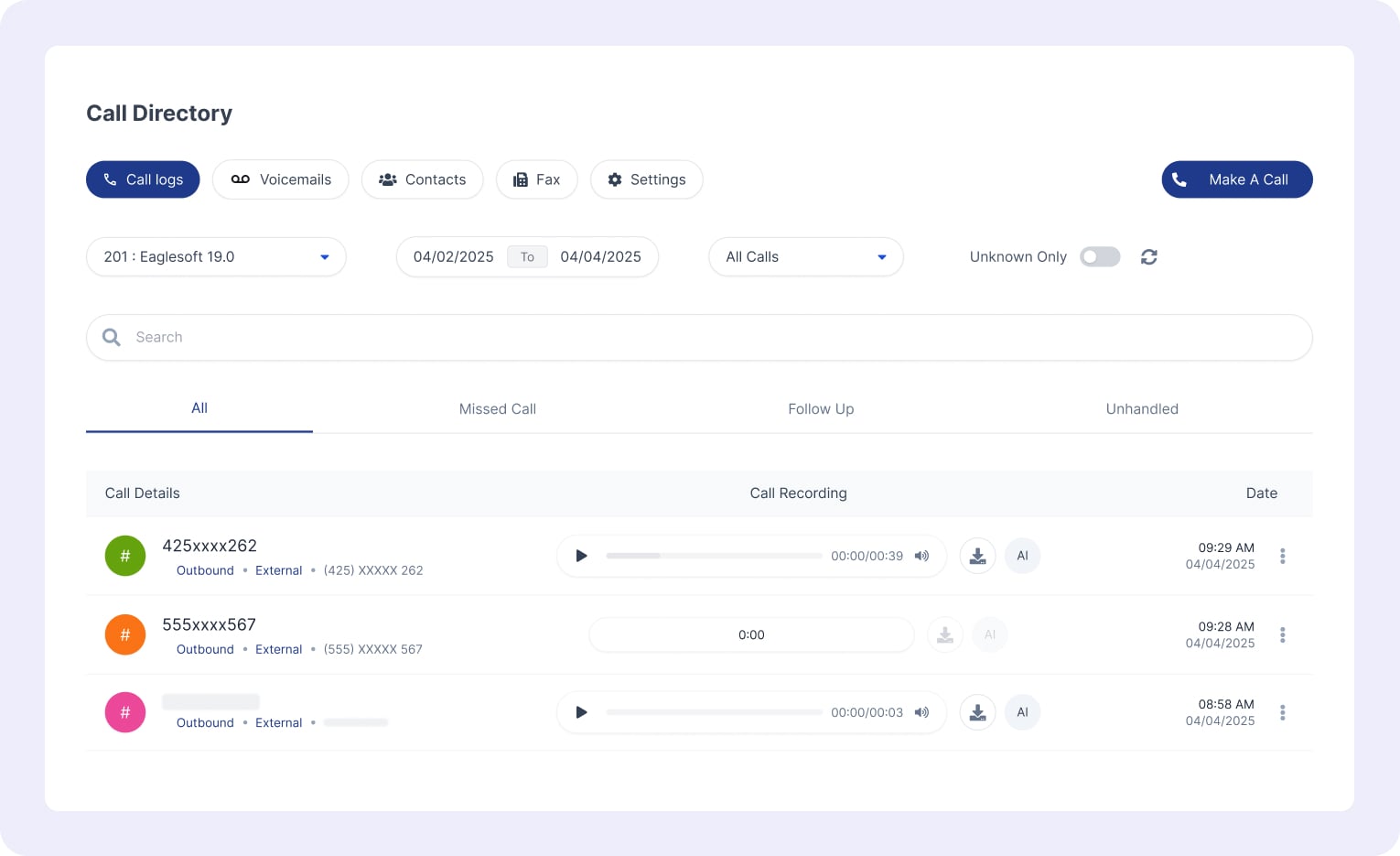
PbN Voice is a cloud-based phone system built specifically for dental clinics. It integrates directly with your practice management data, so calls aren’t just calls; they’re connected to patients, tasks, and outcomes. Every interaction is tracked and actionable, helping your team manage communication more effectively and drive real results.
Core Capabilities of PbN Voice
I. Comprehensive Communication Features and Pricing
PbN Voice delivers enterprise-grade telephony capabilities built for the operational realities of dental practices, providing reliability, scalability, and ease of use across front desk and remote teams.
A. Operational Features and Accessibility
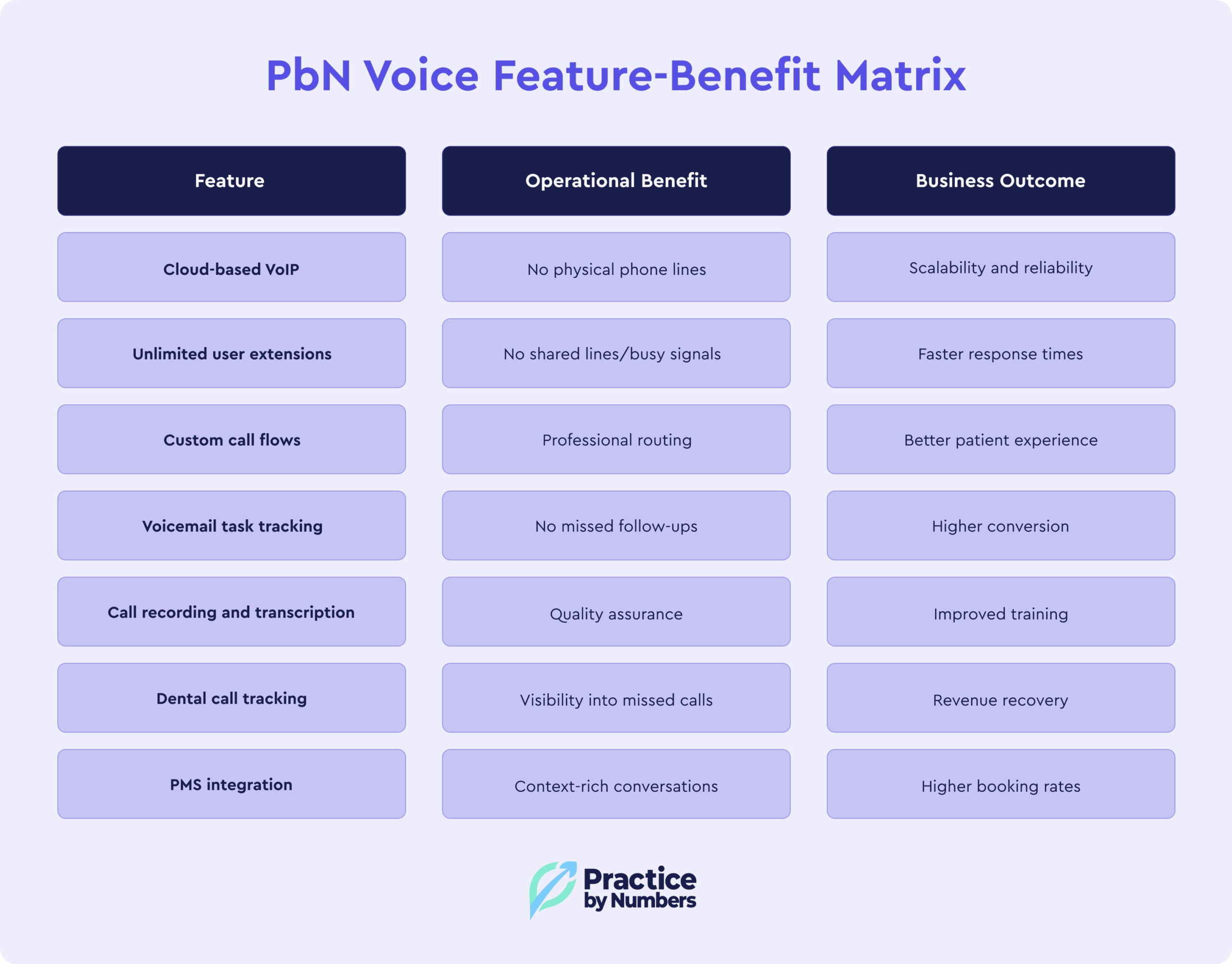
• VoIP Core: PbN Voice operates entirely over internet-based VoIP technology, eliminating the need for traditional phone lines while delivering consistent call quality and modern calling features.
• Cost and Packages: PbN Voice is available as part of the Voice & Communications offering for $99 per month with unlimited extensions. Practices must be on the Engage Plus package or higher to subscribe, and it can also be purchased as a standalone solution, offering flexibility based on practice needs.
• Unlimited Concurrent Calls: Designed to support high-volume dental offices, PbN Voice allows unlimited inbound and outbound calls at the same time. Call waiting is enabled by default, ensuring patients never hear a busy signal during peak hours.
• Emergency Services: During onboarding, each office phone number is linked to the physical office address, enabling accurate location identification for emergency 911 calls and ensuring compliance and safety.
• Fax Capability: Each practice receives one local phone number and one dedicated fax number. Faxing is handled through the web or desktop application, making document transmission simple without the need for physical fax machines. (Mobile faxing is not currently supported.)
B. Flexibility and Device Support
• Softphones and Remote Access: Staff can place and receive calls using a browser-based soft dialer, making it easy to support remote or hybrid teams. International team members can also use the system without disruption, provided they have stable internet connectivity.
• Mobile Access: The PbN Grow iOS app is available globally, allowing team members to stay connected while working remotely or offsite, including international locations such as Peru.
• Supported Hardware: PbN Voice supports select VoIP desk phones, including the Yealink T54W, T53, and W60b models. Physical devices are available for purchase directly through PbN for practices that prefer traditional handsets.
• Do Not Disturb: Users can enable Do Not Disturb (DND) on their extensions to temporarily stop receiving inbound calls, helping staff manage focus time without disrupting overall call flow.
II. Custom Call Flow Management
PbN Voice gives practices full control over how patient calls are routed and handled, ensuring a professional, consistent experience regardless of time, staff availability, or call type.
A. Custom Schedules and Routing
• Call Flow Configuration: Practices can create fully customized call flows, configure extensions, and design Interactive Voice Response (IVR) menus that route callers to the appropriate team members based on their needs.
• Voicemails and Greetings: Custom schedules allow different greetings, messages, and voicemail routing to play automatically during office hours, lunch breaks, after-hours, weekends, or holidays—maintaining professionalism at all times.
• Integration with Existing Systems: PbN Voice supports integration with existing phone providers through dual-ring configurations. Practices using systems like RingCentral, Podium, or Net2Phone can receive call pop-ups in PbN while maintaining their current phone setup during transitions.
B. Setup and Maintenance
• Porting: Practices can keep their existing phone numbers by porting them directly into PbN Voice, ensuring continuity for patients and marketing materials.
• Provider Hours: PbN Voice reads scheduling data from the PMS; however, changes to provider-specific hours (such as hygienist schedules) currently require manual updates within PbN’s office and provider hours settings to ensure accurate routing.
III. Actionable Analytics through Phone IQ
Phone IQ transforms phone activity into measurable intelligence, giving practices visibility into performance, missed opportunities, and staff accountability.
A. Call Tracking and Write-back
• Analytics and Monitoring: Phone IQ dashboards surface key metrics such as “Potential New Patient Missed Calls,” allowing practices to identify lost opportunities and address staffing or process gaps.
• Call Recording and Transcription: Calls can be recorded and transcribed automatically. Practices can enable AI-generated call transcriptions to write back into the PMS, while notes created during phone-related tasks sync directly to the Dentrix Journal for complete documentation.
• Security: To address privacy and access concerns, an upcoming update will allow administrators to set role-based permissions, restricting which users can access call recordings within Phone IQ and the soft dialer.
• Tracking Limitations: While call duration is visible in the patient overview, Phone IQ currently tracks activity by phone line rather than by individual active phone time per user.
B. Leveraging Call Data
PbN Voice works closely with the integrated Tasks feature to track follow-up calls, treatment coordination, and reactivation efforts. This creates a structured system for monitoring outreach tied to specific treatments, ensuring nothing falls through the cracks, and every call contributes to measurable outcomes.
Who Should Use PbN Voice
PbN Voice is best suited for:
- Practices losing new patient calls
- Offices struggling with voicemail follow-up
- Multi-location dental groups
- Practices with remote or centralized teams
- Owners seeking accountability from front desk operations
It is especially valuable for practices that already use Practice by Numbers for analytics, engagement, or growth workflows.
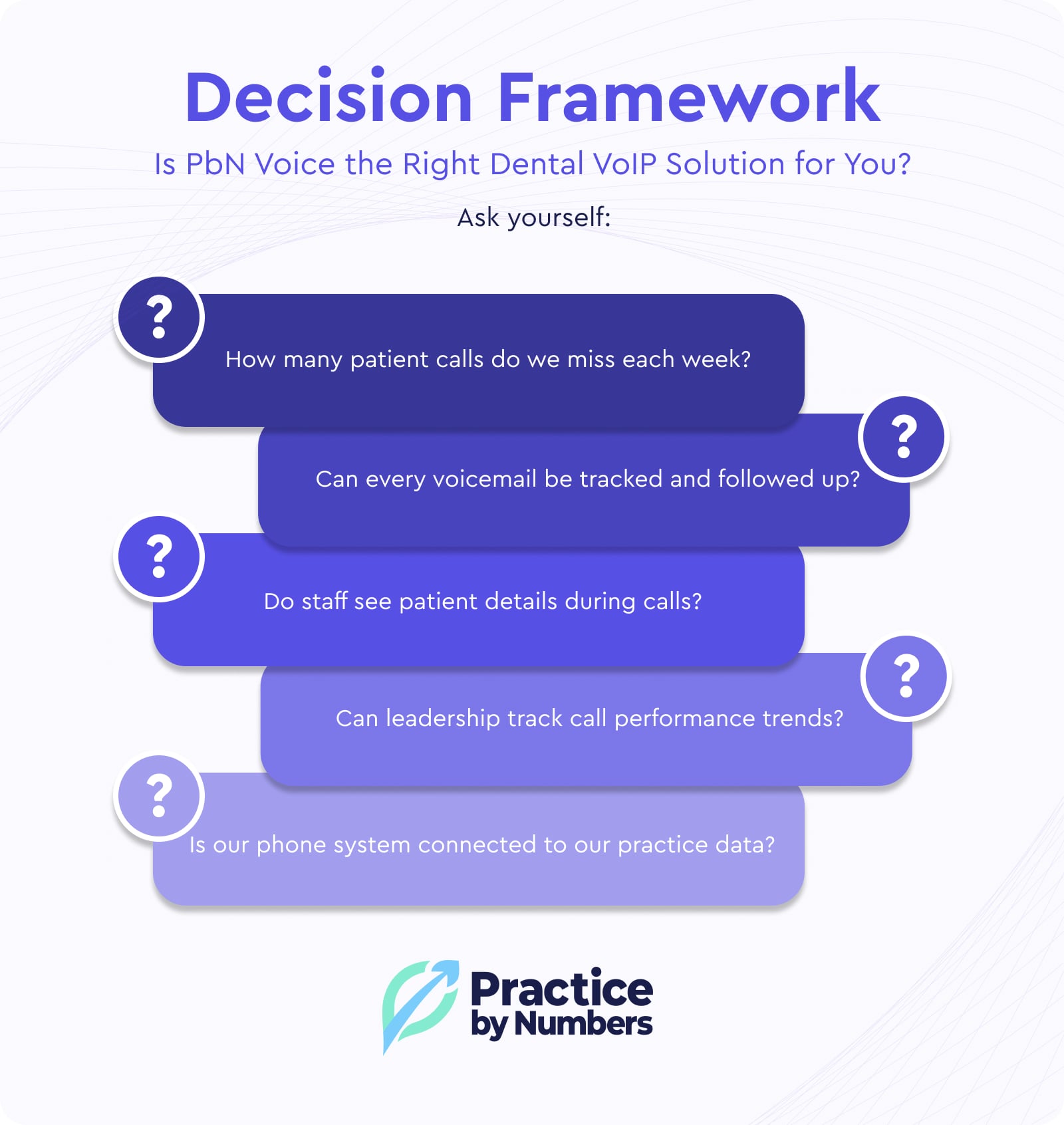
The Reality: If you answered “no” to even one of these questions, your dental practice is likely losing patient opportunities without realizing it. In today’s environment, a modern dental phone system is essential for delivering consistent patient experiences, protecting revenue, and maintaining operational control.
The Solution: PbN Voice, built for dental practices, serves as the foundation for smarter, more connected operations by:
- Capturing every patient opportunity with unlimited concurrent calls, intelligent routing, and missed-call tracking that ensures no inquiry goes unanswered.
- Enabling efficient, context-rich communication by surfacing patient details, treatment history, and follow-up tasks during every call.
- Powering data-driven decisions through call analytics, performance trends, and visibility into staff responsiveness and patient demand.
- Scaling without infrastructure limitations by supporting remote teams, multiple locations, and growth without adding phone lines or hardware complexity.
For practices focused on growth, retention, and operational efficiency, upgrading to PbN Voice, a modern dental VoIP system, is a strategic necessity.
The Strategic Imperative: Why Communication Infrastructure Matters?
Dental practices invest heavily in marketing, technology, and clinical excellence. But without a modern communication backbone, those investments leak value. PbN Voice addresses this gap by transforming the phone from a reactive tool into a proactive growth system.
It is not just VoIP for dental offices. It is a dental-first communication platform designed to support real workflows, real teams, and real outcomes. For practices ready to move beyond basic calling and into measurable, accountable communication, PbN Voice represents a fundamentally better way forward. The ROI question isn’t whether cloud-based phone systems for dental practice operations justify their cost. The question is whether your practice can afford to maintain systems that actively prevent growth, efficiency, and exceptional patient experience.
From Communication Infrastructure to Strategic Asset
Phone systems have evolved from simple communication utilities to strategic practice management platforms. The difference between practices thriving in competitive dental markets and those struggling to grow increasingly correlates with their communication infrastructure sophistication.
Traditional phone systems handle calls. Modern dental VoIP solutions transform patient interactions into data-driven opportunities for better care, stronger relationships, and measurable practice growth.
Practice by Numbers Voice represents this evolution: a HIPAA-compliant phone system built specifically for dentistry, integrating with practice management data, delivering comprehensive analytics, and enabling location-independent communication that scales with practice growth.
For practices committed to operational excellence, the transition from traditional infrastructure to cloud-based phone systems for dental clinics isn’t optional. It’s the foundation enabling everything else your practice is trying to accomplish. When communication becomes integrated, patient interactions become documented, and your phone system actively contributes to practice growth rather than simply connecting calls, you’ve moved beyond basic telephony into operational transformation.