Here’s something most dental practice owners don’t want to hear: the practices that grow consistently aren’t always the best clinically. They’re the ones that market consistently.
That’s not a knock on clinical quality, it matters enormously. But clinical excellence only helps the patients who walk through your door. Marketing is what determines how many of them show up in the first place.
This guide covers every marketing channel and strategy a dental practice should understand. Whether you’re a solo practitioner just getting started or a multi-location group looking to sharpen your approach, this is your starting point.
TL;DR
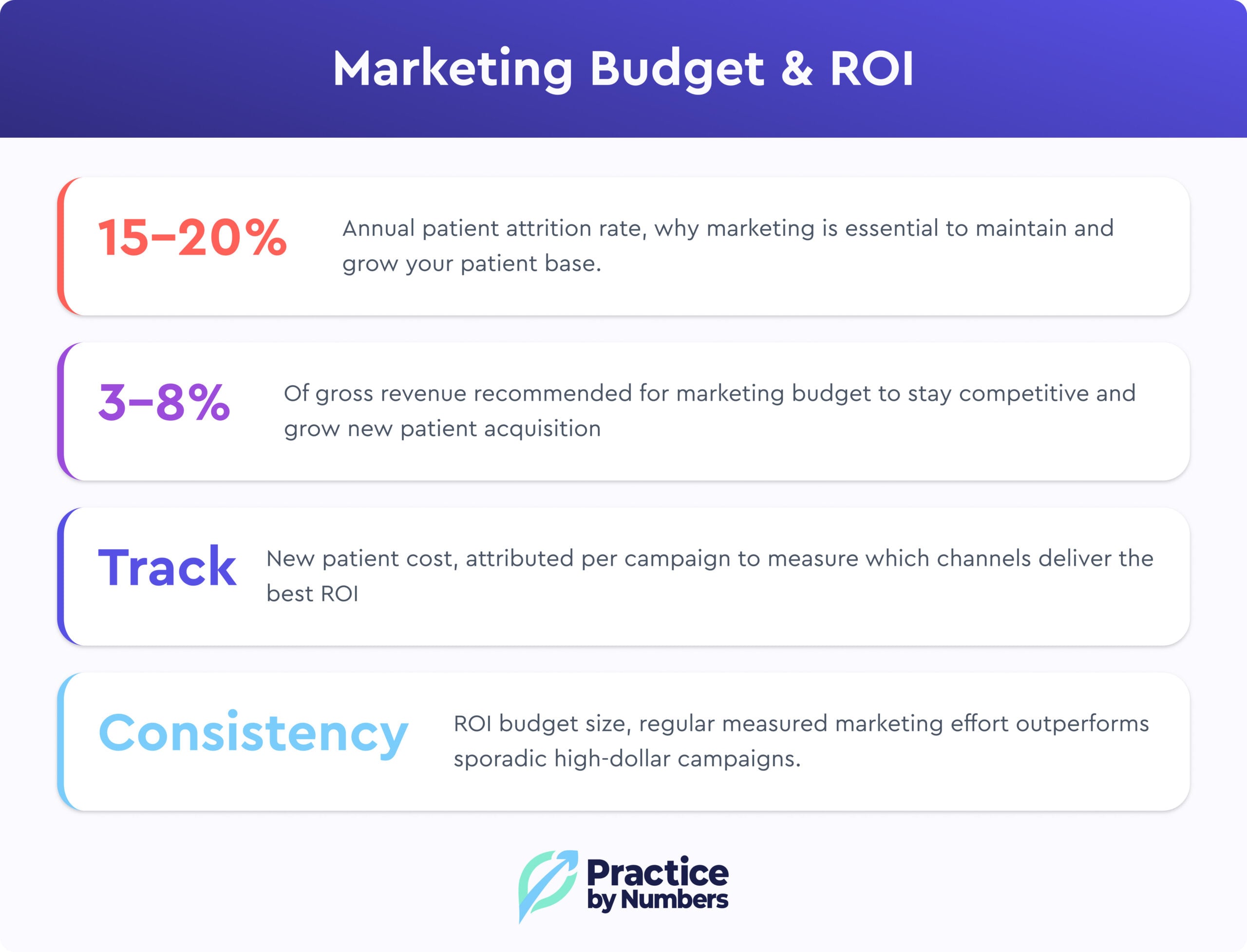
Every dental practice loses a portion of its patient base every year through natural attrition. People move, change jobs, change insurance, or just drift away. Marketing is what replaces them and builds on top.
The channels that consistently deliver the best results for dental practices:
- Local SEO: showing up when nearby patients search for a dentist on Google
- Google reviews: your practice’s first impression for most new patients
- Patient referrals: the highest-converting source of new patients, still
- Paid ads (PPC): faster results than SEO, best for high-intent searches
- Email and recall campaigns: keeping existing patients engaged and coming back
- Content and social media: building trust and staying visible over time
The common thread in all of it: consistency beats budget. A practice that markets steadily and measures its results will always outgrow one that runs big campaigns occasionally and hopes for the best.
Why Does Marketing Matter So Much for Dental Practices?
Most dental practices quietly lose a meaningful share of their active patient base every year. Patients move to a new neighborhood. They change jobs and lose their dental insurance. They have a baby and suddenly have zero bandwidth for routine care. Life happens, and dental visits are easy to skip when nothing hurts.
This isn’t unusual or a sign that your practice is doing something wrong. It’s just how patient bases work. The problem only starts when a practice assumes its existing patients will always be there and stops doing the work to replace the ones who drift away.
Marketing is that work. Not a one-time project. Not a campaign you run when the schedule gets slow. An ongoing function, like patient care itself, that runs consistently in the background and produces compounding results over time.
Practices that treat it that way see more new patients, stronger referral networks, and higher case acceptance from patients who actually know and trust the practice before they walk in the door
How Do You Build a Dental Marketing Plan?
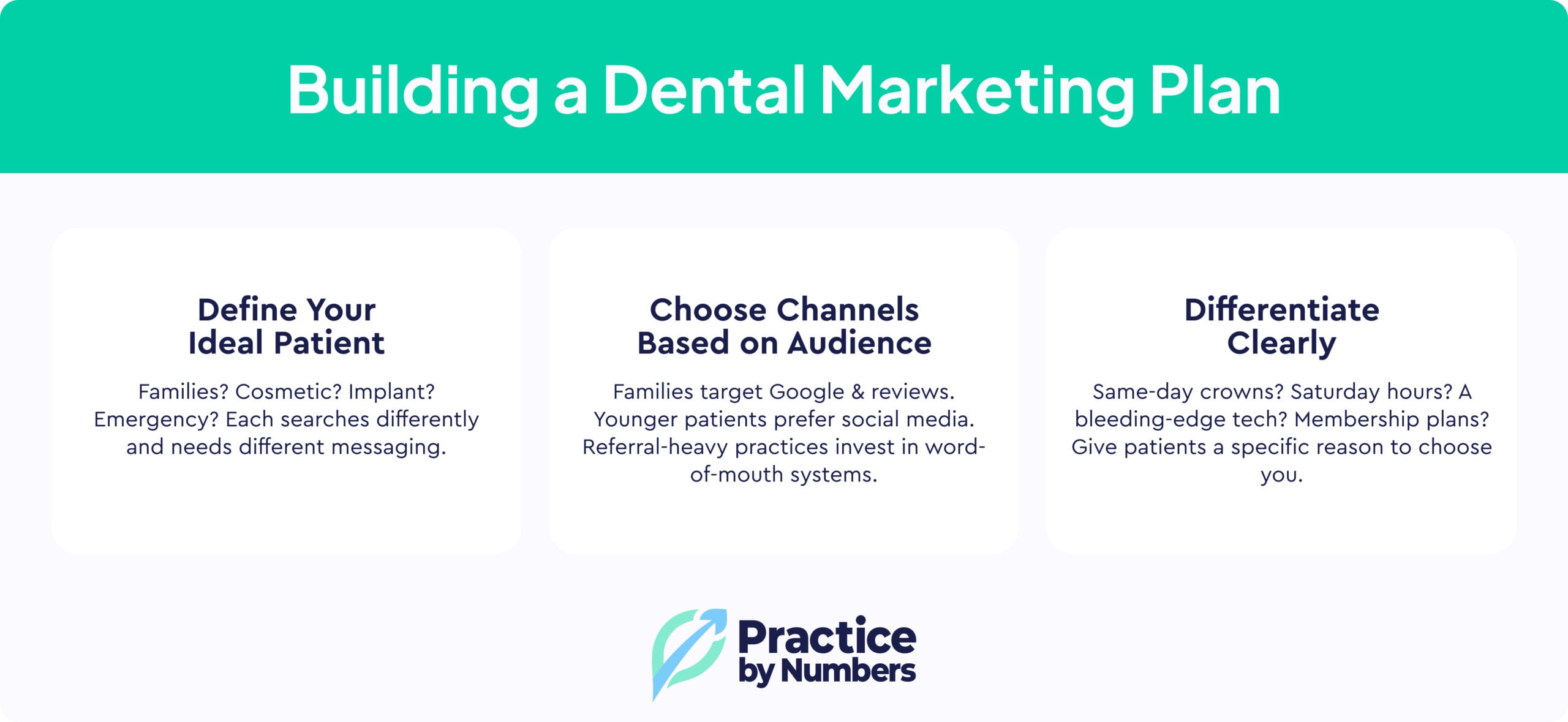
A marketing plan doesn’t need to be long or complicated. It needs to answer three questions clearly.
Who are you trying to reach?
Are you focused on families? Cosmetic patients? Implant candidates? Emergency cases? The answer shapes everything that you say, where you say it, and how you say it. A family practice targeting suburban parents needs different messaging and different channels than a specialty center focused on full-arch implant cases. Know your patient before you choose your marketing.
Where does that patient look for a dentist?
Families with young kids tend to ask friends and search Google. Younger adults often find local businesses through Instagram or TikTok. Patients dealing with a dental emergency are searching Google right now with high urgency. Patients who need implants research heavily before picking up the phone. Each audience has different habits. Go where they already are, not where you’re most comfortable being.
Why should they choose you specifically?
Every dental practice says they’re friendly, professional, and caring. That’s not a differentiator, it’s the baseline. What else do you offer? Same-day crowns? Sedation for anxious patients? Extended evening hours? A dental membership plan for uninsured patients? Clear aligners? Give prospective patients a specific, concrete reason to pick your practice over the one down the street.
What Are the Most Effective Dental Marketing Channels?
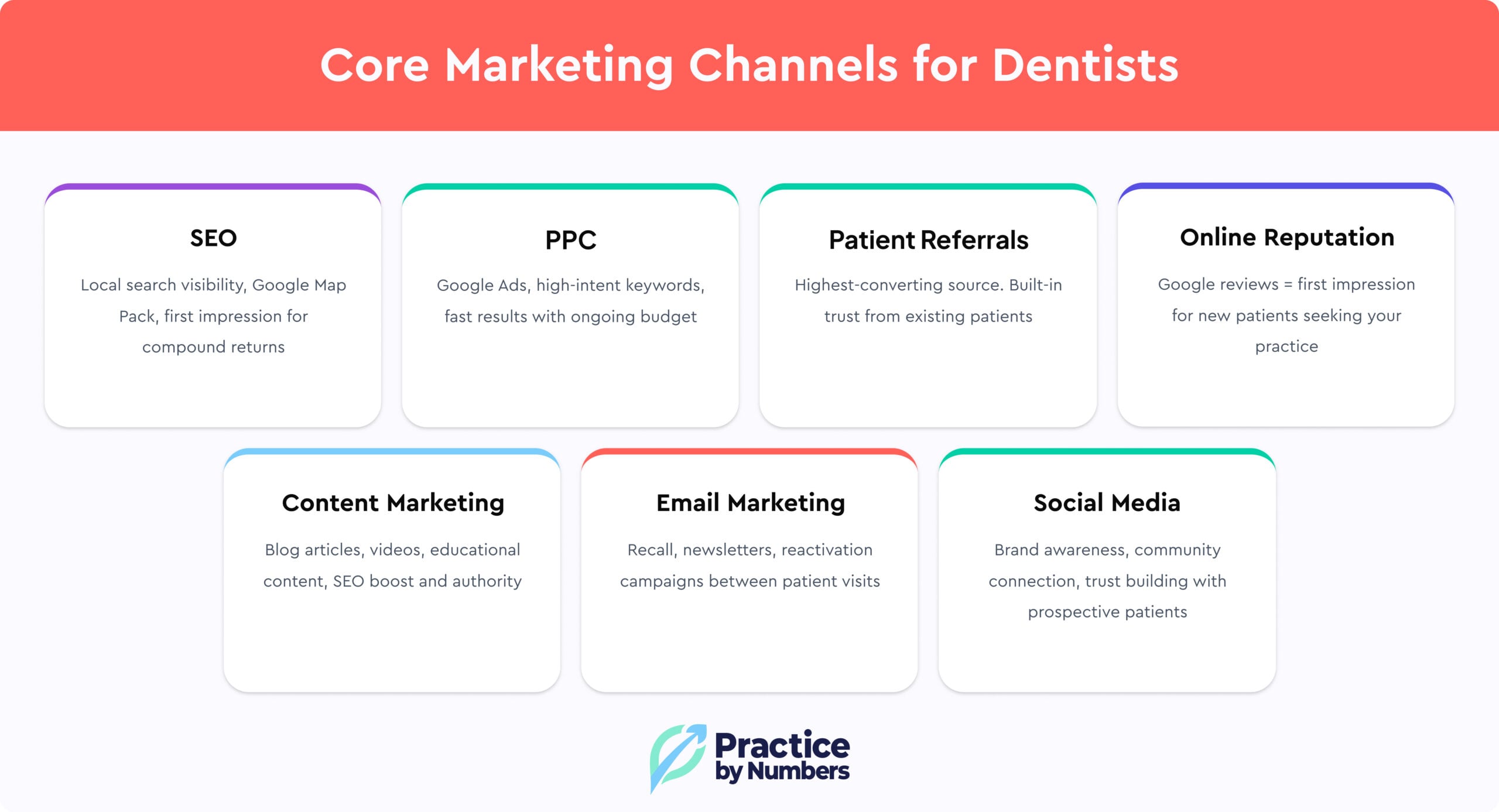
Every marketing channel serves a different purpose. Some channels help patients discover your practice, others build trust, and some improve retention and referrals. The goal is not to be everywhere, it is to invest in the channels that align with your patients, your services, and your growth goals.
1. Local SEO: Getting Found on Google
SEO stands for search engine optimization. In plain terms, it’s the work that makes your practice show up when someone nearby searches “dentist near me” or “emergency dentist [your city].”
For most dental practices, local SEO is the highest-volume marketing channel available. When your practice appears in the Google Map Pack: the three local results that show up above organic search results, you’re capturing patients who are actively looking for exactly what you offer, right now.
Local SEO involves keeping your Google Business Profile fully filled out and regularly updated, getting consistent citations across directories like Yelp and Healthgrades, having a website that loads fast and is built for local keywords, and collecting reviews (more on that below). It’s a long-term investment, but it compounds. The work you do today keeps working for years.
2. Google Reviews: Your Online First Impression
Before a new patient ever calls your office, they’ve almost certainly read your reviews. A practice with a strong volume of recent, positive reviews gets more calls than one with the same quality of care and fewer reviews. That’s just how people make decisions now.
The fix is simple, but it requires a system. Ask every satisfied patient for a review, right after the appointment, via text, with a direct link. Respond to every review you receive, positive or negative. And make review collection part of your routine rather than something you remember to do occasionally.
A handful of new reviews every month is worth far more than a burst of 50 reviews once a year and then nothing.
3. Patient Referrals: Still the Highest-Converting Source
Referred patients arrive already trusting you. They were sent by someone who knows your practice firsthand and vouched for it. That trust makes them more likely to schedule, more likely to show up, and more likely to accept treatment. No paid channel comes close to that conversion profile.
You don’t need a complex referral program. You need to ask. After a positive visit, a simple “We’d love to take care of your family and friends, please send them our way” goes a long way. A referral card with the practice name and phone number, a text-a-friend link, or a small thank-you gesture for referrals that lead to new patients, any of these work when done consistently.
4. Paid Ads (PPC): Faster Results, Active Budget
Google Ads and social media advertising can put your practice in front of the right patients quickly, faster than SEO, which takes months to build. The tradeoff is that paid ads require ongoing budget. When you stop spending, the results stop too.
The most effective dental PPC campaigns go after high-intent searches, patients who are actively looking to book right now. “Emergency dentist near me.” “Dental implants [city].” “Invisalign provider [neighborhood].” These are patients who have already decided they need a dentist. You’re just competing to be the one they call.
One important note: send paid ad traffic to a dedicated landing page designed for that specific patient, not just your homepage. A patient who searched “dental implants” should land on a page about dental implants with a clear next step, not a general homepage where they have to hunt for what they need.
5. Email and Recall Campaigns: Keeping Existing Patients Engaged
New patient acquisition gets most of the attention, but your existing patient base is where a huge amount of revenue already lives. Recall reminders, reactivation campaigns for lapsed patients, educational content, and practice updates keep your practice top of mind for people who have already chosen you once.
Email is affordable, measurable, and effective when it’s consistent. One well-written email per month is more valuable than a flood of emails every week that patients start ignoring.
6. Content Marketing: Building Trust Over Time
Blog articles and educational content serve two purposes at once. They bring in organic traffic from patients searching for answers to dental questions: “does insurance cover implants,” “what to expect after a root canal,” “how long do veneers last,” and they position your practice as the knowledgeable, trustworthy resource those patients were looking for.
The only requirement is consistency. One genuinely useful article per month beats ten articles published at once and then nothing for six months. Search engines and patients both reward practices that show up regularly.
7. Social Media: Visibility and Community
Social media rarely drives direct new patient bookings the same way Google does. What it does is keep your practice visible, build personality and trust, and maintain a connection with your community between visits. Patients who follow your practice on Instagram or Facebook are more likely to refer you, more likely to stay engaged, and more likely to rebook when you show up consistently in their feed.
Think of social media less as a patient acquisition channel and more as a relationship maintenance channel. It works best when it’s genuine like team moments, patient education, behind-the-scenes content, and stops working when it feels like a brochure.
8. Community Involvement: The Channel Nobody Talks About
Sponsoring a local youth sports team, partnering with schools for dental health education days, and showing up at community events build local brand recognition in a way no digital channel can fully replicate. People trust businesses they’ve seen show up in their community. It’s slow-building and hard to attribute, but it’s real, and it compounds.
How Much Should a Dental Practice Spend on Marketing?
The industry benchmark is typically 3–8% of gross revenue. Newer practices or those in highly competitive markets tend to invest closer to the higher end. Established practices with strong referral networks and good retention can often sustain growth toward the lower end.
But the number matters far less than the tracking. Every marketing channel should be measurable. How many new patients came from this source, what did they cost to acquire, and what production did they generate? If you can’t measure it, you can’t improve it. And you’ll keep spending on things that feel like they’re working without knowing whether they actually are.
Ask every new patient how they found you. Use call tracking numbers on different campaigns. Check your website analytics monthly. The practices that grow their marketing budgets intelligently are the ones who know where their best patients come from.
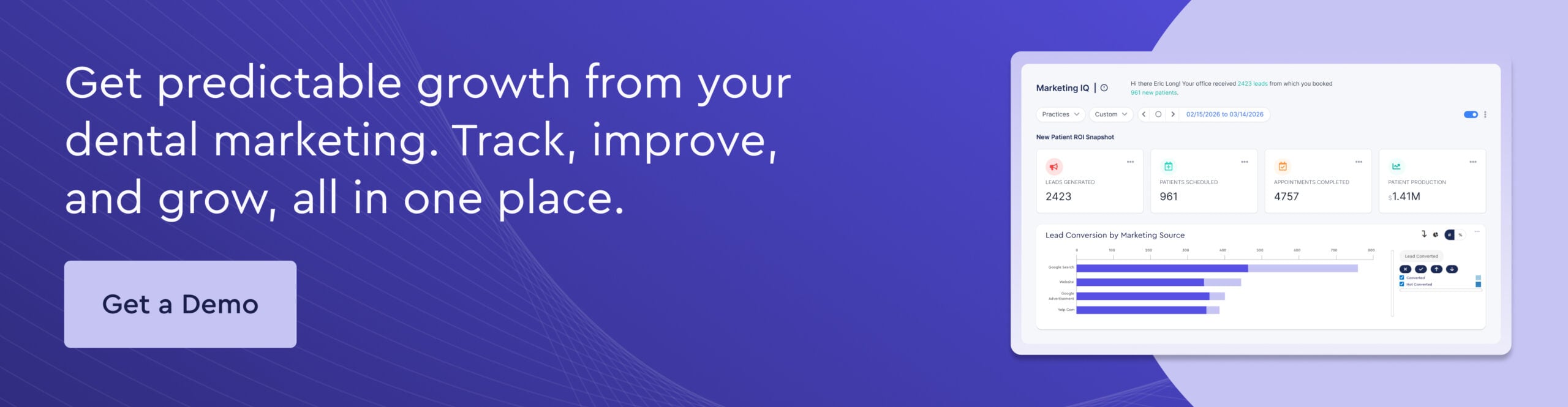
How Marketing IQ by PbN Takes the Guesswork Out of Dental Marketing
Marketing IQ by Practice by Numbers connects your marketing activity to actual practice outcomes, so you’re not just spending on marketing, you’re understanding what it produces.
With Marketing IQ and PbN’s broader marketing tools, your practice can:
- See which channels bring in your best patients
- Automate review collection after every positive visit
- Run recall and reactivation campaigns without extra tools
- Manage online booking that syncs with your actual schedule
- Track marketing performance alongside practice KPIs
Marketing works best when you can see what it’s doing.
FAQs
Q. What is the best marketing strategy for a new dental practice?
Start with local SEO (Google Business Profile optimization), Google Ads targeting high-intent keywords, and an aggressive review-building program. These three channels generate new patient inquiries fastest while longer-term strategies like content marketing build over time.
Q. How do I measure dental marketing ROI?
Track new patient source attribution, ask every new patient how they found you, use call tracking numbers, and monitor website form submissions. Compare the cost of each marketing channel against the number of new patients and revenue it generates.
Q. Should I hire a dental marketing agency or do it in-house?
It depends on your internal capabilities and budget. Agencies bring specialized expertise and save time but cost more than in-house efforts. Many practices use a hybrid approach, managing social media and referrals internally while outsourcing SEO and PPC to specialists.