Every dental practice has the same goal: a steady stream of new patients. But the path to getting there looks different depending on which marketing channels you choose.
You’re posting on social media, maybe running ads, maybe even trying SEO… but new patient flow still feels unpredictable. That’s the reality of online dental marketing in 2026. More options than ever, but far less clarity on what actually works.
This article is for dental practice owners, office managers, and DSOs who want visibility and growth without getting lost in complexity.
In this article, we’ll cover:
- Which online dental marketing channels matter most in 2026
- How each channel actually brings in patients
- Where most practices waste money (and how to avoid it)
- How to prioritize based on effort vs return
TL;DR
If your dental marketing feels inconsistent, it’s not because you need more channels, it’s because the right ones aren’t working together.
In 2026, patient acquisition follows a clear path:
- Patients search with intent (Local SEO, Google Ads)
- They validate trust (Reviews, social proof, content)
- They decide quickly (Website experience)
The channels that actually drive patients are:
- Local SEO (highest intent)
- Google Ads (fast demand capture)
- Patient reviews (trust + conversion)
- Social media (familiarity over time)
- Your website (final decision point)
Focus on building visibility → trust → conversion in that order.
Don’t try to do everything, fix what’s already in place and make it work together.
Why is online dental marketing more complex (and more important) in 2026?
Patients don’t “find a dentist” anymore. They filter, compare, and validate before even calling. So, It’s no longer about just being out there, it’s about being in the right places at the right time.
How patients actually find dentists now:
- They start with a search
- They check your website, read what others say about you
- They scroll through your social media to see your work and team
- They look at your reviews and ratings across platforms
- Only after all this do they pick up the phone or book online
Your online presence has become your first impression. Before anyone walks through your door, they’ve already formed an opinion based on what they found online.
What has really changed in 2026?
People are busier than ever, but when they actually need a dentist, they know it. They don’t browse casually, they search with purpose. The challenge is that their attention is spread across many platforms, so you need to be visible on the channels where they’re actually looking.
The win isn’t about being the loudest. It’s about being in the right place when someone is actively searching for a dentist. Practices that understand this simple shift are the ones attracting consistent new patients.
Which online dental marketing channels actually drive patients today?
Not all channels are equal. Some generate attention, others generate action. Here are the ones that consistently convert in 2026:
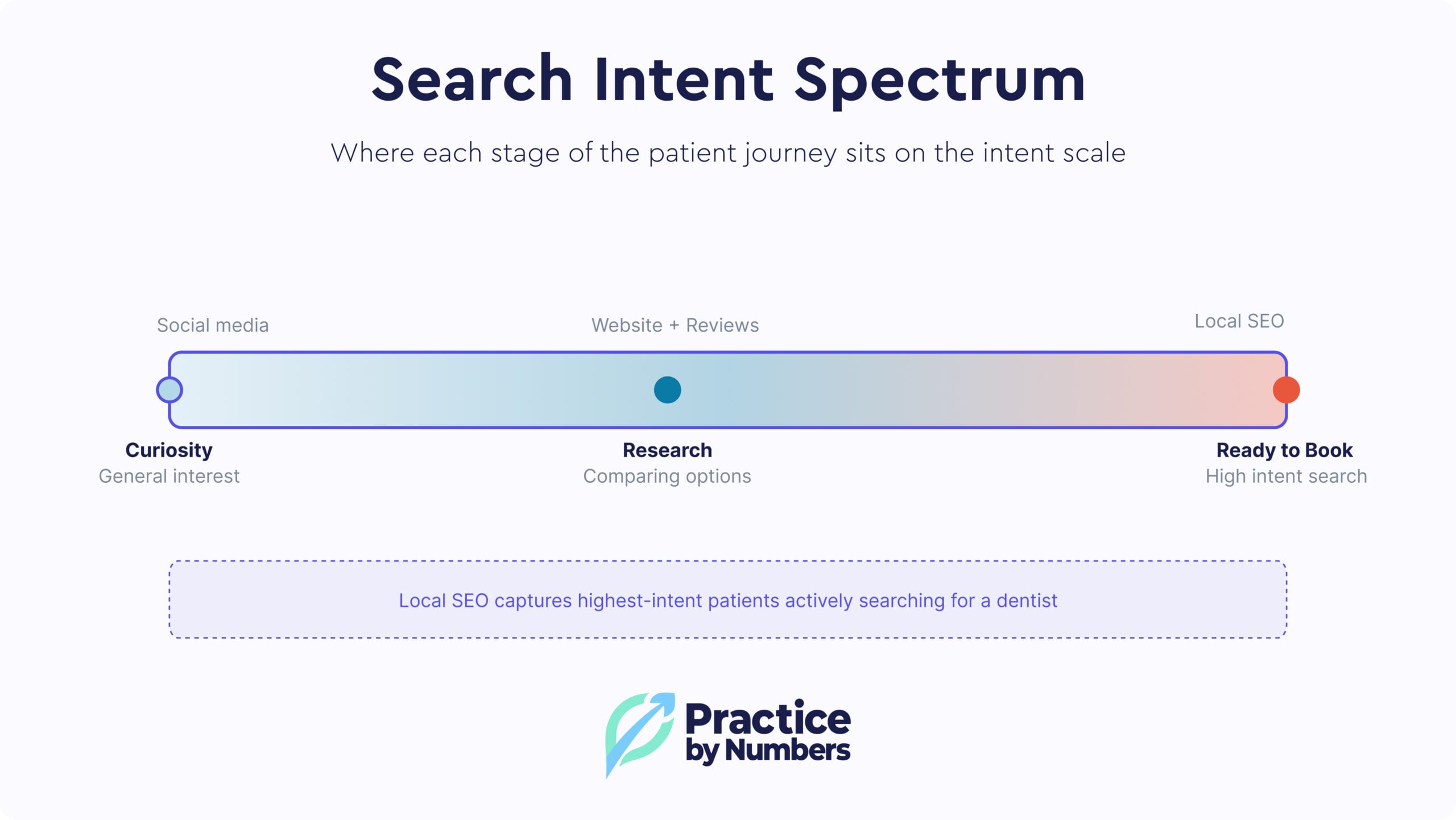
1. Local SEO: Capturing High-Intent Patients
Local SEO puts your practice in front of patients at the exact moment they’re searching. Example: queries like “dentist near me” or “emergency dentist open now.”
This is the highest-intent traffic you can get. These patients aren’t browsing, they’re ready to act.
Winning here isn’t just about ranking. It’s about:
- A fully optimized Google Business profile
- Consistent, high-quality reviews
- Accurate listings across maps and directories
If you’re not visible in local search, you’re invisible at the point of decision.
Key insight: Local SEO doesn’t create demand. It ensures you’re chosen when demand already exists.
2. Google Ads: Capturing Demand Instantly
Google Ads gives you immediate visibility at the top of search results, placing your practice in front of patients before organic listings even appear.
Unlike SEO, this is paid positioning. You’re buying speed and control.
But performance depends entirely on execution:
- Targeting the right keywords (high-intent, not broad)
- Writing clear, relevant ad copy
- Tracking conversions, not just clicks
Used well, ads can fill gaps in your schedule quickly. Used poorly, they burn budget with little return.
Key insight: Google Ads don’t generate new demand, they help you capture existing demand faster than competitors.
3. Patient Reviews: Your Strongest Conversion Driver
Before booking, patients look for reassurance, and they trust other patients far more than marketing.
Reviews act as real-world proof of your care, consistency, and experience. They reduce uncertainty in a way no website or ad can.
In 2026, it’s not just about having good ratings. What matters is:
- Recency (are people still choosing you?)
- Consistency (is the experience reliable?)
- Volume (does this feel like a trusted practice?)
A steady flow of authentic reviews signals credibility and momentum.
Key insight: Reviews don’t just support your marketing, they are your most powerful conversion driver.
👉 See How Patient Relationship Management Boosts Practice Revenue
4. Social Media: Building Familiarity Before Conversion
Social media rarely drives immediate bookings, and that’s where most practices get it wrong. Its real role is to build recognition and comfort over time.
Today, short-form video leads:
- Quick procedure explainers
- Before-and-after transformations
- Simple, educational content
Patients may not act the first time they see you. But repeated exposure builds familiarity and familiarity builds trust.
Key insight: Social media doesn’t convert in the moment, it ensures you’re remembered when the patient is ready.
5. Your Website: Where Patients Decide
Your website is where interest turns into action. By the time a patient lands here, they’re evaluating one thing: Do I feel confident choosing this practice?
That decision depends on:
- Clear, professional design
- Fast load speed (especially on mobile)
- Simple navigation and booking flow
- Trust signals (reviews, credentials, real images)
A confusing or outdated site introduces doubt — and doubt kills conversions instantly.
Key insight: Your website doesn’t need to impress, it needs to remove friction and make saying “yes” easy.
👉 See How Smart Online Booking Drives Dental Practice Growth
How should you prioritize these channels without getting overwhelmed?
Most practices don’t struggle because they lack options, they struggle because they try to do everything at once, without a clear order.
A better way to think about marketing is in layers, not channels:
Layer 1 | Visibility (SEO + Ads): This is how patients find you. Without visibility, nothing else matters.
Layer 2 | Trust (Reviews + Social proof): Once they find you, they need a reason to believe you’re the right choice.
Layer 3 | Conversion (Website + booking flow): Finally, you need to make it easy for them to take action.
Each layer builds on the one before it. If one is weak, the others underperform. For example, great ads won’t work if your website creates doubt. Strong SEO won’t convert without reviews.
You don’t need to be everywhere, you need these layers working together.
Growth doesn’t come from adding more channels. It comes from aligning the ones that directly influence the patient decision journey.
👉 Explore PbN Dental Marketing Suite
What mistakes are practices still making in online dental marketing?
Despite better tools and more awareness, most practices are still making the same foundational mistakes, not because they don’t care, but because they lack clarity on what actually drives results.
The most common patterns:
- Running Google Ads without optimizing the website they send traffic to
- Posting on social media without a defined purpose (education, trust, or visibility)
- Treating reviews as damage control instead of a consistent growth lever
- Measuring activity (clicks, posts, impressions) instead of actual patient conversions
These are prioritization problems. Marketing feels “busy,” but not effective, because there’s no clear connection between effort and outcome.
What’s missing is a simple question: Where did this patient come from, and why did they choose us? If you can’t trace a booked patient back to a channel or touchpoint, either that channel isn’t working or you’re not measuring what matters.
What does a simple, effective online dental marketing strategy look like in 2026?
The most effective strategies today aren’t complex, they’re disciplined and focused on the fundamentals that actually drive patient acquisition.
Start with a strong foundation:
- Local SEO that ensures you show up for high-intent searches
- Targeted Google Ads to capture immediate demand
- Consistent review generation to build trust and credibility
- A fast, clear website that converts interest into bookings
Once these are working together, you can layer in:
- Educational content
- Social media for familiarity and recall
- Additional channels for scale
The difference is sequencing. High-performing practices don’t jump to advanced tactics, they strengthen the basics first. The best strategy isn’t the most sophisticated one. It’s the one you can execute consistently, measure clearly, and improve over time.
Key Takeaways
- Local SEO and Google Ads capture existing demand, not create it
- Patient reviews are your strongest conversion driver, not just a support tactic
- Social media builds familiarity and recall, not immediate conversions
- Your website is where patients finalize decisions, friction here kills growth
- Most practices fail by:
- Spreading efforts too thin
- Ignoring reviews until there’s a problem
- Running ads without fixing conversion systems
- Tracking activity instead of actual patient outcomes
- The most effective strategy is layered:
- Visibility → Get found
- Trust → Get chosen
- Conversion → Get booked
- Growth doesn’t come from adding more channels, it comes from aligning the right ones
- You don’t need a complex strategy, you need a consistent, measurable one
- The fastest way to improve results:
→ Fix one underperforming channel completely before expanding
People Also Ask
Q. What is the most important online dental marketing channel in 2026?
Local SEO is the most important because it captures high-intent patients actively searching for a dentist near them.
Q. How much should a dental practice spend on online marketing?
Most practices spend 5–10% of revenue, but effectiveness matters more than budget size.
Q. Do dental practices still need social media?
Yes, but mainly for building trust and familiarity, not immediate patient acquisition.
Q. How long does dental SEO take to show results?
Typically 3–6 months for noticeable improvement, but it compounds over time.
Q. Why isn’t my dental marketing generating patients?
Usually because of weak conversion systems, like poor websites, lack of reviews, or unclear tracking, not lack of effort.