To get new dental patients, you need 4 things working together: patients can find you, they have a reason to pick you over the practice down the street, booking is easy, and you know what each new patient costs you. Many practices get the first part right and lose patients in the other three.
Competition is tighter than it was 5 years ago. ADA Health Policy Institute data shows more than 1 in 4 dentists within 10 years of graduation were affiliated with a DSO in 2024, and DSOs bring bigger marketing budgets. Patients are also changing how they search. rater8’s 2026 Patient Choice Report found 47% of patients now use AI to find a healthcare provider.
- Differentiate your practice through services, convenience, pricing, and patient experience.
- Improve visibility across Google, AI search, reviews, and local directories.
- Make booking easier with online scheduling, quick responses, and reliable call handling.
- Use patient referrals, paid advertising, and local partnerships to attract new patients.
- Offer clear insurance, financing, and membership options to reduce booking barriers.
- Track cost per new patient, conversion rates, and retention to measure growth.
What Is a Patient Acquisition Strategy?
A patient acquisition strategy is your plan for attracting, converting, and keeping new patients at a cost your practice can afford. It answers 4 questions:
- Which patients do we want most?
- Where do they look for a dentist?
- Why should they choose us?
- What does each new patient cost, and what are they worth?
Step 1: Decide Why Patients Should Choose You
Look at the 5 practices closest to you and list what they don’t offer. Those gaps are where you can stand out.
Gap to check | Example of how to stand out |
|---|---|
Hours | Early mornings, evenings or Saturdays |
Speed | Same-week new patient visits, same-day emergencies |
Services | Implants, sedation, clear aligners or sleep apnea in-house |
Payment | In-house membership plan for uninsured patients |
Patients served | Kids, anxious patients, seniors, a specific language |
Experience | Clear upfront pricing, short wait times, modern technology |
Pick 1 or 2 differences and put them everywhere: your Google Business Profile, website headline, ads and front desk script.
Step 2: Get Found Where Patients Look
Patients find dentists through Google search and Maps, AI tools like ChatGPT, review sites, and friends. Cover the basics first:
- Google Business Profile: Complete every field, list every service, add new photos monthly and post updates.
- Reviews: rater8’s 2026 report found 75% of patients won’t consider a provider rated below 4.0 stars. Ask every happy patient by text after their visit and reply to every review.
- Directories: Keep your name, address and phone number identical on Healthgrades, Zocdoc, Yelp, and Bing. AI tools pull heavily from these listings.
- Website: One page per service with a clear answer, cost range and booking button at the top. These pages are what Google and AI tools quote.
For the full channel breakdown, see our 360° digital marketing strategy for dental practices.
Step 3: Make Your Offer Easy To Say Yes To
Cost is the first question most new patients ask. Make the answer easy to find.
- List the insurance plans you accept on your website and Google profile. “Do you take my insurance?” is one of the most common calls a front desk gets.
- Offer an in-house membership plan for patients without insurance. A flat yearly fee covering cleanings, exams and X-rays, plus a discount on other treatment, gives uninsured patients a clear reason to book.
- Show financing options for larger treatment like implants and aligners.
- Use a simple new patient offer, such as a set price for an exam, cleaning and X-rays. Check your state dental board’s rules on advertising discounts first.
Step 4: Answer Every Call and Booking Request
This step decides whether your marketing spend pays off. A new patient who reaches voicemail usually calls the next practice on the list.
- Track your answer rate. Review missed calls by hour and day. Lunch, early morning and late afternoon are common gaps.
- Cover the gaps. Use call routing, a virtual receptionist or an AI phone assistant for overflow and after-hours calls.
- Text back missed calls within minutes. A quick “Sorry we missed you, how can we help?” saves many of them.
- Use a new patient script. Greet warmly, ask what brought them in, answer the insurance question, and offer 2 specific appointment times.
- Offer online booking on your website and Google profile for patients who don’t want to call.
- Reply to web forms and social messages the same business day.
Step 5: Turn Patients Into Referrals
Your current patients are your cheapest source of new ones. Most will refer if you ask at the right moment.
- Ask after a good experience, such as a smooth cleaning or a finished treatment.
- Give patients something to pass on: a referral card, a text link or an email with your booking link.
- Thank every referrer with a handwritten note. Check your state’s rules before offering gifts or credits for referrals.
- Track referrals by name so you can see who your best advocates are.
Step 6: Use Paid Ads to Fill Specific Gaps
Paid ads work best when you know what you’re trying to fill: open hygiene slots, more implant consults or a new location.
- Google Search ads for high-intent searches like “emergency dentist near me” or “dental implants [city].” Send each ad to the matching service page.
- Google Local Services Ads charge per lead and show a “Google Screened” badge above regular results.
- Facebook and Instagram ads for awareness within a few miles of your office, especially for cosmetic services and new patient offers.
Set a monthly budget, track every call and form, and pause anything that doesn’t produce booked patients within 60 to 90 days.
Step 7: Build Local Partnerships
Local relationships bring a steady flow of referred patients.
- Local employers: Offer lunch-and-learn sessions or on-site screenings, and become a recommended dentist for their staff.
- Physicians and specialists: Pediatricians, OB-GYNs and sleep physicians refer patients who need dental care.
- Schools and sports teams: Sponsor teams, offer mouthguard fittings or visit classrooms.
- New residents: Reach people who just moved into your area through welcome mailers and neighborhood apps.
Track Cost Per New Patient
The most important acquisition number is cost per new patient:
Cost per new patient = marketing spend for a channel ÷ new patients from that channel
Compare it with what a new patient is worth over time.
Metric | Why it matters |
|---|---|
New patients per month, by source | Shows which channels work |
Cost per new patient, by channel | Shows where to spend more or less |
Call answer rate | Shows how many leads you lose at the front desk |
Call-to-appointment rate | Shows how well your team converts interest |
First-visit show rate | Shows whether booked patients show up |
New patient retention at 12 months | Shows whether you’re keeping who you win |
Turn Your Patient Acquisition Strategy Into Measurable Growth
Getting more dental patients isn’t just about increasing visibility or spending more on marketing. It’s about giving patients a reason to choose your practice, making appointments easy to book, and turning first visits into lasting relationships.
Start by identifying gaps in your patient acquisition process, improving how your team handles inquiries, and tracking which channels bring in new patients at a sustainable cost.
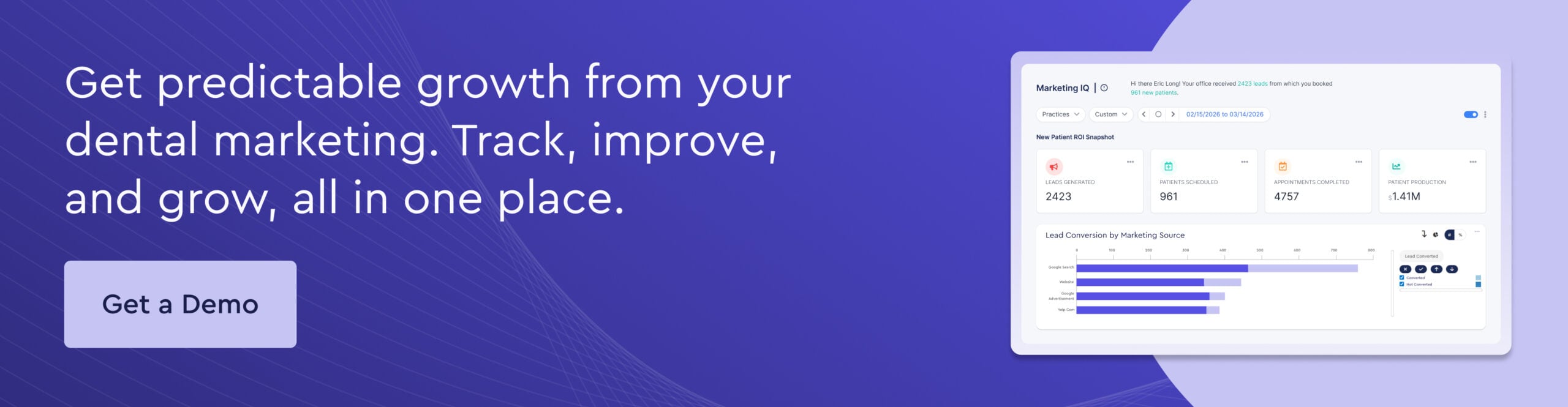
With Practice by Numbers’ Dental Marketing Suite, you can connect marketing campaigns, calls, and patient records to track new patient acquisition, measure cost per patient, and identify which channels contribute to practice growth.