Moving to a new practice management system (PMS), or rolling one out across new locations, is one of the biggest changes a dental practice can take on. It’s also where good plans quietly fall apart. On the Special Edition of the Practice Pulse podcast, host and Practice by Numbers co-founder Dr. Aditi Agarwal and Jill Nesbitt, founder of Optimize Dental, deep dive into why these projects get chaotic and how leaders can steer them calmly.
The theme that ran through the whole conversation: a software change is really a people change, and treating it that way is what keeps it from becoming a crisis.
- Growth and software change tend to bring chaos unless the people side is managed on purpose.
- A new system is a behavior change, not just a new tool to switch on.
- Start with why: the team wasn’t in the room for your decision, so they need the reasons and the benefits.
- Resistance is usually embarrassment, not defiance. People knew the old system well and don’t want to look lost.
- Give the team a voice early, and support struggling members instead of pressuring them.
- For multi-location groups, optimize what you have before adding the next location.
- Practice by Numbers gives every location one consistent view, so growth doesn’t mean losing sight of performance.
Why Change Turns Into Chaos
Dr. Agarwal named the pattern that so many growing practices live through, where expansion and disorder arrive together.
“With growth comes chaos. They kind of work hand in hand.”
– Dr. Aditi Agarwal
A big part of why is that people underestimate what a software change really is. It isn’t just installing something new. As the conversation drew out, it’s a change in how people work every day, and that is a far bigger ask than a new login.
A Software Change Is a People Change
Jill describes her work in a way that cuts to the heart of why implementations succeed or fail. The technology is the easy part.
“We handle the people side of change. Like we’re not writing software. We’re not selling software. We’re handling the people side of helping people use the new system so that it can work for them.”
– Jill Nesbitt
That framing matters for any leader. The platform can be excellent, and the rollout can still fail if the people expected to use it aren’t brought along. Which raises the question every change effort has to answer first.
Start With Why
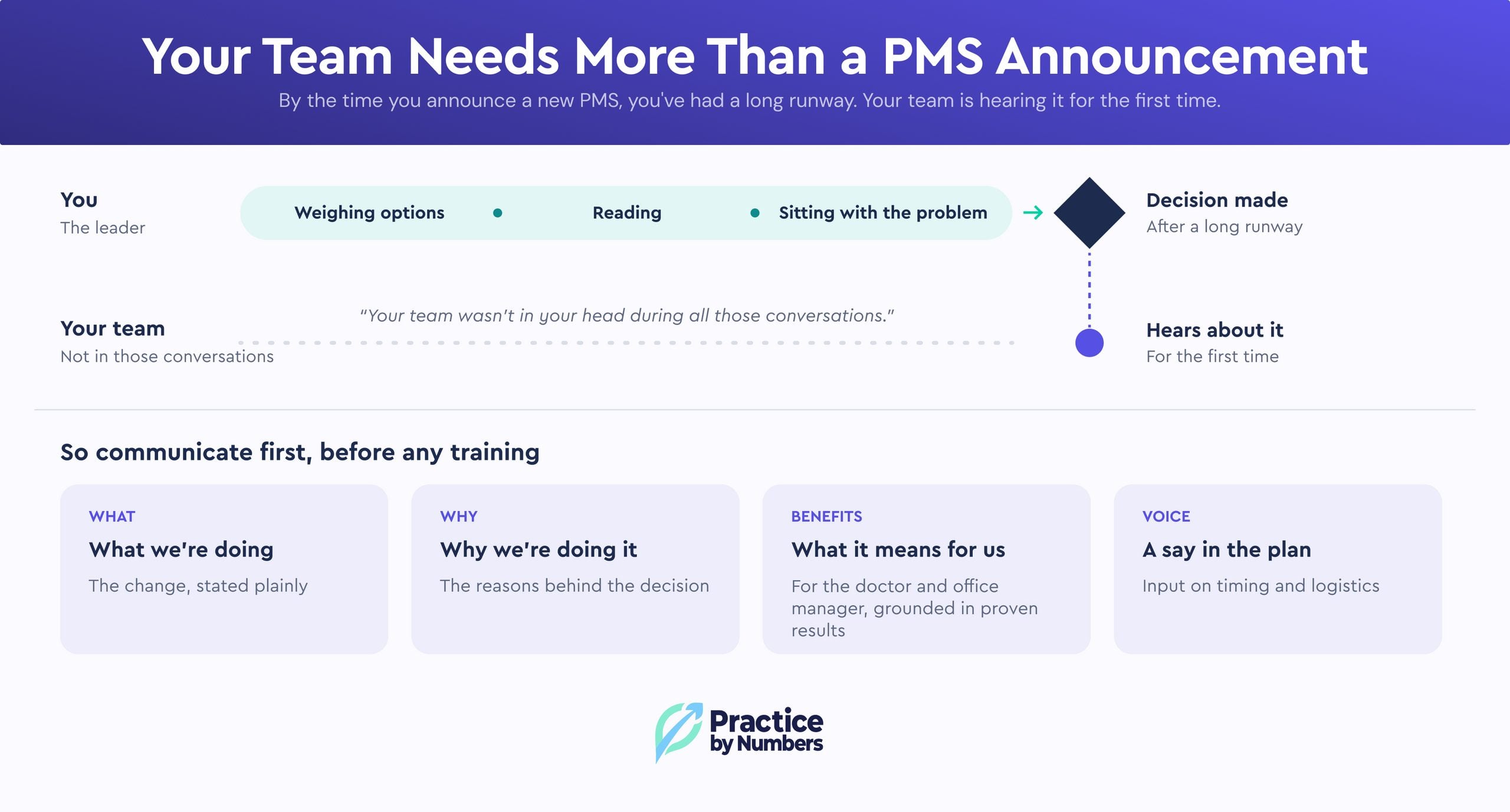
When a leader decides to adopt new software, they’ve usually been thinking about it for a while, weighing options, reading, sitting with the problem. The team hasn’t had any of that runway.
“Your team wasn’t in your head during all those conversations, and they don’t know.”
– Jill Nesbitt
So the first job isn’t training, it’s communication. Jill starts every rollout by making the reasons explicit.
“We’re creating the communication on why. Why are we doing this in the first place?”
– Jill Nesbitt
From there, she spells out what the practice is doing, why it’s doing it, and the specific benefits for the doctor and the office manager. These benefits are grounded in proven results rather than wishful thinking. Giving people the reasoning and a chance to weigh in on timing and logistics turns a mandate into something the team can get behind.
Resistance Is Usually Embarrassment
When a team member pushes back or struggles, it’s easy to read it as stubbornness. Jill reads it very differently, and more accurately.
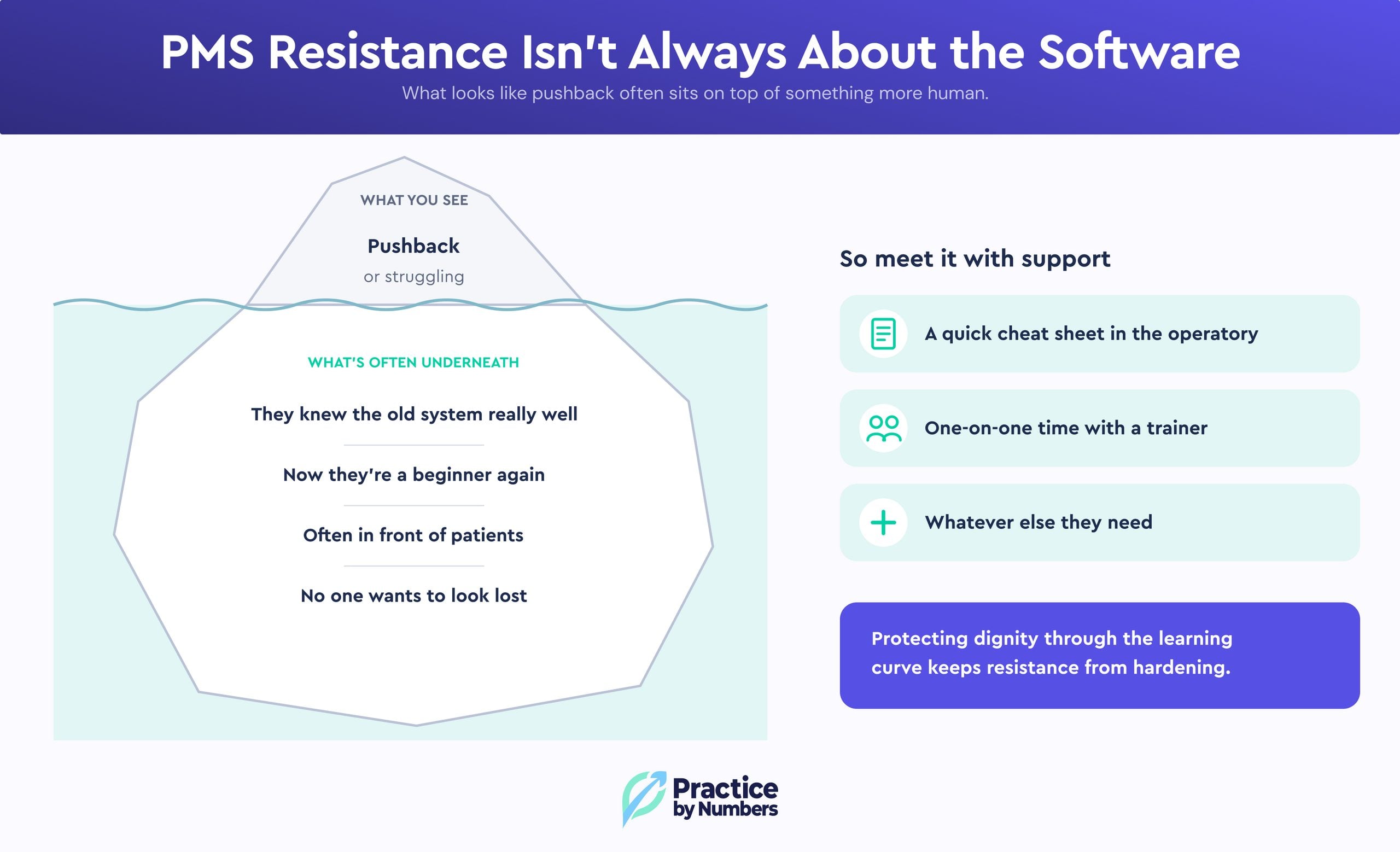
“A lot of what I see when that’s happening is that the team is embarrassed. They probably knew the old system, whatever we were using, they probably knew it really well.”
– Jill Nesbitt
That reframing changes how a leader should respond. Someone who was an expert on the old system is suddenly a beginner again, often in front of patients, and that’s uncomfortable.
“No one wants to look dumb. No one wants to be feeling like they can’t do their job well in front of their patient.”
– Jill Nesbitt
The answer isn’t pressure, it’s support. Jill’s instinct is to come alongside the person rather than lean on them, making clear the practice will give them whatever they need, whether that’s a quick cheat sheet in the operatory or one-on-one time with a trainer. Protecting people’s dignity through the learning curve is what keeps resistance from hardening.
Scaling Across Locations: Optimize Before You Expand
For growing groups, the temptation is to bolt on the next location and keep moving. Jill’s advice is to slow down just enough to get the current locations right first.
“It’s not just helping make the switch. It’s really making it thoughtful and in a way that optimizes what you have before switching additional locations.”
– Jill Nesbitt
Expanding on top of a shaky setup multiplies the problems. Jill described practices where the cost of getting it wrong was concrete: team members who couldn’t move between locations because the software wasn’t set up consistently, and owners who couldn’t get a single consolidated view of the business.
“The owners themselves could not get consolidated reporting.”
– Jill Nesbitt
The lesson for any multi-location group is to standardize and stabilize what you already run before adding the next site, so each new location inherits a system that works instead of one that’s still being fixed.
Scale Your Dental Practice With Clearer Visibility Across Locations
As your dental practice expands, maintaining consistent performance across locations becomes increasingly challenging. What’s working at one office may not be working at another, and disconnected reporting makes those differences harder to recognize.
Practice by Numbers integrates with your existing practice management system (PMS) to bring data from multiple locations into one consolidated view, helping your team:
- Compare performance consistently: Track the same metrics across locations to understand what’s working and where improvements are needed.
- Identify growth opportunities: Spot underperforming areas and recognize successful approaches that can be replicated across offices.
- Make informed operational decisions: Use location-level insights to guide staffing, scheduling, and resource allocation.
- Improve accountability: Give leadership and office managers a shared view of performance and priorities.
- Scale with confidence: Maintain visibility into each location’s progress without losing sight of the bigger picture.
With Practice by Numbers, your existing PMS remains central to daily operations, while leadership gains the cross-location visibility needed to manage growth more effectively.