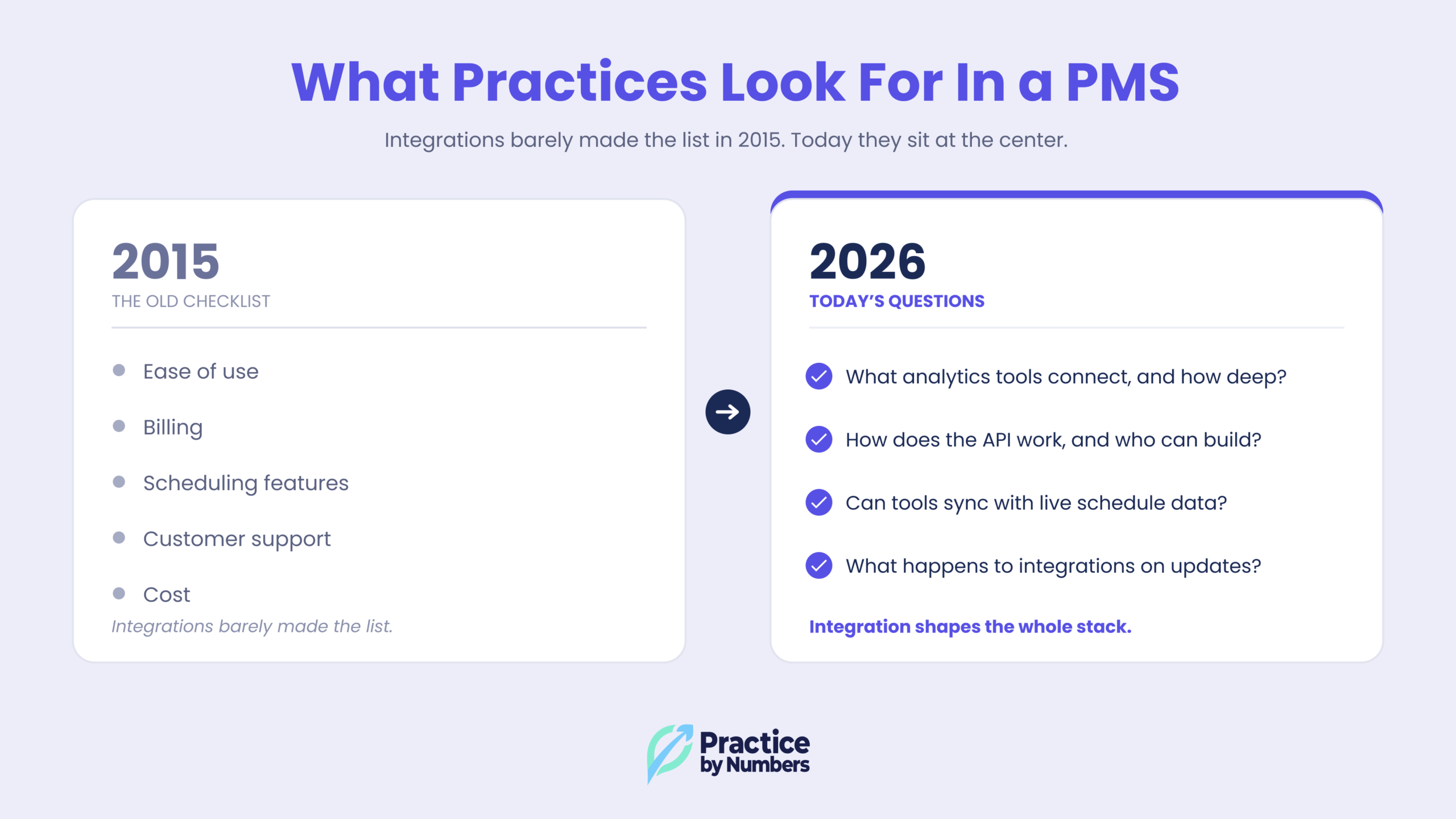
If you asked a dental practice owner in 2015 what they wanted in a new PMS, the answers were consistent: ease of use, billing, scheduling features, customer support, and cost.
Integrations barely made the list.
In 2026, that has changed a lot. Practices evaluating a PMS today, or deciding whether to stay on their current one, are asking questions that weren’t on anyone’s checklist a decade ago:
- What analytics tools connect to this, and how deep is the integration?
- How does your API work? Can third-party developers use it?
- Can my current communication platform sync with your schedule data?
- What happens to my integrations when you release a major update?
These aren’t edge-case questions from tech-forward outliers. They’re mainstream criteria from ordinary practices that have realized one thing: a PMS’s integration capability shapes what the whole software stack can do.
Why Integrations Moved to the Center of PMS Buying
The shift happened in stages, and each stage built on the one before it.
First came analytics platforms. Practices realized their PMS held a great deal of valuable data, things like production trends, provider performance, case acceptance, and recall metrics. When analytics tools arrived that could read from the PMS directly and show real-time dashboards, the practices that adopted them gained a real operational edge.
Then came patient communication tools. The best reminder, recall, and reactivation platforms work far better when they sync with the live schedule, when they know exactly who’s due, which appointment just cancelled, and which treatment plan has sat unaccepted for six weeks. That sync works because the PMS shares data.
Then came payment platforms, phone integrations, multi-location reporting, and AI-assisted scheduling. Each new category of dental technology works better with live access to PMS data. The encouraging part is how the major PMS platforms have responded, building more ways for these tools to connect. Practices today have more integration options than ever, whichever platform they run.
What Dental PMS Integration Capability Actually Means
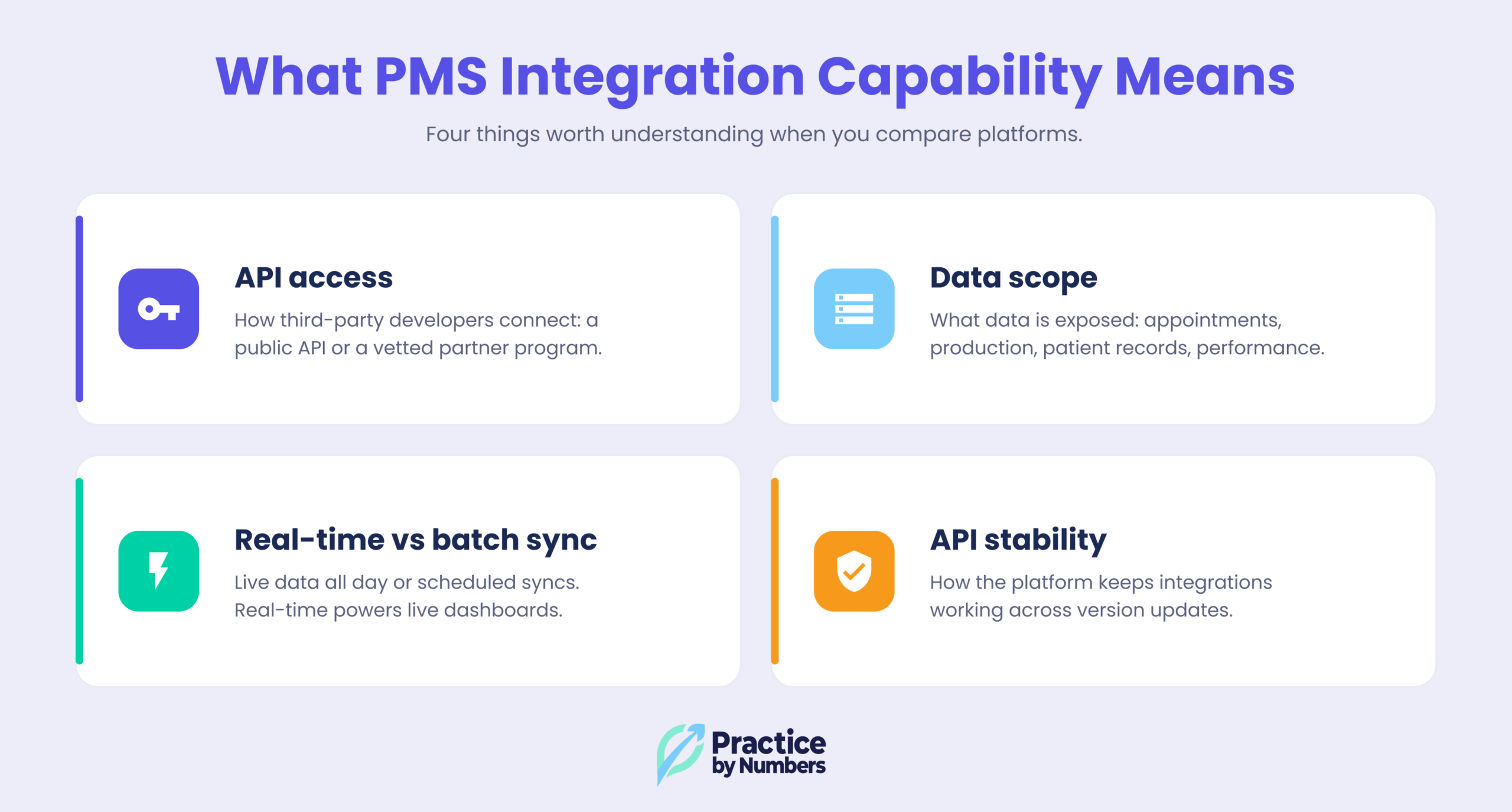
When you look at a PMS through the lens of integration, four things are worth understanding.
- API access: How do third-party developers connect to the platform? Some PMSs publish their API openly; others run a partner program that reviews and approves integrations. Both are valid ways to manage quality and access.
- Data scope: What data is available through the integration? Appointment data alone is useful. Appointment data plus production, patient records, and provider performance opens up a deeper level of capability. The scope tells you what’s possible.
- Real-time versus batch sync: Can integrations read live data through the day, or on a scheduled basis? Real-time access is what makes live dashboards, automated communication, and operational alerts possible.
- API stability: How does the platform keep integrations working across version updates? A platform that manages this well gives practices confidence that the tools they rely on will keep running smoothly.
How the Major Dental PMS Platforms Approach Integration
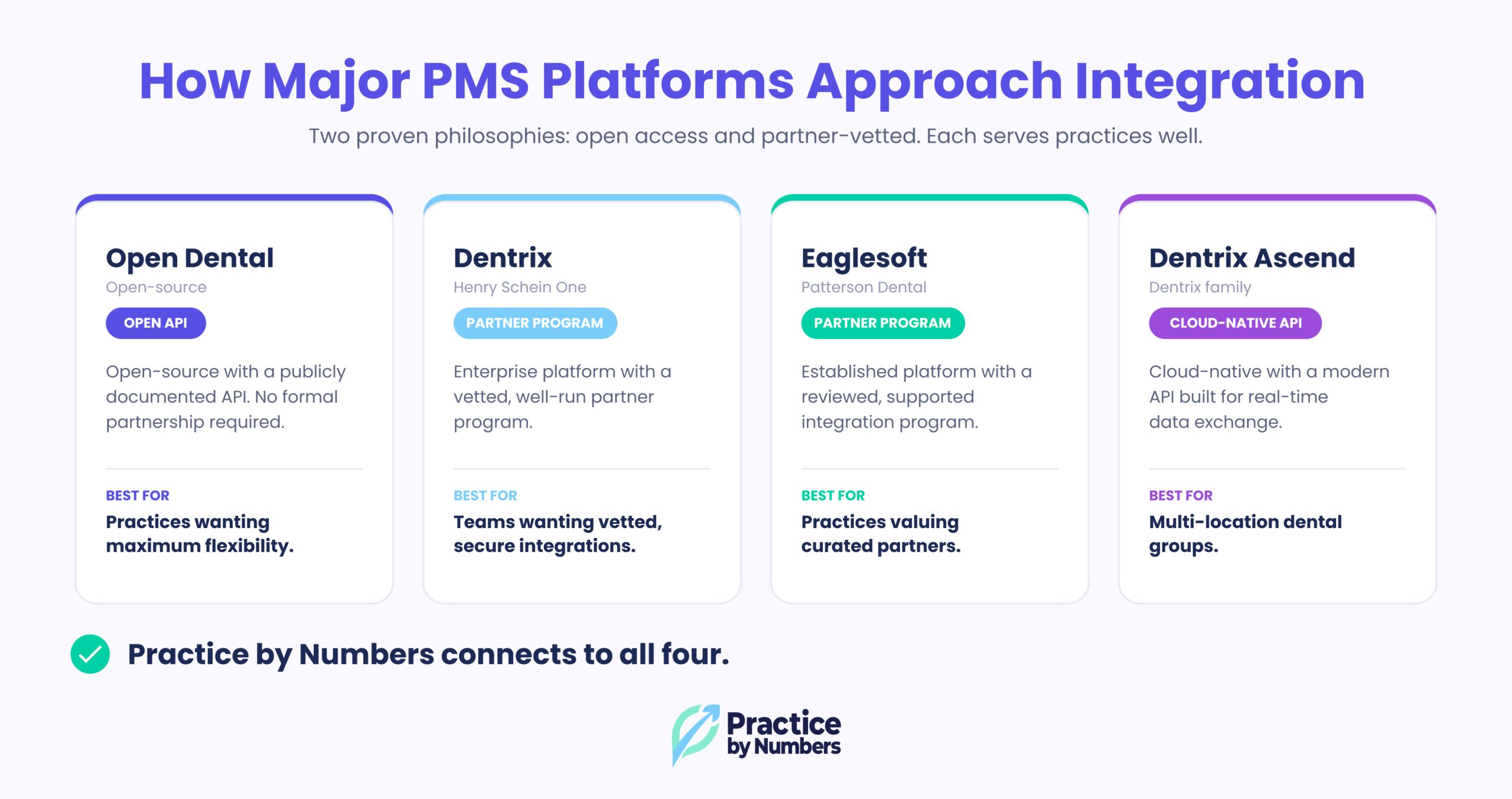
Dental PMS platforms take different paths to integration, and each one serves a real set of practices well.
Open Dental is open by design. As an open-source platform, it publishes its API documentation publicly and welcomes third-party developers without a formal partnership requirement. That has attracted a broad community of integrations built natively on top of it, which makes it a favorite for practices that value maximum flexibility and choice.
Dentrix and Eaglesoft, from Henry Schein One and Patterson Dental, are established enterprise platforms with well-run partner programs. Integrations go through a defined review process, which gives practices added confidence that connected tools are vetted, secure, and properly supported. For the many partners in these ecosystems, the depth of integration is excellent.
Dentrix Ascend is the cloud-native member of the Dentrix family, with a modern API built for real-time data exchange. Its integration story keeps growing, and it’s a strong fit for practices managing multiple locations.
Each of these reflects a different philosophy: open and community-driven, or curated and partner-vetted. Both philosophies have made practices successful. Knowing how your preferred tools fit within your platform’s approach is smart due diligence, worth doing before you sign.
Why Integration Is a Long-Term Investment
Choosing a PMS with integration in mind isn’t only about today’s tools. The more useful question is what you’ll want to connect in three to five years.
That list almost certainly includes capabilities that are still maturing: AI-assisted treatment planning, real-time insurance verification, scheduling tools that anticipate no-shows before they happen, and patient communication that personalizes outreach based on visit history.
Every one of these will work best with good access to PMS data. The good news for practices is that the major platforms are all investing in integration, each in their own way, so the tools you adopt next are likely to connect to the PMS you already trust. Thinking about integration early simply sets your practice up to grow comfortably as new technology arrives.
Integration Questions to Ask Before Choosing a PMS
Whether you’re evaluating a new PMS or getting to know your current one better, these questions are a helpful place to start:
- How does your API work, and how do third-party developers connect to it?
- What analytics, communication, and payment platforms integrate with your system today, and at what depth?
- If a new tool wants to build an integration, what does that process look like?
- How do you keep integrations stable across version updates and new features?
- Can you share examples of third-party integrations that practices in your customer base use today?
The answers help you understand how each platform supports the tools you’ll want to use, so you can choose with confidence.
How Practice by Numbers Works Across Every Major PMS
Practice by Numbers is built on a simple idea: practices shouldn’t have to change their PMS to add better analytics, communication, and operational tools. We’ve built deep integrations with Open Dental, Dentrix, Eaglesoft, and Dentrix Ascend, precisely because each of these platforms has invested in making integration possible.
The qualities that make these platforms strong, their openness, their partner ecosystems, their commitment to connectivity, are the same qualities that let PbN add value on top while the practice’s foundation stays intact. That’s what a healthy, connected dental software ecosystem makes possible.