Most dental practices choose a PMS the same way they make other big infrastructure decisions. They go with what they trained on, what the previous owner used, or what a rep demonstrated at a conference. The software runs in the background, and as long as nothing breaks, nobody thinks about it much.
That math has changed.
In 2026, your PMS does more than schedule patients and send claims. It sits at the center of your practice’s technology. Every other tool you use, your analytics platform, your communication system, your payment processor, your reporting software, connects to it in some way. How easily that connection happens shapes how capable your practice can become without replacing everything you already have.
What Is a Dental PMS Ecosystem?
A PMS ecosystem is the set of tools, integrations, and platforms that connect to your practice management software and share data with it.
When a platform publishes its API and welcomes third-party integrations, you can assemble a best-in-class software stack. You pick the patient communication tool that suits your practice, the analytics platform you like, the payment processor that fits. Each one can talk to the others, and they work better together than any of them would alone.
Other platforms manage integrations through a curated partner program, where the vendor reviews and supports the tools that connect. That model gives practices confidence that connected tools are vetted, secure, and well maintained. Both are valid approaches. What matters is knowing how your platform handles connections, because it shapes how you’ll add tools over time.
Why Your PMS Ecosystem Matters More Than It Did Five Years Ago
Five years ago, dental software was mostly siloed on purpose. Your PMS handled scheduling and billing. Your imaging software handled X-rays. Your phone system was just a phone system. The categories were clearly defined and mostly separate.
Those walls have come down.
Analytics platforms now pull production data in real time. Communication tools sync with the live schedule to send accurate recall campaigns. Payment processors update the ledger automatically when they collect. Operational dashboards surface insight across providers, time periods, and locations.
All of this depends on data moving between tools, and the good news is that the major PMS platforms have leaned into connectivity. The more easily your platform shares data, the more smoothly you can adopt new tools as your practice grows.
The API Question Every Practice Should Ask
Before committing to any PMS, or deciding to stay on your current one, a simple question is worth asking: how does your API work, and who can access it?
The answers tell you a lot about the kind of growth the platform supports:
- Is API access documented publicly, or managed through a partner program?
- Is it a modern API or an older database connection, and what does that mean for the integrations built on it?
- Does it support real-time data sync, or scheduled batch exports?
- How are existing integrations handled when the PMS ships a major update?
Open Dental, for example, has a publicly documented API that any developer can build against directly. Other platforms manage integrations through a formal partner program that reviews and supports the tools that connect. Both approaches can serve a practice well. The point is to know which one you’re working with, because it shapes what your practice can do next.
What a Connected Dental Software Stack Looks Like
Picture a practice running Open Dental as its PMS with Practice by Numbers connected on top. Here’s how the data moves through a normal day:
- PbN reads appointment data from Open Dental and shows it in a real-time production dashboard, updated throughout the day.
- PbN syncs patient records and automates recall reminders and reactivation outreach, triggered by actual due dates and appointment gaps.
- PbN connects to the practice phone system and shows missed-call data next to schedule performance, so nothing slips by.
- PbN processes payments, updates the Open Dental ledger, and tracks collections against daily and monthly goals.
- The owner opens one dashboard and sees production, collections, recall rates, new patient metrics, and team performance in one place.
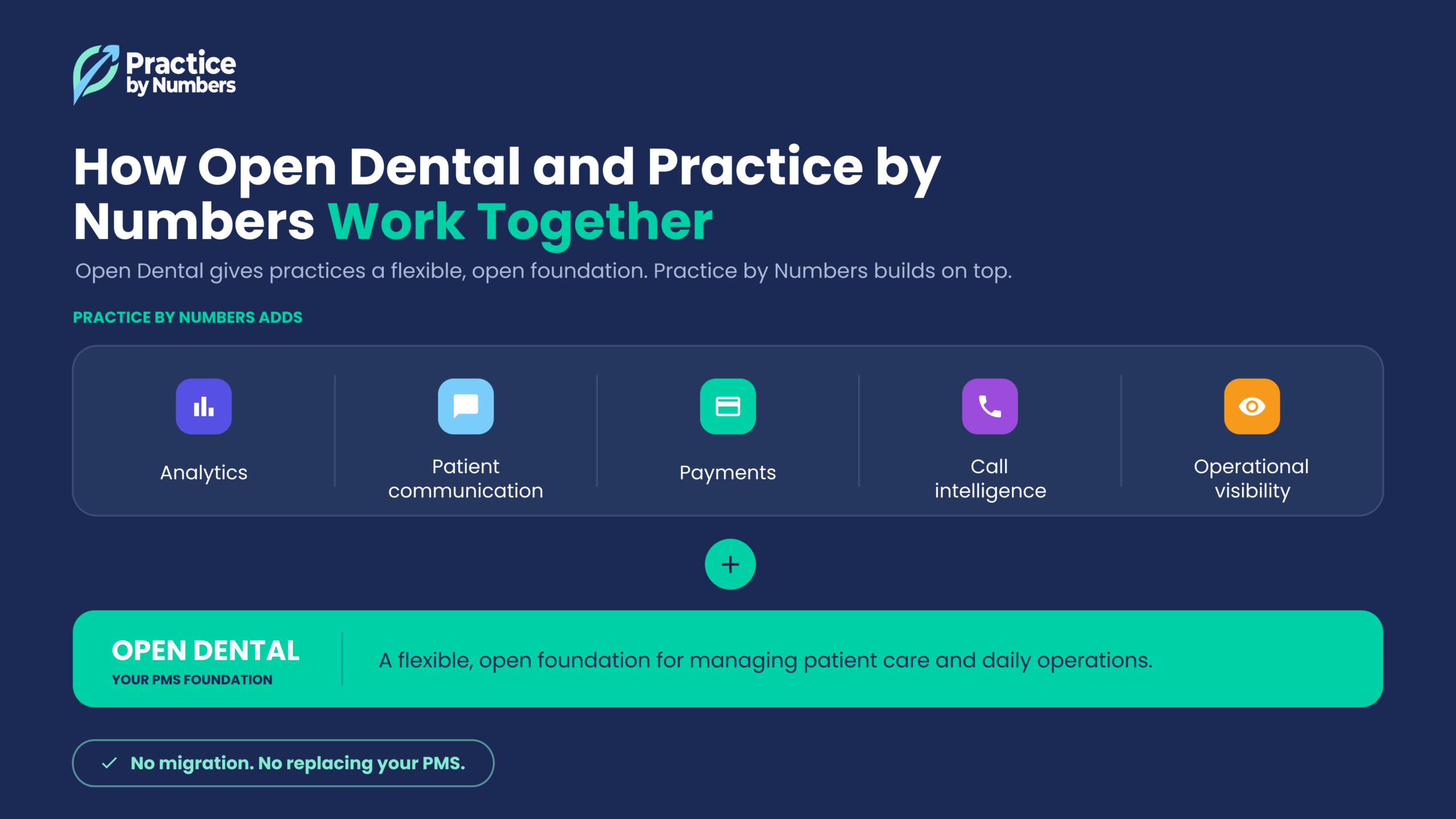
None of this requires replacing Open Dental. The PMS stays exactly where it is, and the ecosystem around it gets a lot more capable. That’s what a connected, open platform makes possible.
Cloud, On-Prem, and Where Your Data Can Go
The dental software industry has spent years debating cloud versus on-premise as the main PMS buying question. The more useful question is how easily your data can reach the tools you want to use.
Where the servers live matters less than how the platform shares data. Open Dental runs locally and has a very accessible API. Dentrix Ascend is cloud-native and runs a partner ecosystem that manages how integrations connect. Both are legitimate designs that serve practices well. So the question to focus on is how your data moves, not only where the server sits.
How to Evaluate Your Dental PMS Ecosystem
If you want to understand how connected your current setup is, a few honest questions help:
- Can I pull production data into my analytics platform in real time, or do I rely on end-of-day exports?
- Do my communication tools sync with my live schedule, or is there some lag?
- When I want to add a new tool, what does that connection process look like?
- How easily can I get to my own practice data when I need it?
Your answers show how your current setup handles connectivity, and where you might want a little more from the tools around your PMS.
How Practice by Numbers Fits Into Your PMS Ecosystem
Practice by Numbers was built to sit on top of existing PMS platforms, not to replace them. We don’t think practices should have to change what’s working to grow. That’s why we’ve built deep integrations with the four major platforms dental practices rely on: Open Dental, Dentrix, Eaglesoft, and Dentrix Ascend.
We connect to the PMS your practice already runs, read the data that matters, and present it in a way that helps you make better clinical and operational decisions, without asking you to change the system your team has built its workflows around.
Your PMS is the foundation. PbN is the growth layer. And the more connected your PMS ecosystem is, the more that layer can do for you.