Your dental office voicemail greeting may seem like a small detail, but it can have a significant impact on patient experience and appointment conversion. When patients call after hours, during lunch breaks, or when your team is assisting other patients, your voicemail becomes the voice of your practice.
A generic or outdated greeting can create frustration and uncertainty. Patients may wonder if they’ve reached the right office, whether their message will be returned, or what to do if they have an urgent dental issue. In some cases, they may simply hang up and call another provider.
An effective dental office voicemail greeting does more than take messages. It reassures callers, sets clear expectations, provides alternative ways to connect with your practice, and helps patients take the next step, even when your team isn’t available to answer the phone.
In this guide, you’ll find dental office voicemail greeting examples for common scenarios, including after-hours calls, holiday closures, busy periods, and new patient inquiries. You’ll also learn the best practices that make voicemail greetings more effective and discover how modern patient communication tools can help practices reduce missed opportunities.
- Your voicemail greeting is often the first interaction patients have with your practice when no one answers the phone. The best dental office voicemail greetings:
- Keep it under 30 seconds
- State your practice name immediately
- Provide office hours
- Include emergency instructions
- Set clear callback expectations
- Offer alternative contact options like texting or online scheduling
- Sound warm, personal, and professional
- Below, you’ll find ready-to-use voicemail scripts for after-hours calls, busy periods, holidays, and new patient inquiries, along with best practices that help convert missed calls into scheduled appointments.
Why Your Dental Office Voicemail Greeting Matters
Many dental practices spend thousands of dollars attracting new patients through referrals, websites, SEO, and advertising. Yet when a prospective patient calls after hours or during a busy period, their experience is often determined by a voicemail greeting that was recorded years ago.
A poorly designed voicemail greeting can:
- Create frustration
- Cause callers to hang up
- Increase missed appointment opportunities
- Make the practice seem disorganized
- Reduce patient confidence
A well-crafted greeting does the opposite. It reassures callers, answers immediate questions, and directs patients toward the next step.
Think of your voicemail as a digital front desk employee that works 24/7.
👉 Learn How to Streamline Dental Office Communication & Scheduling
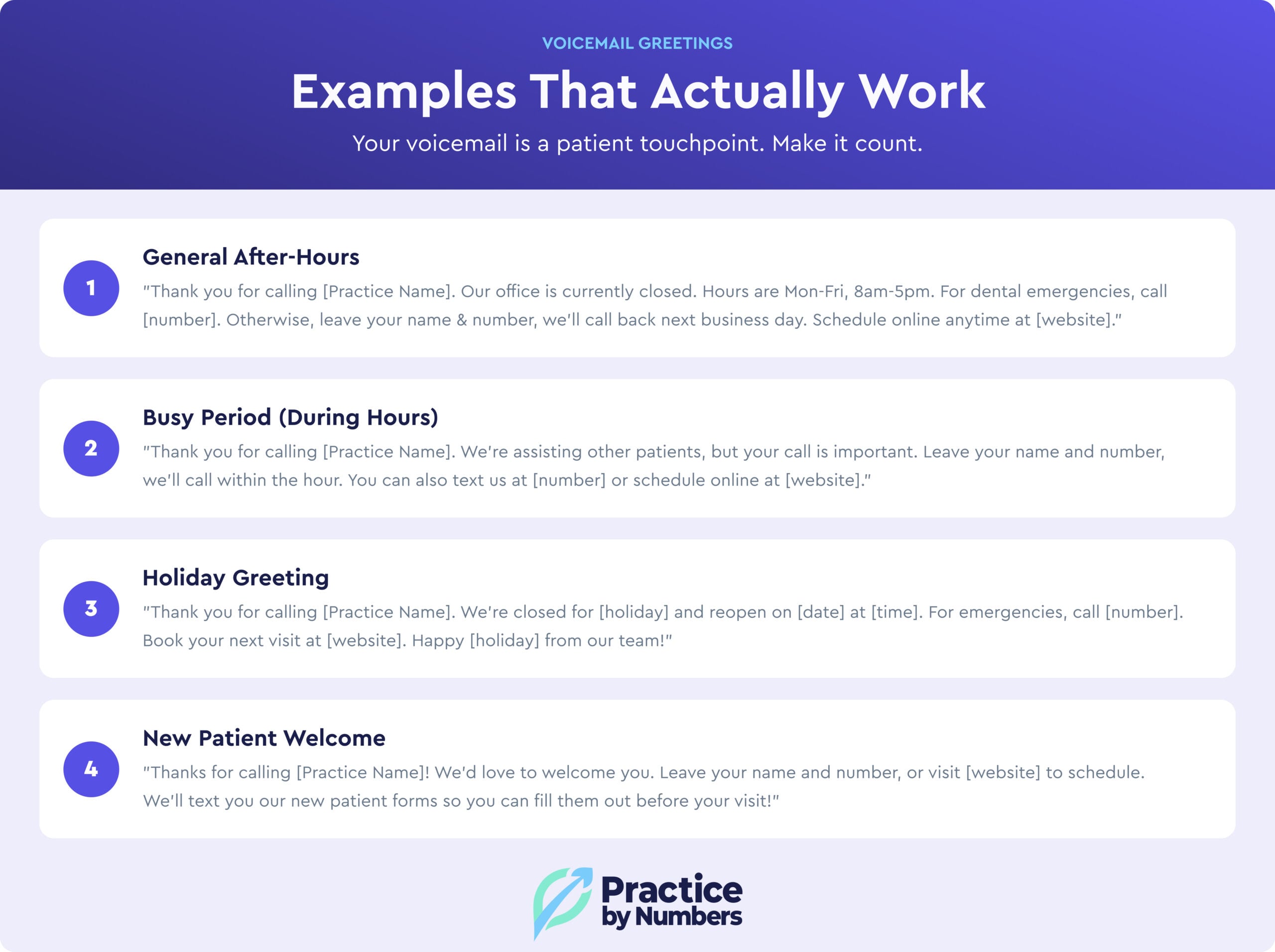
General After-Hours Voicemail Greeting Example
When patients call outside office hours, they need three things:
- Confirmation they’ve reached the correct office
- Guidance for emergencies
- A clear expectation for follow-up
Example Script
“Thank you for calling [Practice Name]. Our office is currently closed. Our regular hours are Monday through Friday, 8 AM to 5 PM. If this is a dental emergency, please call [emergency number]. Otherwise, leave your name, number, and a brief message, and we’ll return your call on the next business day. You can also schedule an appointment online anytime at [website]. Thank you!”
Why This Greeting Works
This greeting succeeds because it removes uncertainty. It:
- Immediately identifies the practice
- Communicates office availability
- Provides emergency instructions
- Sets realistic callback expectations
- Gives patients an alternative way to book
Patients are far less likely to seek another provider when they know exactly what happens next.
Busy Period Greeting Example (During Office Hours)
Dental teams frequently experience call surges during lunch breaks, mornings, and appointment confirmation periods. Rather than allowing callers to wait indefinitely, use a voicemail greeting that acknowledges the delay and offers options.
Example Script
“Thank you for calling [Practice Name]. We’re currently assisting other patients, but your call is important to us. Please leave your name and number, and we’ll call you back within the hour. If you’d prefer, you can text us at [phone number] or schedule online at [website]. Thank you for your patience.”
Why This Greeting Works
Patients become frustrated when businesses say they’ll call back “as soon as possible.” Specificity builds trust. This greeting:
- Acknowledges the wait
- Shows respect for the caller’s time
- Provides a clear response timeline
- Offers convenient alternatives
For many patients, especially younger demographics, texting may be more appealing than leaving a voicemail.
👉 How Do You Reactivate Lapsed Dental Patients? Explore This Step-by-Step Playbook
Holiday Voicemail Greeting Example
Holiday closures create unique challenges because patients need to know exactly when you’ll return. Without that information, they may assume the office is unavailable longer than expected.
Example Script
“Thank you for calling [Practice Name]. Our office is closed for [holiday] and will reopen on [date] at [time]. If you have a dental emergency, please call [emergency number]. For scheduling, visit [website] to book your next appointment online. Happy [holiday] from our team!”
Why This Greeting Works
Holiday greetings should answer the caller’s most important question: “When can I expect a response?”
This script:
- States the reason for closure
- Provides a reopening date and time
- Maintains a friendly tone
- Includes emergency instructions
- Encourages online scheduling
The result is fewer frustrated callers and fewer missed opportunities.
New Patient Voicemail Greeting Example
New patient inquiries are among the most valuable calls your practice receives. Your voicemail should make these callers feel welcomed and make it easy for them to schedule.
Example Script
“Thanks for calling [Practice Name]! We’d love to welcome you as a new patient. Please leave your name and number, or visit [website] to schedule your first appointment online. We’ll reach out with any forms or information you need before your visit. We look forward to meeting you!”
Why This Greeting Works
This greeting creates a positive first impression by:
- Speaking directly to prospective patients
- Using warm, welcoming language
- Offering immediate scheduling options
- Reducing uncertainty about the onboarding process
Patients often evaluate professionalism before they ever enter the office. A thoughtful voicemail helps establish confidence early.
What Makes a Great Dental Office Voicemail Greeting?
While every practice is different, the most effective voicemail greetings share a few common characteristics.
1. Keep It Under 30 Seconds
Attention spans are short. Long greetings increase abandonment rates and make it less likely callers will leave a message.
Aim for:
- 20–30 seconds
- Clear, concise language
- Only essential information
If you need to communicate extensive details, direct callers to your website instead.
2. State the Practice Name Immediately
Never make callers wait to confirm they’ve reached the correct office. The practice name should appear within the first few seconds.
Example
“Thank you for calling Smith Family Dental.”
This simple step reduces confusion and reassures callers instantly.
3. Set Clear Callback Expectations
Patients want certainty. Compare these two statements:
“We’ll call you back as soon as possible.”
“We’ll return your call by the next business day.”
Specific timelines create confidence and reduce repeat calls.
4. Include Emergency Instructions
Dental emergencies don’t stop when your office closes. Your voicemail should clearly explain:
- What qualifies as an emergency
- How patients can reach emergency care
- Whether an on-call provider is available
This information can significantly improve the patient experience during stressful situations.
5. Offer Alternative Communication Channels
Today’s patients expect convenience. Many would rather:
- Schedule online
- Send a text
- Complete forms digitally
Providing alternative contact methods ensures patients can continue their journey even when no team member is available.
6. Sound Like a Person, Not a Recording
Patients want a human connection. When recording your greeting:
- Speak naturally
- Smile while talking
- Avoid reading word-for-word in a monotone voice
- Record in a quiet room
- Re-record until it sounds conversational
A warm voice can make a surprisingly strong impression.
7. Update Your Greeting Regularly
An outdated greeting sends the wrong message. Review voicemail recordings whenever:
- Office hours change
- Holidays approach
- New services are introduced
- Emergency procedures change
At minimum, perform a quarterly voicemail audit.
Common Voicemail Mistakes Dental Practices Make
Even experienced practices occasionally overlook voicemail optimization. Avoid these common mistakes:
- Not mentioning the practice name: Patients may wonder whether they reached the correct office.
- Providing no emergency instructions: This creates frustration during urgent situations.
- Using vague callback promises: Unclear expectations reduce trust.
- Recording poor-quality audio: Background noise and muffled sound appear unprofessional.
- Forgetting to update holiday messages: Nothing signals neglect faster than a holiday greeting from six months ago.
How Modern Communication Tools Reduce Voicemail Dependence
While voicemail remains important, many practices are reducing the number of messages they receive by offering additional communication options.
Modern patient communication platforms can help practices:
- Enable online appointment booking
- Offer two-way patient texting
- Send automated appointment reminders
- Manage recalls and follow-ups
- Route calls intelligently
- Automatically respond to missed calls
Practice by Numbers Patient Relationship Management (PRM) suite includes tools such as two-way texting, online appointment booking, automated reminders, patient follow-ups, review management, and PbN Voice, helping practices stay connected with patients even when team members are unavailable. These tools are designed to centralize patient communication and reduce manual administrative workload for a more responsive and convenient patient experience.
👉 Learn How Patient Relationship Management Boosts Practice Revenue