The dental front office is the operational nerve center of the practice. While clinical teams deliver patient care, the front desk controls the patient experience before treatment begins and after treatment ends. Every phone call answered, appointment scheduled, insurance question resolved, and payment collected directly affects patient satisfaction and practice profitability.
A highly skilled front office can increase appointment retention, improve case acceptance, reduce claim denials, and create a smoother patient experience. A poorly trained one can generate scheduling bottlenecks, billing mistakes, missed opportunities, and patient frustration. The challenge is that many practices invest heavily in clinical education while relying on informal, inconsistent training methods for administrative staff.
This guide explains what dental front office training should include, which training methods produce the best results, and how practices can build a culture of continuous learning that drives measurable growth.
TL;DR
- Dental front office training should cover scheduling, insurance, patient communication, billing, software proficiency, and compliance.
- Strong front-office performance directly impacts collections, patient retention, case acceptance, and operational efficiency.
- The most effective training combines onboarding, peer mentoring, vendor education, role-playing, and ongoing coaching.
- Technology training is increasingly important as practices adopt patient communication, analytics, insurance verification, and automation tools.
- Success should be measured through KPIs such as phone conversion rates, claim denials, collections, no-show rates, and patient satisfaction.
- Continuous education produces better long-term results than one-time onboarding alone.
How Front Office Training Impacts Practice Growth
Today’s patients expect the same convenience from healthcare that they receive from retail, banking, and hospitality industries. They want online scheduling, fast responses, transparent billing, digital communication, and minimal administrative friction.
At the same time, dental practices face increasing pressure from staffing shortages, rising operating costs, and growing patient expectations.
The front office sits at the intersection of all these challenges.
When front-office teams are properly trained, they can:
- Reduce scheduling gaps and chair downtime
- Improve patient retention and recall effectiveness
- Increase treatment acceptance through clearer communication
- Reduce insurance-related delays and denials
- Accelerate collections and cash flow
- Create a more consistent patient experience
Training is no longer just an HR responsibility. It is a growth strategy.
What Front Office Training Should Cover
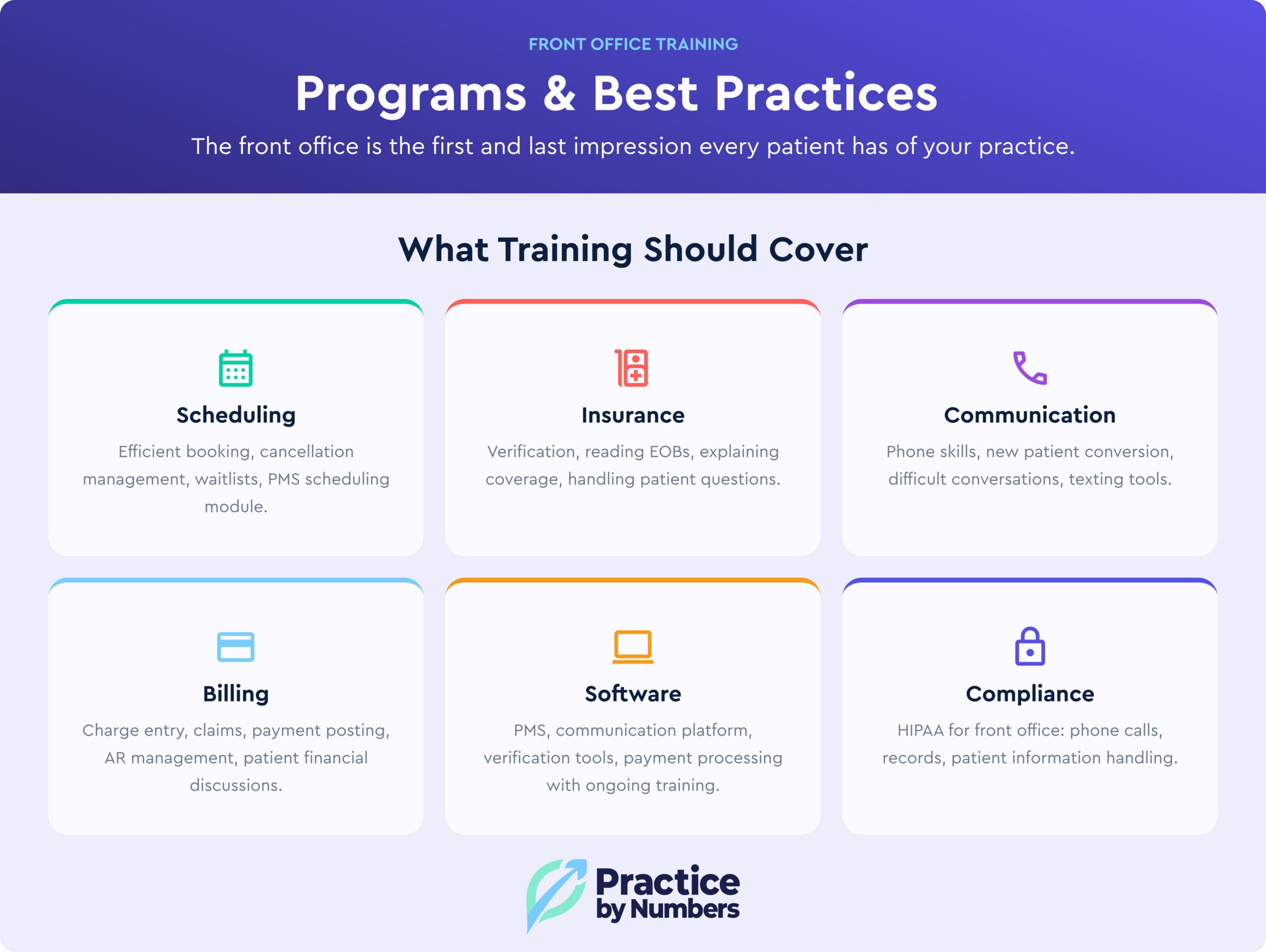
Front office responsibilities touch nearly every stage of the patient journey, from the first phone call to the final payment. Because the role spans customer service, operations, insurance, and financial coordination, training needs to be broad enough to build confidence across multiple areas while still providing role-specific depth. The most effective programs focus on the core skills that directly impact patient experience, efficiency, and revenue.
1. Scheduling and Patient Flow
Scheduling is often viewed as a simple administrative task, but in reality it is one of the most important drivers of practice productivity.
A well-trained scheduler understands how to balance provider availability, procedure length, patient preferences, production goals, and emergency appointments while keeping the schedule efficient.
Training should include:
- Appointment scheduling best practices
- Block scheduling strategies
- Managing cancellations and no-shows
- Waitlist management
- Scheduling for production efficiency
- Handling same-day treatment opportunities
- Online booking workflows
- Daily schedule optimization
2. Insurance and Benefits
Insurance remains one of the most common sources of patient frustration and administrative errors.
Front-office teams must understand both the technical aspects of insurance verification and the communication skills required to explain coverage confidently.
Training should include:
- Eligibility verification
- Benefit breakdowns
- Pre-authorizations
- Reading Explanation of Benefits (EOBs)
- Coordination of benefits
- Common denial reasons
- Insurance terminology
- Patient financial responsibility discussions
3. Patient Communication
Communication skills influence nearly every performance metric in the practice.
A new patient’s first phone call often determines whether they choose your office or a competitor. Likewise, a billing concern or scheduling issue can either strengthen or damage a patient relationship.
Training should include:
- New patient call conversion
- Active listening techniques
- Building rapport over the phone
- Appointment confirmation conversations
- Managing difficult conversations
- Handling complaints professionally
- Texting and digital communication etiquette
- Follow-up communication strategies
4. Billing and Collections
Many front-office employees feel uncomfortable discussing money, yet financial conversations are essential to practice success.
Training should help team members approach collections with confidence, clarity, and empathy.
Key topics include:
- Treatment estimates
- Payment collection processes
- Claims submission
- Payment posting
- Outstanding balance management
- Payment plans
- Financial policy communication
- Collections follow-up
5. Software Proficiency
Technology has become deeply integrated into front-office workflows.
Many practices use multiple systems for scheduling, patient communication, insurance verification, payments, analytics, forms, and reporting.
Training should include:
- Practice management software workflows
- Reporting and dashboards
- Digital forms
- Insurance verification tools
- Patient communication systems
- Online scheduling tools
- Payment processing workflows
- Mobile and remote access tools
6. Compliance
Compliance training protects both patients and the practice. Even seemingly harmless mistakes can create significant legal and operational risks.
Training should include:
- HIPAA fundamentals
- Secure communication practices
- Patient record access rules
- Data security procedures
- Documentation requirements
- Consent and disclosure guidelines
Front-office employees frequently handle sensitive patient information. Regular compliance training helps ensure privacy standards are maintained consistently across the practice.
Front Office Training Approaches That Work
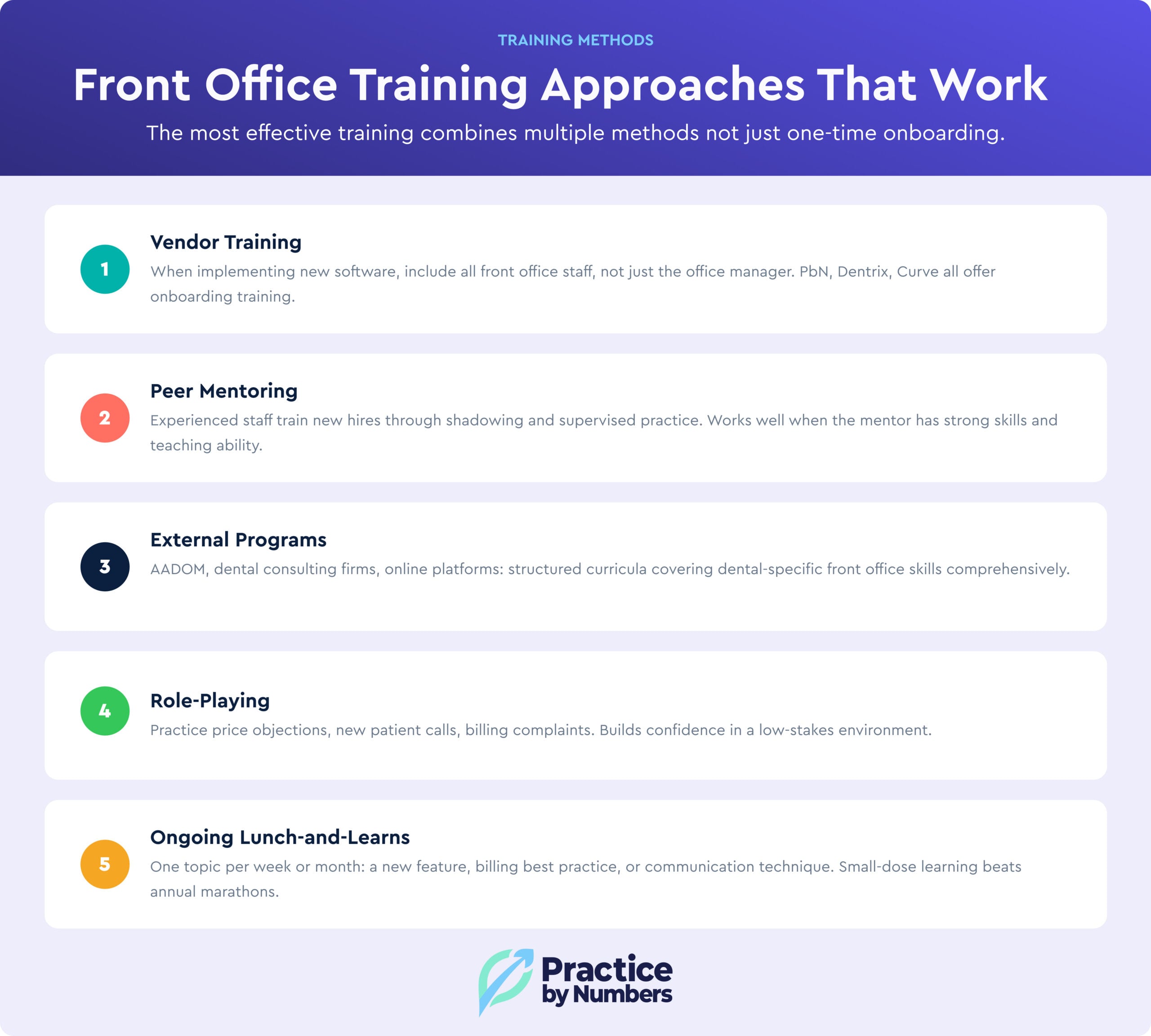
The most effective front-office teams aren’t built through onboarding alone. They develop through a combination of structured training, hands-on coaching, and continuous skill development. By using multiple learning methods, practices can reinforce knowledge, build confidence, and improve performance over time.
1. Vendor Training
Whenever new technology is implemented, take advantage of vendor onboarding and educational resources. This is particularly important for communication platforms, analytics systems, insurance tools, and payment solutions. Vendor-led training ensures employees learn the intended workflows and best practices from day one.
2. Peer Mentoring and Shadowing
Pairing new hires with experienced team members provides real-world exposure to daily operations.
Benefits include:
- Faster onboarding
- Knowledge transfer
- Increased confidence
- Better cultural integration
To avoid passing down bad habits, mentors should follow documented procedures and training standards.
3. External Training Programs
Organizations such as AADOM and dental consulting groups provide structured educational pathways for administrative teams.
These programs often cover:
- Insurance management
- Leadership skills
- Practice operations
- Patient communication
- Financial coordination
External education also exposes employees to industry best practices beyond what they learn inside the practice.
4. Role-Playing Exercises
Role-playing remains one of the most effective ways to build communication confidence.
Practice scenarios may include:
- New patient calls
- Insurance objections
- Scheduling conflicts
- Payment discussions
- Patient complaints
- Treatment acceptance conversations
Repetition helps team members respond more naturally during real interactions.
5. Lunch-and-Learns
Small, focused learning sessions are often more effective than annual training events.
A monthly 30-minute session can cover:
- New software features
- Scheduling improvements
- Insurance updates
- Communication techniques
- KPI reviews
Consistent learning creates lasting improvement.
Measuring Whether Front Office Training Works
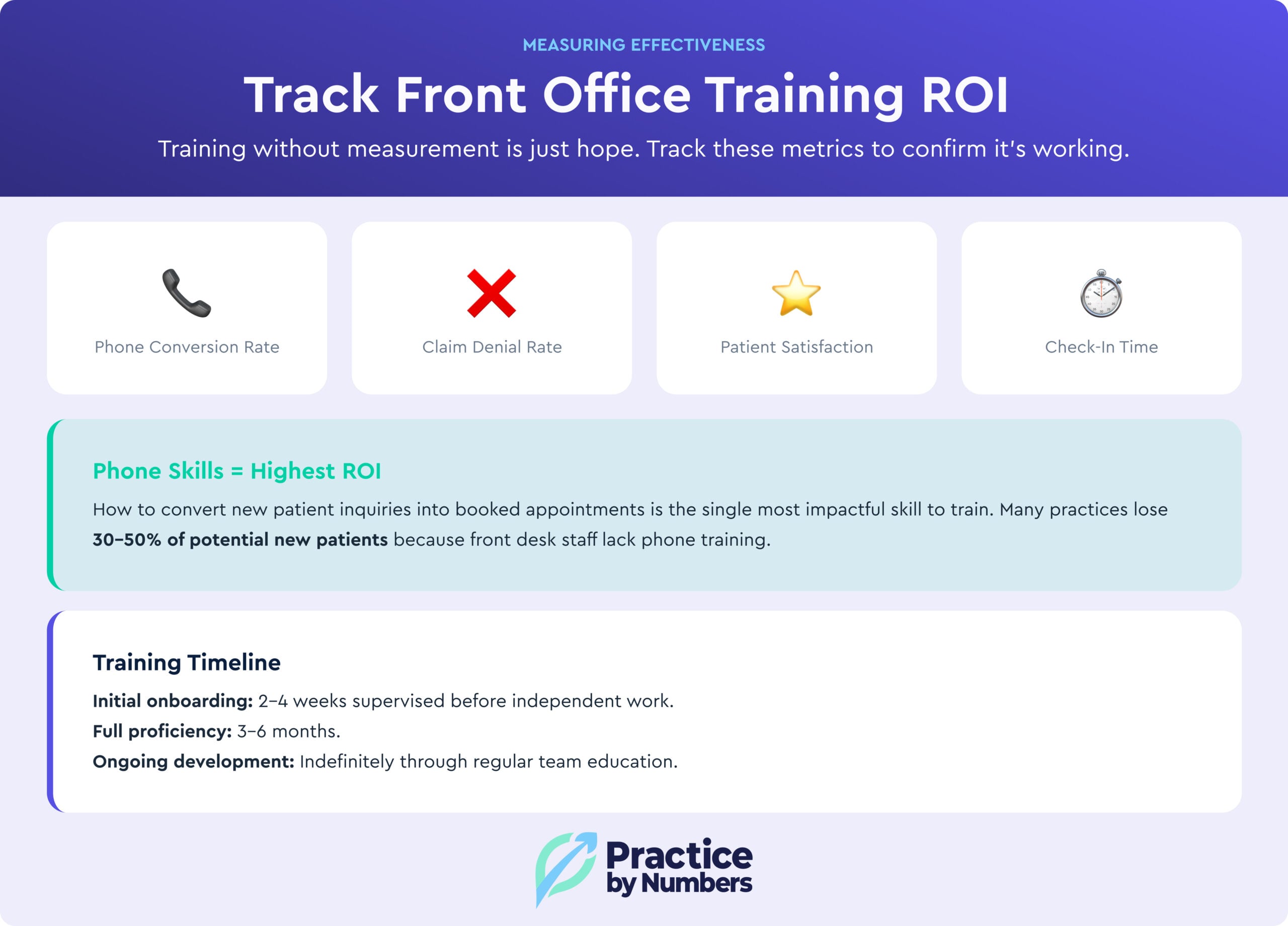
Training without measurement is just hope. Track these:
- Phone conversion rate (new patient calls that become appointments)
- Claim denial rate (errors from front office data entry)
- Patient satisfaction with the front desk experience
- Average check-in time and wait time
When these improve, your training is working. When they stall, the content or delivery needs a change.
Building a Culture of Continuous Learning
The highest-performing practices treat training as an ongoing process rather than an onboarding event.
New regulations emerge. Insurance rules change. Technology evolves. Patient expectations continue to rise.
Practices that invest in regular education create teams that are:
- More adaptable
- More confident
- More productive
- More patient-focused
- Better equipped for growth
When learning becomes part of the culture, performance improvements compound over time.
Supporting Front Office Performance with Practice by Numbers
Training provides the foundation for success, but technology helps teams execute consistently. Even the best-trained front office team can struggle when they’re working with disconnected systems and limited visibility into practice performance. That’s where a platform like Practice by Numbers can help.
By bringing together patient communication, online scheduling, digital forms, insurance verification, payments, and practice analytics in one connected platform, teams spend less time switching between tools and more time focusing on patients. Front office staff can manage appointments, communicate with patients, monitor outstanding balances, and track key performance metrics from a single system.
For practice leaders, this creates greater operational visibility and accountability, helping ensure that training efforts translate into measurable improvements in patient experience, efficiency, and revenue performance.
FAQs
Q. How long should front office training take for a new hire?
Most practices should expect 2–4 weeks of supervised onboarding before a new hire operates independently. Full proficiency typically develops over 3–6 months, depending on the complexity of the role and technology stack.
Q. What’s the most important front office skill to train?
Phone conversion skills are often the highest-impact area. Every new patient call represents potential production, and many practices lose opportunities simply because team members haven’t been trained to guide callers toward booking an appointment.
Q. Should I send my team to an outside training program?
Yes, when budget permits. External programs provide structured education, exposure to industry best practices, and professional development opportunities that complement internal training efforts.
Q. How often should front office staff receive training?
At minimum, quarterly training should be scheduled. However, the most successful practices incorporate ongoing coaching, monthly learning sessions, and refresher training whenever workflows or technology change.