The right dental marketing agency knows dentistry, reports on new patients and production, gives you full ownership of your accounts, and explains its plan for Google and AI search in plain language. The wrong one locks you into a long contract and sends reports full of numbers that never turn into booked appointments.
This guide covers what dental marketing services include, what they cost, the questions to ask before you sign, and how to judge results after 90 days.
- Compare agencies, freelancers, software, and in-house marketing based on your practice’s needs.
- Expect agency costs of $1,000–$5,000 per month, with ad spend typically separate.
- Ask about dental experience, account ownership, reporting, HIPAA compliance, and AI search visibility.
- Watch for guaranteed rankings, unclear contracts, and reports that don’t track booked patients.
- Review performance after 90 days using new patients, cost per acquisition, calls, and campaign results.
- Track marketing performance independently to understand which channels generate actual patients and revenue.
What Dental Marketing Services Include
A dental marketing company may offer some or all of these services:
Service | What It Covers | Common Pricing Model |
|---|---|---|
Website design | New site or redesign, service pages, booking | One-time project, plus hosting |
SEO and local SEO | Google Business Profile, service pages, listings, content | Monthly retainer |
AI search visibility (GEO) | Getting named in ChatGPT, Google AI Overviews and similar tools | Usually part of SEO |
Paid ads | Google Search, Local Services Ads, Facebook and Instagram | Management fee plus ad spend |
Reviews and reputation | Review requests, monitoring, responses | Monthly fee or software |
Social media | Posting, video, community management | Monthly retainer |
Email and text | Recall, reactivation, newsletters | Monthly fee or software |
Call tracking and reporting | Tracking numbers, call recordings, dashboards | Monthly fee or software |
Some agencies do everything. Others specialize in 1 or 2 areas. Pick the one whose strength matches your biggest gap.
Agency, Freelancer, Software or In-House?
Option | Best for | Watch out for |
|---|---|---|
Full-service dental agency | Practices with no marketing staff that want one partner for everything | Higher cost; quality varies by service |
Specialist agency | A clear single need, like Google Ads or a new website | You manage several vendors |
Freelancer | Small, defined projects | Limited capacity and backup |
Marketing software | Practices with a team member who can run campaigns | Someone has to own it |
In-house marketer | Groups and DSOs with several locations | Salary, training and turnover |
Many practices use a mix: software for reviews, reminders and reporting, and an agency for SEO, ads or the website.
How Much Dental Marketing Services Cost
Prices vary by market, service and practice size. Agency guides commonly quote $1,000 to $5,000 a month for small practices, with ad spend billed separately. Website projects can run from a few thousand dollars to much more for custom work.
2 ways to set your budget with more confidence:
- Percentage of revenue: Many practices spend 5% to 8% of gross revenue on marketing, as covered in our 360° digital marketing strategy.
- Cost per new patient: Decide what you can pay for a new patient based on their lifetime value, then hold your agency to it.
Ask every agency to split its quote into management fees, ad spend, software and one-time costs.
10 Questions to Ask Before You Sign
- How many dental practices do you work with, and can I call 2 of them? Current clients will tell you how the agency works day to day.
- Who will work on my account day to day? Ask whether it’s a dedicated person or a rotating team, and how often account managers change.
- What will you do in the first 90 days? Ask for a list of specific tasks.
- How do you track new patients, not just leads? They should connect calls and forms to booked appointments.
- Which reports will I get, and how often? Ask to see a sample report.
- Who owns the website, domain, Google Business Profile, and ad accounts? The answer should be you.
- How do you handle patient information? Will they sign a business associate agreement (BAA) for HIPAA if they touch call recordings, forms or patient data?
- What’s your plan for AI search? Ask how they help practices get mentioned in ChatGPT and Google’s AI Overviews, and how they measure it.
- Do you work with other practices near me? If so, ask how they avoid a conflict of interest.
- What are the contract length and cancellation terms? Look for 30 to 90 days’ notice.
Red Flags to Watch For
- Guaranteed #1 rankings: No one controls Google’s results. Google’s own SEO guidance warns against anyone who guarantees rankings.
- Fake or bought reviews: The FTC’s rule on fake reviews took effect in October 2024, with penalties of more than $50,000 per violation. Your practice can be held responsible too.
- They own your accounts: If the agency registers your domain or ad account in its name, leaving becomes hard and expensive.
- Reports full of impressions and clicks: Traffic means little if no one can show you booked patients.
- The same package for everyone: A pediatric practice and an implant practice need different plans.
- No answer on HIPAA: An agency handling call recordings or form data without a BAA puts your practice at risk.
- Long contracts with steep exit fees: Good agencies keep clients with results.
Your Contract Checklist
Before signing, make sure the contract states:
- You own the domain, website files, content, photos and videos.
- You have admin access to your Google Business Profile, Google Ads, Google Analytics, Search Console and social accounts.
- Call tracking numbers can be transferred to you if you leave.
- The scope of work lists each service and deliverable.
- Reporting includes new patients by source, cost per new patient, and call outcomes.
- A BAA is signed if the agency handles any patient information.
- Notice period and exit terms are clear, including how files and accounts are handed back.
Check Their AI Search Skills
Patients now ask AI tools for dentist recommendations. rater8’s 2026 Patient Choice Report found 47% of patients use AI to find a healthcare provider. A modern agency should explain how it builds your visibility there.
Ask them to run 5 to 10 patient-style prompts, like “best implant dentist in [your city],” and show where you appear today. Then ask what they’d change: your Google Business Profile, directory listings, reviews, service pages or content. If they can’t explain it simply, keep looking.
How to Judge Results After 90 Days
Give any new partner 90 days to set up and start delivering, then review these numbers:
Metric | What Good Looks Like |
|---|---|
New patients by source | Rising from the channels they manage |
Cost per new patient | Steady or falling by channel |
Calls answered and booked | Tracked and reported, not estimated |
Google Business Profile actions | More calls, direction requests and website clicks |
Reviews | Steady new reviews and replies to all of them |
AI visibility | Named in more of your test prompts |
Work completed | Matches the 90-day plan they promised |
SEO takes longer than ads, so judge SEO on progress (rankings, profile actions, content shipped) at 90 days and on new patients at 6 months.
Make Your Dental Marketing Investment Count
The right dental marketing agency should do more than generate traffic or improve rankings. It should help your practice attract new patients, track results, and understand where your marketing budget is going.
Before committing, compare your options, clarify account ownership, and set measurable goals. Once campaigns are running, regularly review which channels are generating appointments and revenue.
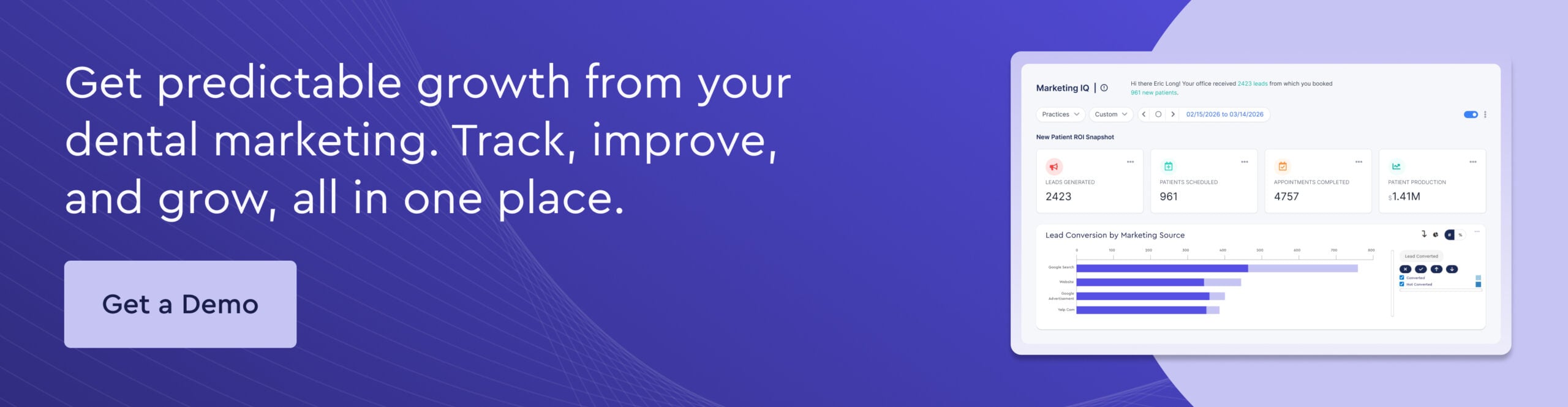
Keep your own view of the numbers so you’re never relying only on the agency’s report. Practice by Numbers’ Dental Marketing Suite connects calls, campaigns and patient records, so you can see what each channel brings in, whoever runs it.